Thank you for visiting SNEWPapers!
Sign up free
Literary
July 30, 1882
The Salt Lake Herald
Salt Lake City, Salt Lake County, Utah
What is this article about?
An essay exploring the connection between Darwinian natural selection and physical exercise, arguing that exercise strengthens faculties in the struggle for existence, with primary benefits to the nervous system rather than just muscles, as discussed by Du Bois-Reymond.
Clipping
OCR Quality
72%
Good
Full Text
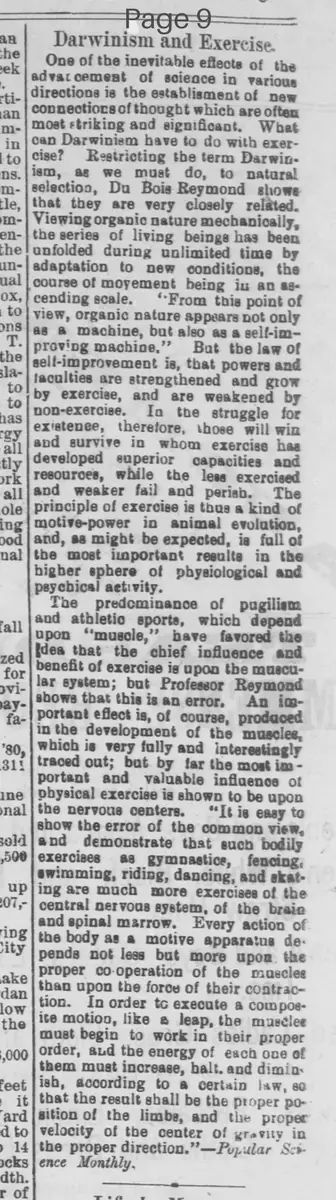
Darwinism and Exercise
One of the inevitable effects of the advancement of science in various directions is the establishment of new connections of thought which are often most striking and significant. What can Darwinism have to do with exercise? Restricting the term Darwinism, as we must do, to natural selection, Du Bois Reymond showed that they are very closely related.
Viewing organic nature mechanically, the series of living beings has been unfolded during unlimited time by adaptation to new conditions, the course of movement being in an ascending scale.
"From this point of view, organic nature appears not only as a machine, but also as a self-improving machine." But the law of self-improvement is, that powers and faculties are strengthened and grow by exercise, and are weakened by non-exercise. In the struggle for existence, therefore, those will win and survive in whom exercise has developed superior capacities and resources, while the less exercised and weaker fail and perish. The principle of exercise is thus a kind of motive-power in animal evolution, and, as might be expected, is full of the most important results in the higher sphere of physiological and psychical activity.
The predominance of pugilism and athletic sports, which depend upon "muscle," have favored the idea that the chief influence and benefit of exercise is upon the muscular system; but Professor Reymond shows that this is an error. An important effect is, of course, produced in the development of the muscles, which is very fully and interestingly traced out; but by far the most important and valuable influence of physical exercise is shown to be upon the nervous centers.
"It is easy to show the error of the common view, and demonstrate that such bodily exercises as gymnastics, fencing, swimming, riding, dancing, and skating are much more exercises of the central nervous system, of the brain and spinal marrow. Every action of the body as a motive apparatus depends not less but more upon the proper co-operation of the muscles than upon the force of their contraction. In order to execute a composite motion, like a leap, the muscles must begin to work in their proper order, and the energy of each one of them must increase, halt, and diminish, according to a certain law, so that the result shall be the proper position of the limbs, and the proper velocity of the center of gravity in the proper direction."-Popular Science Monthly.
One of the inevitable effects of the advancement of science in various directions is the establishment of new connections of thought which are often most striking and significant. What can Darwinism have to do with exercise? Restricting the term Darwinism, as we must do, to natural selection, Du Bois Reymond showed that they are very closely related.
Viewing organic nature mechanically, the series of living beings has been unfolded during unlimited time by adaptation to new conditions, the course of movement being in an ascending scale.
"From this point of view, organic nature appears not only as a machine, but also as a self-improving machine." But the law of self-improvement is, that powers and faculties are strengthened and grow by exercise, and are weakened by non-exercise. In the struggle for existence, therefore, those will win and survive in whom exercise has developed superior capacities and resources, while the less exercised and weaker fail and perish. The principle of exercise is thus a kind of motive-power in animal evolution, and, as might be expected, is full of the most important results in the higher sphere of physiological and psychical activity.
The predominance of pugilism and athletic sports, which depend upon "muscle," have favored the idea that the chief influence and benefit of exercise is upon the muscular system; but Professor Reymond shows that this is an error. An important effect is, of course, produced in the development of the muscles, which is very fully and interestingly traced out; but by far the most important and valuable influence of physical exercise is shown to be upon the nervous centers.
"It is easy to show the error of the common view, and demonstrate that such bodily exercises as gymnastics, fencing, swimming, riding, dancing, and skating are much more exercises of the central nervous system, of the brain and spinal marrow. Every action of the body as a motive apparatus depends not less but more upon the proper co-operation of the muscles than upon the force of their contraction. In order to execute a composite motion, like a leap, the muscles must begin to work in their proper order, and the energy of each one of them must increase, halt, and diminish, according to a certain law, so that the result shall be the proper position of the limbs, and the proper velocity of the center of gravity in the proper direction."-Popular Science Monthly.
What sub-type of article is it?
Essay
What keywords are associated?
Darwinism
Natural Selection
Exercise
Nervous System
Evolution
Self Improvement
Literary Details
Title
Darwinism And Exercise
Form / Style
Prose Essay On Science And Evolution
Key Lines
From This Point Of View, Organic Nature Appears Not Only As A Machine, But Also As A Self Improving Machine.
It Is Easy To Show The Error Of The Common View, And Demonstrate That Such Bodily Exercises As Gymnastics, Fencing, Swimming, Riding, Dancing, And Skating Are Much More Exercises Of The Central Nervous System, Of The Brain And Spinal Marrow.