Thank you for visiting SNEWPapers!
Sign up free
Editorial
February 13, 1886
The Examiner
Hartford, Hartford County, Connecticut
What is this article about?
Editorial criticizes the absence of Connecticut's philanthropic women at state labor committee hearings on child labor in factories, highlighting the cruelty of long hours for children starting at age eight and contrasting it with women's focus on foreign missions.
Clipping
OCR Quality
98%
Excellent
Full Text
THEY WEREN'T THERE
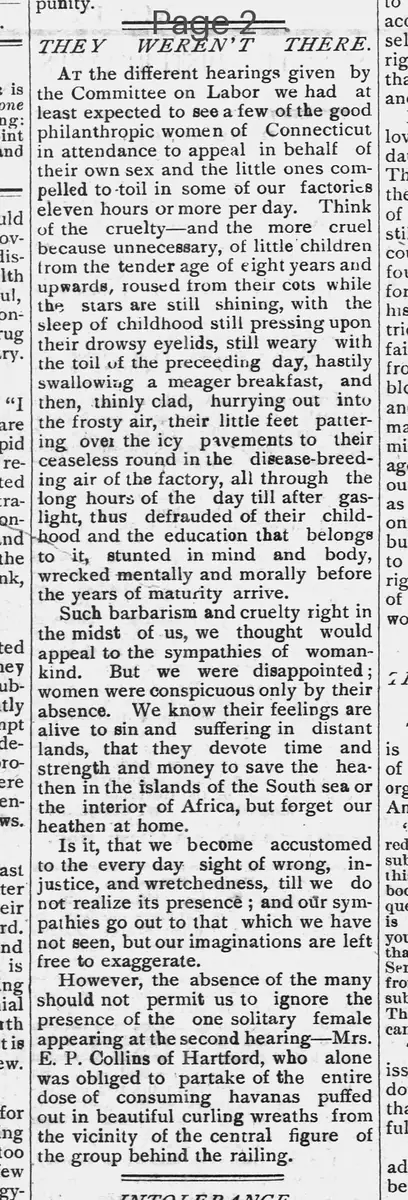
At the different hearings given by the Committee on Labor we had at least expected to see a few of the good philanthropic women of Connecticut in attendance to appeal in behalf of their own sex and the little ones compelled to toil in some of our factories eleven hours or more per day. Think of the cruelty—and the more cruel because unnecessary, of little children from the tender age of eight years and upwards, roused from their cots while the stars are still shining, with the sleep of childhood still pressing upon their drowsy eyelids, still weary with the toil of the preceding day, hastily swallowing a meager breakfast, and then, thinly clad, hurrying out into the frosty air, their little feet pattering over the icy pavements to their ceaseless round in the disease-breeding air of the factory, all through the long hours of the day till after gas-light, thus defrauded of their childhood and the education that belongs to it, stunted in mind and body, wrecked mentally and morally before the years of maturity arrive.
Such barbarism and cruelty right in the midst of us, we thought would appeal to the sympathies of womankind. But we were disappointed; women were conspicuous only by their absence. We know their feelings are alive to sin and suffering in distant lands, that they devote time and strength and money to save the heathen in the islands of the South sea or the interior of Africa, but forget our heathen at home.
Is it that we become accustomed to the every day sight of wrong, injustice, and wretchedness, till we do not realize its presence; and our sympathies go out to that which we have not seen, but our imaginations are left free to exaggerate.
However, the absence of the many should not permit us to ignore the presence of the one solitary female appearing at the second hearing—Mrs. E. P. Collins of Hartford, who alone was obliged to partake of the entire dose of consuming havanas puffed out in beautiful curling wreaths from the vicinity of the central figure of the group behind the railing.
At the different hearings given by the Committee on Labor we had at least expected to see a few of the good philanthropic women of Connecticut in attendance to appeal in behalf of their own sex and the little ones compelled to toil in some of our factories eleven hours or more per day. Think of the cruelty—and the more cruel because unnecessary, of little children from the tender age of eight years and upwards, roused from their cots while the stars are still shining, with the sleep of childhood still pressing upon their drowsy eyelids, still weary with the toil of the preceding day, hastily swallowing a meager breakfast, and then, thinly clad, hurrying out into the frosty air, their little feet pattering over the icy pavements to their ceaseless round in the disease-breeding air of the factory, all through the long hours of the day till after gas-light, thus defrauded of their childhood and the education that belongs to it, stunted in mind and body, wrecked mentally and morally before the years of maturity arrive.
Such barbarism and cruelty right in the midst of us, we thought would appeal to the sympathies of womankind. But we were disappointed; women were conspicuous only by their absence. We know their feelings are alive to sin and suffering in distant lands, that they devote time and strength and money to save the heathen in the islands of the South sea or the interior of Africa, but forget our heathen at home.
Is it that we become accustomed to the every day sight of wrong, injustice, and wretchedness, till we do not realize its presence; and our sympathies go out to that which we have not seen, but our imaginations are left free to exaggerate.
However, the absence of the many should not permit us to ignore the presence of the one solitary female appearing at the second hearing—Mrs. E. P. Collins of Hartford, who alone was obliged to partake of the entire dose of consuming havanas puffed out in beautiful curling wreaths from the vicinity of the central figure of the group behind the railing.
What sub-type of article is it?
Labor
Social Reform
Education
What keywords are associated?
Child Labor
Factory Toil
Women's Absence
Labor Hearings
Connecticut Factories
Philanthropic Women
What entities or persons were involved?
Committee On Labor
Philanthropic Women Of Connecticut
Mrs. E. P. Collins Of Hartford
Editorial Details
Primary Topic
Absence Of Women At Child Labor Hearings
Stance / Tone
Disappointed And Critical
Key Figures
Committee On Labor
Philanthropic Women Of Connecticut
Mrs. E. P. Collins Of Hartford
Key Arguments
Cruelty Of Child Labor In Factories For Children Aged Eight And Up, Working 11+ Hours Daily
Children Deprived Of Childhood, Education, Stunted Mentally And Morally
Women's Absence At Hearings Despite Expected Sympathy
Women Focus On Foreign Missions While Ignoring Domestic Suffering
Accustomization To Local Wrongs Reduces Awareness
Mrs. E. P. Collins Attended Alone Despite Poor Conditions