Thank you for visiting SNEWPapers!
Sign up free
Editorial
February 23, 1916
New Hampshire Farmer And Weekly Union
Manchester, Hillsborough County, New Hampshire
What is this article about?
Editorial discusses British Foreign Office list of 42 absolute contraband items and conditional contraband during war, noting interference with neutral trade and potential for international disputes under international law.
Clipping
OCR Quality
98%
Excellent
Full Text
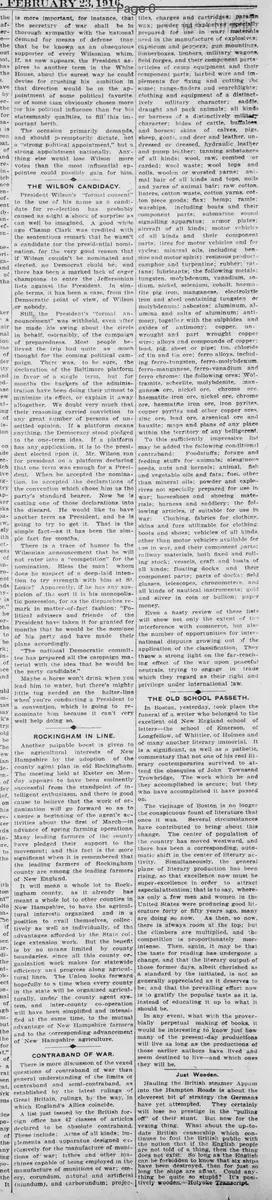
CONTRABAND OF WAR.
There is more discussion of the vexed questions of contraband of war than general understanding of the limits of contraband and semi-contraband, as established by the latest rulings of Great Britain, rulings, by the way, in which England's Allies coincide.
A list just issued by the British foreign office has 42 classes of articles declared to be absolute contraband. These include: Arms of all kinds; implements and apparatus designed exclusively for the manufacture of munitions of war; lathes and other machines capable of being employed in the manufacture of munitions of war; emery, corundum, natural and artificial (Alundum), and carborundum; projectiles, charges and cartridges; paraffin wax; powder and explosives especially prepared for use in war; materials used in the manufacture of explosives; capsicum and peppers; gun mountings, limberboxes, limbers, military wagons field forges, and their component parts articles of camp equipment and their component parts; barbed wire and implements for fixing and cutting the same; range-finders and searchlights; clothing and equipment of a distinctively military character; saddle, draught and pack animals: all kinds of harness of a distinctively military character; hides of cattle, buffaloes and horses; skins of calves, pigs, sheep, goats, and deer and leather, undressed or dressed, hydraulic leather and pump leather: tanning substances of all kinds; wool, raw, combed or carded: wool waste; wool tops and noils, woolen or worsted yarns: animal hair of all kinds and tops, noils and yarns of animal hair: raw cotton, linters, cotton waste, cotton yarns, cotton piece goods: flax; hemp; ramie: warships, including boats and their component parts; submarine sound signalling apparatus; armor plates: aircraft of all kinds; motor vehicles of all kinds and their component parts: tires for motor vehicles and for cycles: mineral oils, including benzine and motor spirit; resinous products camphor and turpentine; rubber: rattan; lubricants; the following metals: tungsten, molybdenum, vanadium, sodium, nickel, selenium, cobalt, haematite pig iron, manganese, electrolytic iron and steel containing tungsten or molybdenum; asbestos: aluminum, alumina and salts of aluminum; antimony, together with the sulphides and oxides of antimony; copper, unwrought and part wrought copper wire; alloys and compounds of copper; lead, pig, sheet or pipe; tin, chloride of tin and tin ore; ferro alloys, including ferro-tungsten, ferro-molybdenum, ferro-manganese, ferro-vanadium and ferro chrome: the following ores: Wolframite, scheelite, molybdenite, manganese ore, nickel ore, chrome ore, haematite iron ore, nickel ore, chrome ore, haematite iron ore, iron pyrites, copper pyrites and other copper ores, zinc ore, lead ore, arsenical ore and bauxite; maps and plans of any place within the territory of any belligerent.
To this sufficiently impressive list may be added the following conditional contraband:
Foodstuffs; forage and feeding stuffs for animals.; oleaginous seeds, nuts and kernels; animal, fish and vegetable oils and fats; fuel, other than mineral oils; powder and explosives not specially prepared for use in war: horseshoes and shoeing materials; harness and saddlery: the following articles, if suitable for use in war: Clothing, fabrics for clothing, skins and furs utilizable for clothing, boots and shoes: vehicles of all kinds, other than motor vehicles available for use in war, and their component parts; railway materials, both fixed and rolling stock; vessels, craft and boats of all kinds; floating docks and their component parts; parts of docks; field glasses, telescopes, chronometers, and all kinds of nautical instruments; gold and silver in coin or bullion; paper money.
Even a hasty review of these lists will show not only the extent of the interference with commerce, but also the number of opportunities for international disputes growing out of the application of the classification. They throw a strong light on the far-reaching effect of the war upon peaceful neutrals, trying to engage in trade which they regard as their right and privilege under international law.
There is more discussion of the vexed questions of contraband of war than general understanding of the limits of contraband and semi-contraband, as established by the latest rulings of Great Britain, rulings, by the way, in which England's Allies coincide.
A list just issued by the British foreign office has 42 classes of articles declared to be absolute contraband. These include: Arms of all kinds; implements and apparatus designed exclusively for the manufacture of munitions of war; lathes and other machines capable of being employed in the manufacture of munitions of war; emery, corundum, natural and artificial (Alundum), and carborundum; projectiles, charges and cartridges; paraffin wax; powder and explosives especially prepared for use in war; materials used in the manufacture of explosives; capsicum and peppers; gun mountings, limberboxes, limbers, military wagons field forges, and their component parts articles of camp equipment and their component parts; barbed wire and implements for fixing and cutting the same; range-finders and searchlights; clothing and equipment of a distinctively military character; saddle, draught and pack animals: all kinds of harness of a distinctively military character; hides of cattle, buffaloes and horses; skins of calves, pigs, sheep, goats, and deer and leather, undressed or dressed, hydraulic leather and pump leather: tanning substances of all kinds; wool, raw, combed or carded: wool waste; wool tops and noils, woolen or worsted yarns: animal hair of all kinds and tops, noils and yarns of animal hair: raw cotton, linters, cotton waste, cotton yarns, cotton piece goods: flax; hemp; ramie: warships, including boats and their component parts; submarine sound signalling apparatus; armor plates: aircraft of all kinds; motor vehicles of all kinds and their component parts: tires for motor vehicles and for cycles: mineral oils, including benzine and motor spirit; resinous products camphor and turpentine; rubber: rattan; lubricants; the following metals: tungsten, molybdenum, vanadium, sodium, nickel, selenium, cobalt, haematite pig iron, manganese, electrolytic iron and steel containing tungsten or molybdenum; asbestos: aluminum, alumina and salts of aluminum; antimony, together with the sulphides and oxides of antimony; copper, unwrought and part wrought copper wire; alloys and compounds of copper; lead, pig, sheet or pipe; tin, chloride of tin and tin ore; ferro alloys, including ferro-tungsten, ferro-molybdenum, ferro-manganese, ferro-vanadium and ferro chrome: the following ores: Wolframite, scheelite, molybdenite, manganese ore, nickel ore, chrome ore, haematite iron ore, nickel ore, chrome ore, haematite iron ore, iron pyrites, copper pyrites and other copper ores, zinc ore, lead ore, arsenical ore and bauxite; maps and plans of any place within the territory of any belligerent.
To this sufficiently impressive list may be added the following conditional contraband:
Foodstuffs; forage and feeding stuffs for animals.; oleaginous seeds, nuts and kernels; animal, fish and vegetable oils and fats; fuel, other than mineral oils; powder and explosives not specially prepared for use in war: horseshoes and shoeing materials; harness and saddlery: the following articles, if suitable for use in war: Clothing, fabrics for clothing, skins and furs utilizable for clothing, boots and shoes: vehicles of all kinds, other than motor vehicles available for use in war, and their component parts; railway materials, both fixed and rolling stock; vessels, craft and boats of all kinds; floating docks and their component parts; parts of docks; field glasses, telescopes, chronometers, and all kinds of nautical instruments; gold and silver in coin or bullion; paper money.
Even a hasty review of these lists will show not only the extent of the interference with commerce, but also the number of opportunities for international disputes growing out of the application of the classification. They throw a strong light on the far-reaching effect of the war upon peaceful neutrals, trying to engage in trade which they regard as their right and privilege under international law.
What sub-type of article is it?
War Or Peace
Foreign Affairs
Trade Or Commerce
What keywords are associated?
Contraband Of War
Absolute Contraband
Conditional Contraband
British Foreign Office
Neutral Trade
International Law
Wartime Commerce
What entities or persons were involved?
Great Britain
England's Allies
British Foreign Office
Editorial Details
Primary Topic
British Rulings On Contraband Of War
Stance / Tone
Informative Analysis Of Wartime Trade Restrictions
Key Figures
Great Britain
England's Allies
British Foreign Office
Key Arguments
42 Classes Of Articles Declared Absolute Contraband By Britain
Conditional Contraband Includes Foodstuffs And Other Items
Extensive Lists Interfere With Neutral Commerce
Create Opportunities For International Disputes
Highlight Far Reaching Effects On Peaceful Neutrals Under International Law