Thank you for visiting SNEWPapers!
Sign up free
Literary
February 7, 1771
The Virginia Gazette
Richmond, Williamsburg, Richmond County, Virginia
What is this article about?
This philosophical essay explores how happiness and misfortune are subjective, depending on one's perspective and contentment. It argues that true wealth and joy come from internal satisfaction rather than external circumstances, using anecdotes from history and daily life to illustrate that individuals make their own fortune through attitude.
Clipping
OCR Quality
98%
Excellent
Full Text
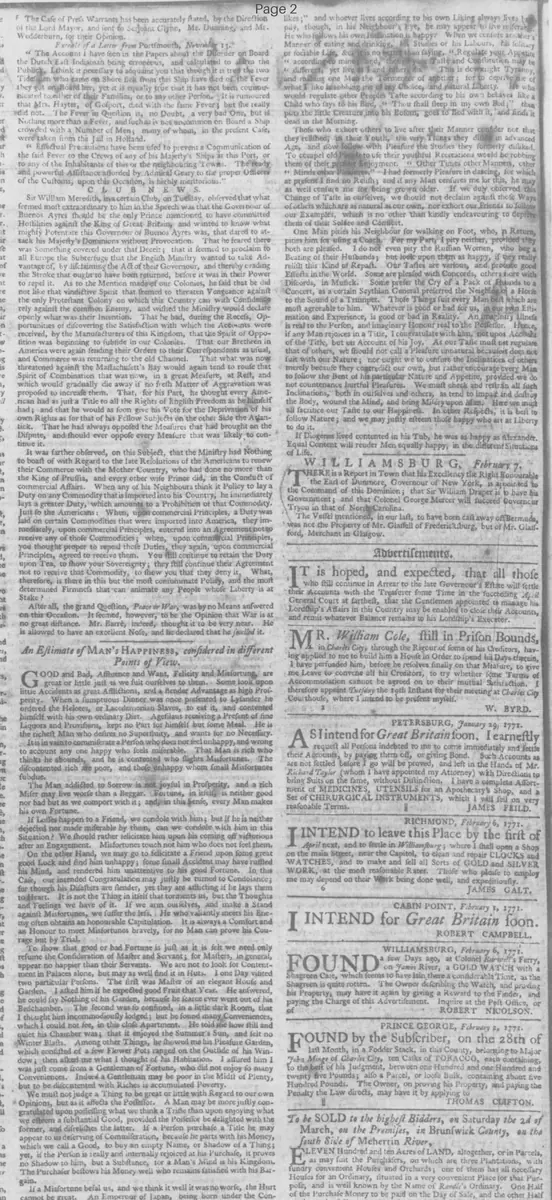
An Estimate of Man's Happiness, considered in different Points of View.
Good and Bad, Affluence and Want, Felicity and Misfortune, are great or little just as we suit ourselves to them. Some look upon little Accidents as great Afflictions, and a slender Advantage as high Prosperity. When a Sumptuous Dinner was once presented to Lysander he ordered the Helotes, or Lacedemonian Slaves, to eat it, and contented himself with his own ordinary Diet. Agesilaus receiving a Present of fine Liquors and Provisions, kept no Part for himself but some Meal. He is the richest Man who desires no Superfluity, and wants for no Necessary.
It is in vain to commiserate a Person who does not feel unhappy, and wrong to account any one happy who feels miserable. That Man is rich who thinks he abounds, and he is contented who flights Misfortunes. The discontented rich are poor, and those unhappy whom Small Misfortunes subdue.
The Man addicted to Sorrow is not joyful in Prosperity, and a rich Miser may live worse than a Beggar. Fortune, in itself, is neither good nor bad but as we comport with it; and, in this Sense, every Man makes his own Fortune.
If Loss happen to a Friend, we condole with him; but if he is neither dejected nor made miserable by them, can we condole with him in this Situation? We should rather felicitate him upon his coming off victorious after an Engagement. Misfortunes touch not him who does not feel them.
On the other Hand, we may go to felicitate a Friend upon Some great good Luck and find him unhappy; some small Accident may have ruffled his Mind, and rendered him inattentive to his good Fortune. In this Case, our intended Congratulation may justly be turned to Condolence; for though his Disasters are slender, yet they are afflicting if he lays them to Heart. It is not the Thing in itself that torments us, but the Thoughts and Feelings we have of it. If we arm ourselves, and make a Stand against Misfortunes, we suffer the less. He who valiantly meets his Enemy often obtains an honourable Capitulation. It is always a Comfort and an Honour to meet Misfortunes bravely, for no Man can prove his Courage but by Trial.
To show that good or bad Fortune is just as it is felt we need only resume the Consideration of Master and Servant; for Masters, in general, appear no happier than their Servants. We are not to look for Contentment in Palaces alone, but may as well find it in Huts. I one Day visited two particular Persons. The first was Master of an elegant House and Garden. I asked him if he expected good Fruit that Year. He answered, he could say Nothing of his Garden, because he scarce ever went out of his Bedchamber. The second was so confined, in a little dark Room, that I thought him incommodiously lodged; but he found many Conveniences, which I could not see, in this close Apartment. He told me how still and quiet his Chamber was; that it enjoyed the Summer's Sun, and felt no Winter Blasts. Among other Things, he showed me his Pleasure Garden, which consisted of a few Flower Pots ranged on the Outside of his Window; then asked me what I thought of his Habitation. I assured him I was just come from a Gentleman of Fortune, who did not enjoy so many Conveniences. Indeed a Gentleman may be poor in the Midst of Plenty, but to be discontented with Riches is accumulated Poverty.
We must not judge a Thing to be great or little with Regard to our own Opinions, but as it affects the Possessor. A Man may be more justly congratulated upon possessing what we think a Trifle than upon enjoying what we esteem a substantial Good, provided the Possessor be delighted with the former, and disrelishes the latter. If a Person purchase a Title he may appear to us deserving of Commiseration, because he parts with his Money, which we call a Good, to buy an empty Name, or Shadow of a Thing; yet, if the Person is really and internally rejoiced at his Purchase, it proves no Shadow to him, but a Substance, for a Man's Mind is his Kingdom.
The Purchaser bestows his Money well who remains satisfied with his Bargain.
If a Misfortune befall us, and we think it well it was no worse, the Hurt cannot be great. An Emperor of Japan, being born under the Constellation of the Dog, conceived such an Affection for the canine Species that he ordered, whenever a Dog died, the Owner of him should carry the Carcass to a certain Burying Ground appointed for that Purpose. As a Gentleman was one Day sweating under the Load of his dead Dog, and complaining of the Hardship of the Order, his Friend, to comfort him, said, "We have Reason to thank God that the Emperor was not born under the Horse, for Horse would have been a much heavier Burthen."
Could any ancient Greek Philosopher have moralised better upon the Occasion!
There is Nothing more strange, and at the Same Time more common, than for one Man to judge of another by his own Taste. We hear, every Day, one Neighbour censuring another for his Manner of Life; though Nobody can determine which of the two leads the best while each of them follows his own Inclination. We say, to a Proverb, "Every Man as he likes;" and whoever lives according to his own Liking always lives happily, though, in his Neighbour's Eye, he may appear to live miserably.
He who follows his own Inclination is happy. When we censure another Manner of eating and drinking, his Studies or his Labours, his solitary or sociable Life, &c. it is no better than saying. "Regulate your Appetite according to mine and, though your Taste and Constitution may be different, yet live as I and others do." This is downright Tyranny, and making one Man the Tormentor of another; for to deprive me of what I like is nothing less than robbing me of my Choice, and natural Liberty. He who would regulate other Peoples Taste according to his own behaves like a Child who says to his Bird,"Thou shalt sleep in my own Bed;" then puts the little Creature into his Bosom, goes to Bed with it, and finds it dead in the Morning.
Those who exhort others to live after their Manner consider not that they relished, in their Youth, the very Things they disdain in advanced Age, and now follow with Pleasure the Studies they formerly disliked. To compel old People to use their youthful Recreations would be robbing them of their present Enjoyment. "Other Times other Manners, other Minds other Pleasures." -I had formerly Pleasure in dancing, for which at present find no Relish; and if any Man censures me for this, he may as well censure me for being grown older. If we duly observed this Change of Taste in ourselves, we should not declaim against those Ways of others which are as natural as our own, nor exhort our Friends to follow our Examples, which is no other than kindly endeavouring to deprive them of their Solace and Comfort.
One Man pities his Neighbour for walking on Foot, who, in Return, pities him for using a Coach. For my Part, I pity neither, provided they both are pleased. I do not even pity the Russian Women, who began Beating of their Husbands; but look upon them as happy, if they really relish this Kind of Repast. Our Tastes are various, and produce good Effects in the World. Some are pleased with Concords, others more with Discords, in Music. Some prefer the Cry of a Pack of Hounds to a Concert, as a certain Scythian General preferred the Neighing of a Horse to the Sound of a Trumpet. Those Things suit every Man best which are most agreeable to him. Whatever is good or bad for us, in our own Estimation and Experience, is good or bad in Reality. An imaginary Illness is real to the Person, and imaginary Honour real to the Possessor. Hence, if any Man rejoices in a Title, I congratulate with him, not upon Account of the Title, but on Account of his Joy. As our Taste must not regulate that of others, we should not call a Pleasure unnatural because it does not suit with our Nature; nor ought we to censure the Inclinations of others merely because they contradict our own, but rather encourage every Man to follow the Bent of his particular Nature and Appetite, provided we do not countenance hurtful Pleasures. We must check and restrain all such Inclinations, both in ourselves and others, as tend to impair and destroy the Body, wound the Mind, and bring Misery upon Man. Here we must all sacrifice our Taste to our Happiness. In other Respects, it is best to follow Nature; and we may justly esteem those happy who are at Liberty to do it.
If Diogenes lived contented in his Tub, he was as happy as Alexander. Equal Content will render Men equally happy, in the different Situations of Life.
Good and Bad, Affluence and Want, Felicity and Misfortune, are great or little just as we suit ourselves to them. Some look upon little Accidents as great Afflictions, and a slender Advantage as high Prosperity. When a Sumptuous Dinner was once presented to Lysander he ordered the Helotes, or Lacedemonian Slaves, to eat it, and contented himself with his own ordinary Diet. Agesilaus receiving a Present of fine Liquors and Provisions, kept no Part for himself but some Meal. He is the richest Man who desires no Superfluity, and wants for no Necessary.
It is in vain to commiserate a Person who does not feel unhappy, and wrong to account any one happy who feels miserable. That Man is rich who thinks he abounds, and he is contented who flights Misfortunes. The discontented rich are poor, and those unhappy whom Small Misfortunes subdue.
The Man addicted to Sorrow is not joyful in Prosperity, and a rich Miser may live worse than a Beggar. Fortune, in itself, is neither good nor bad but as we comport with it; and, in this Sense, every Man makes his own Fortune.
If Loss happen to a Friend, we condole with him; but if he is neither dejected nor made miserable by them, can we condole with him in this Situation? We should rather felicitate him upon his coming off victorious after an Engagement. Misfortunes touch not him who does not feel them.
On the other Hand, we may go to felicitate a Friend upon Some great good Luck and find him unhappy; some small Accident may have ruffled his Mind, and rendered him inattentive to his good Fortune. In this Case, our intended Congratulation may justly be turned to Condolence; for though his Disasters are slender, yet they are afflicting if he lays them to Heart. It is not the Thing in itself that torments us, but the Thoughts and Feelings we have of it. If we arm ourselves, and make a Stand against Misfortunes, we suffer the less. He who valiantly meets his Enemy often obtains an honourable Capitulation. It is always a Comfort and an Honour to meet Misfortunes bravely, for no Man can prove his Courage but by Trial.
To show that good or bad Fortune is just as it is felt we need only resume the Consideration of Master and Servant; for Masters, in general, appear no happier than their Servants. We are not to look for Contentment in Palaces alone, but may as well find it in Huts. I one Day visited two particular Persons. The first was Master of an elegant House and Garden. I asked him if he expected good Fruit that Year. He answered, he could say Nothing of his Garden, because he scarce ever went out of his Bedchamber. The second was so confined, in a little dark Room, that I thought him incommodiously lodged; but he found many Conveniences, which I could not see, in this close Apartment. He told me how still and quiet his Chamber was; that it enjoyed the Summer's Sun, and felt no Winter Blasts. Among other Things, he showed me his Pleasure Garden, which consisted of a few Flower Pots ranged on the Outside of his Window; then asked me what I thought of his Habitation. I assured him I was just come from a Gentleman of Fortune, who did not enjoy so many Conveniences. Indeed a Gentleman may be poor in the Midst of Plenty, but to be discontented with Riches is accumulated Poverty.
We must not judge a Thing to be great or little with Regard to our own Opinions, but as it affects the Possessor. A Man may be more justly congratulated upon possessing what we think a Trifle than upon enjoying what we esteem a substantial Good, provided the Possessor be delighted with the former, and disrelishes the latter. If a Person purchase a Title he may appear to us deserving of Commiseration, because he parts with his Money, which we call a Good, to buy an empty Name, or Shadow of a Thing; yet, if the Person is really and internally rejoiced at his Purchase, it proves no Shadow to him, but a Substance, for a Man's Mind is his Kingdom.
The Purchaser bestows his Money well who remains satisfied with his Bargain.
If a Misfortune befall us, and we think it well it was no worse, the Hurt cannot be great. An Emperor of Japan, being born under the Constellation of the Dog, conceived such an Affection for the canine Species that he ordered, whenever a Dog died, the Owner of him should carry the Carcass to a certain Burying Ground appointed for that Purpose. As a Gentleman was one Day sweating under the Load of his dead Dog, and complaining of the Hardship of the Order, his Friend, to comfort him, said, "We have Reason to thank God that the Emperor was not born under the Horse, for Horse would have been a much heavier Burthen."
Could any ancient Greek Philosopher have moralised better upon the Occasion!
There is Nothing more strange, and at the Same Time more common, than for one Man to judge of another by his own Taste. We hear, every Day, one Neighbour censuring another for his Manner of Life; though Nobody can determine which of the two leads the best while each of them follows his own Inclination. We say, to a Proverb, "Every Man as he likes;" and whoever lives according to his own Liking always lives happily, though, in his Neighbour's Eye, he may appear to live miserably.
He who follows his own Inclination is happy. When we censure another Manner of eating and drinking, his Studies or his Labours, his solitary or sociable Life, &c. it is no better than saying. "Regulate your Appetite according to mine and, though your Taste and Constitution may be different, yet live as I and others do." This is downright Tyranny, and making one Man the Tormentor of another; for to deprive me of what I like is nothing less than robbing me of my Choice, and natural Liberty. He who would regulate other Peoples Taste according to his own behaves like a Child who says to his Bird,"Thou shalt sleep in my own Bed;" then puts the little Creature into his Bosom, goes to Bed with it, and finds it dead in the Morning.
Those who exhort others to live after their Manner consider not that they relished, in their Youth, the very Things they disdain in advanced Age, and now follow with Pleasure the Studies they formerly disliked. To compel old People to use their youthful Recreations would be robbing them of their present Enjoyment. "Other Times other Manners, other Minds other Pleasures." -I had formerly Pleasure in dancing, for which at present find no Relish; and if any Man censures me for this, he may as well censure me for being grown older. If we duly observed this Change of Taste in ourselves, we should not declaim against those Ways of others which are as natural as our own, nor exhort our Friends to follow our Examples, which is no other than kindly endeavouring to deprive them of their Solace and Comfort.
One Man pities his Neighbour for walking on Foot, who, in Return, pities him for using a Coach. For my Part, I pity neither, provided they both are pleased. I do not even pity the Russian Women, who began Beating of their Husbands; but look upon them as happy, if they really relish this Kind of Repast. Our Tastes are various, and produce good Effects in the World. Some are pleased with Concords, others more with Discords, in Music. Some prefer the Cry of a Pack of Hounds to a Concert, as a certain Scythian General preferred the Neighing of a Horse to the Sound of a Trumpet. Those Things suit every Man best which are most agreeable to him. Whatever is good or bad for us, in our own Estimation and Experience, is good or bad in Reality. An imaginary Illness is real to the Person, and imaginary Honour real to the Possessor. Hence, if any Man rejoices in a Title, I congratulate with him, not upon Account of the Title, but on Account of his Joy. As our Taste must not regulate that of others, we should not call a Pleasure unnatural because it does not suit with our Nature; nor ought we to censure the Inclinations of others merely because they contradict our own, but rather encourage every Man to follow the Bent of his particular Nature and Appetite, provided we do not countenance hurtful Pleasures. We must check and restrain all such Inclinations, both in ourselves and others, as tend to impair and destroy the Body, wound the Mind, and bring Misery upon Man. Here we must all sacrifice our Taste to our Happiness. In other Respects, it is best to follow Nature; and we may justly esteem those happy who are at Liberty to do it.
If Diogenes lived contented in his Tub, he was as happy as Alexander. Equal Content will render Men equally happy, in the different Situations of Life.
What sub-type of article is it?
Essay
What themes does it cover?
Moral Virtue
Liberty Freedom
What keywords are associated?
Happiness
Misfortune
Contentment
Perspective
Inclination
Fortune
Philosophy
Literary Details
Title
An Estimate Of Man's Happiness, Considered In Different Points Of View.
Key Lines
He Is The Richest Man Who Desires No Superfluity, And Wants For No Necessary.
Fortune, In Itself, Is Neither Good Nor Bad But As We Comport With It; And, In This Sense, Every Man Makes His Own Fortune.
It Is Not The Thing In Itself That Torments Us, But The Thoughts And Feelings We Have Of It.
He Who Follows His Own Inclination Is Happy.
If Diogenes Lived Contented In His Tub, He Was As Happy As Alexander.