Thank you for visiting SNEWPapers!
Sign up free
Editorial
July 9, 1846
Port Gibson Herald
Port Gibson, Claiborne County, Mississippi
What is this article about?
The Philadelphia Sentinel critiques anti-tariff advocates' inconsistency in proposing repeal amid war finances, arguing low duties fail to fill the Treasury and harm the economy, especially the South, urging Congress to maintain the current tariff.
Clipping
OCR Quality
98%
Excellent
Full Text
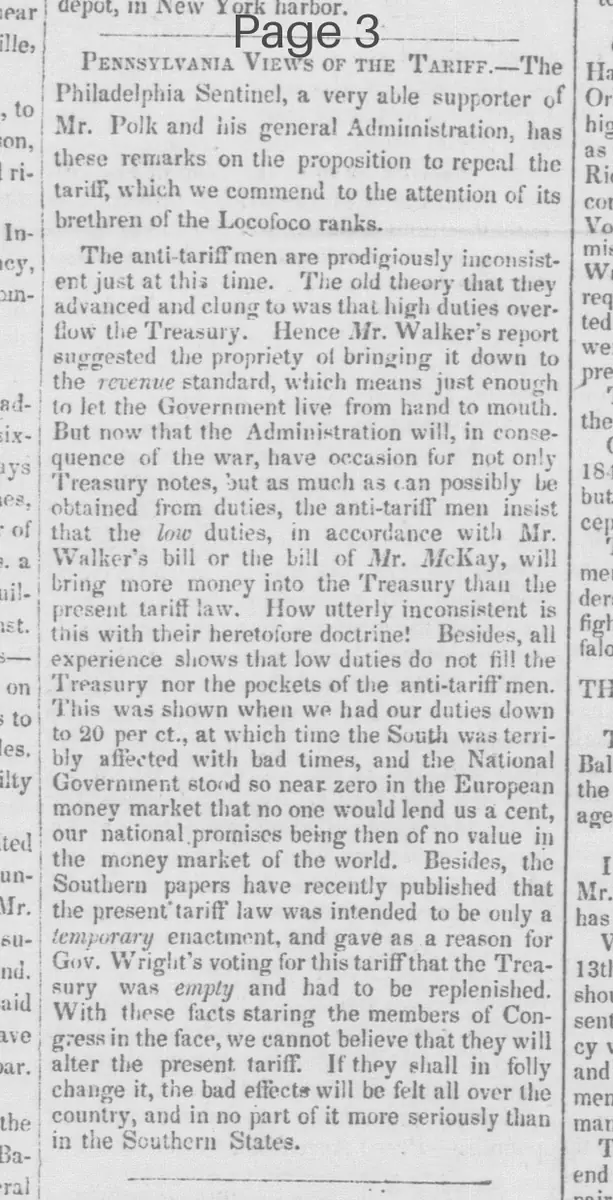
PENNSYLVANIA VIEWS OF THE TARIFF.-The Philadelphia Sentinel, a very able supporter of Mr. Polk and his general Administration, has these remarks on the proposition to repeal the tariff, which we commend to the attention of its brethren of the Locofoco ranks.
The anti-tariff men are prodigiously inconsistent just at this time. The old theory that they advanced and clung to was that high duties overflow the Treasury. Hence Mr. Walker's report suggested the propriety of bringing it down to the revenue standard, which means just enough to let the Government live from hand to mouth. But now that the Administration will, in consequence of the war, have occasion for not only Treasury notes, but as much as can possibly be obtained from duties, the anti-tariff men insist that the low duties, in accordance with Mr. Walker's bill or the bill of Mr. McKay, will bring more money into the Treasury than the present tariff law. How utterly inconsistent is this with their heretofore doctrine! Besides, all experience shows that low duties do not fill the Treasury nor the pockets of the anti-tariff men. This was shown when we had our duties down to 20 per ct., at which time the South was terribly affected with bad times, and the National Government stood so near zero in the European money market that no one would lend us a cent, our national promises being then of no value in the money market of the world. Besides, the Southern papers have recently published that the present tariff law was intended to be only a temporary enactment, and gave as a reason for Gov. Wright's voting for this tariff that the Treasury was empty and had to be replenished. With these facts staring the members of Congress in the face, we cannot believe that they will alter the present tariff. If they shall in folly change it, the bad effects will be felt all over the country, and in no part of it more seriously than in the Southern States.
The anti-tariff men are prodigiously inconsistent just at this time. The old theory that they advanced and clung to was that high duties overflow the Treasury. Hence Mr. Walker's report suggested the propriety of bringing it down to the revenue standard, which means just enough to let the Government live from hand to mouth. But now that the Administration will, in consequence of the war, have occasion for not only Treasury notes, but as much as can possibly be obtained from duties, the anti-tariff men insist that the low duties, in accordance with Mr. Walker's bill or the bill of Mr. McKay, will bring more money into the Treasury than the present tariff law. How utterly inconsistent is this with their heretofore doctrine! Besides, all experience shows that low duties do not fill the Treasury nor the pockets of the anti-tariff men. This was shown when we had our duties down to 20 per ct., at which time the South was terribly affected with bad times, and the National Government stood so near zero in the European money market that no one would lend us a cent, our national promises being then of no value in the money market of the world. Besides, the Southern papers have recently published that the present tariff law was intended to be only a temporary enactment, and gave as a reason for Gov. Wright's voting for this tariff that the Treasury was empty and had to be replenished. With these facts staring the members of Congress in the face, we cannot believe that they will alter the present tariff. If they shall in folly change it, the bad effects will be felt all over the country, and in no part of it more seriously than in the Southern States.
What sub-type of article is it?
Economic Policy
Taxation
What keywords are associated?
Tariff Repeal
Polk Administration
Revenue Standard
Low Duties
Southern Economy
War Finances
Congressional Policy
What entities or persons were involved?
Philadelphia Sentinel
Mr. Polk
Mr. Walker
Mr. Mckay
Gov. Wright
Locofoco Ranks
Southern States
Congress
Editorial Details
Primary Topic
Opposition To Tariff Repeal
Stance / Tone
Supportive Of Maintaining The Present Tariff
Key Figures
Philadelphia Sentinel
Mr. Polk
Mr. Walker
Mr. Mckay
Gov. Wright
Locofoco Ranks
Southern States
Congress
Key Arguments
Anti Tariff Men Inconsistently Claim Low Duties Will Now Yield More Revenue Despite Past Theories
High Duties Previously Seen As Overflowing Treasury, But War Needs More Funds
Experience Proves Low Duties Fail To Fill Treasury Or Benefit Anti Tariff Advocates
20% Duties Caused Southern Economic Hardship And Loss Of International Credit
Current Tariff Temporary To Replenish Empty Treasury, As Gov. Wright Voted For It
Congress Should Not Alter Tariff, As Changes Would Harm Country Especially South