Thank you for visiting SNEWPapers!
Sign up free
Story
July 13, 1901
Kentucky Irish American
Louisville, Jefferson County, Kentucky
What is this article about?
In 1881, 16-year-old Kate Shelley heroically crossed a storm-damaged trestle over the Des Moines River in Iowa to warn an oncoming train of a washed-out bridge, saving 200 passengers after rescuing two crew members from a wreck.
Clipping
OCR Quality
95%
Excellent
Full Text
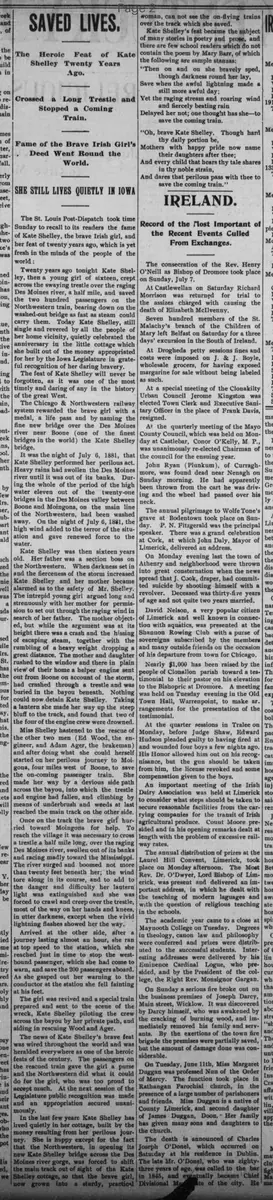
SAVED LIVES.
The Heroic Feat of Kate Shelley Twenty Years Ago.
Crossed a Long Trestle and Stopped a Coming Train.
Fame of the Brave Irish Girl's Deed Went Round the World.
SHE STILL LIVES QUIETLY IN IOWA
The St. Louis Post-Dispatch took time Sunday to recall to its readers the fame of Kate Shelley, the brave Irish girl, and her feat of twenty years ago, which is yet fresh in the minds of the people of the world:
Twenty years ago tonight Kate Shelley, then a young girl of sixteen, crept across the swaying trestle over the raging Des Moines river, a half mile, and saved the two hundred passengers on the Northwestern train, bearing down on the washed-out bridge as fast as steam could carry them. Today Kate Shelley, still single and revered by all the people of her home vicinity, quietly celebrated the anniversary in the little cottage which she built out of the money appropriated for her by the Iowa Legislature in grateful recognition of her daring bravery.
The feat of Kate Shelley will never be forgotten, as it was one of the most timely and daring of any in the history of the great West.
The Chicago & Northwestern railway system rewarded the brave girl with a medal, a life pass and by naming the fine new bridge over the Des Moines river near Boone (one of the finest bridges in the world) the Kate Shelley bridge.
It was the night of July 6, 1881, that Kate Shelley performed her perilous act. Heavy rains had swollen the Des Moines river until it was out of its banks. During the whole of the period of the high water eleven out of the twenty-one bridges in the Des Moines valley between Boone and Moingona, on the main line of the Northwestern, had been washed away. On the night of July 6, 1881, the high wind added to the terror of the situation and gave renewed force to the water.
Kate Shelley was then sixteen years old. Her father was a section boss on the Northwestern. When darkness set in and the fierceness of the storm increased Kate Shelley and her mother became alarmed as to the safety of Mr. Shelley. The intrepid young girl argued long and strenuously with her mother for permission to set out through the raging wind in search of her father. The mother objected, but while the argument was at its height there was a crash and the hissing of escaping steam, together with the rumbling of a heavy weight dropping a great distance. The mother and daughter rushed to the window and there in plain view of their home a helper engine sent out from Boone on account of the storm, had crashed through a trestle and was buried in the bayou beneath. Nothing could now detain Kate Shelley. Taking a lantern she made her way up the steep bluff to the track, and found that two of the four of the engine crew were drowned. Miss Shelley hastened to the rescue of the other two men (Ed Wood, the engineer, and Adam Ager, the brakeman) and after doing what she could herself started on her perilous journey to Moingona, four miles west of Boone, to save the on-coming passenger train. She made her way by a devious side path across the bayou, into which the trestle and engine had fallen, and climbing by means of underbrush and weeds at last reached the main track on the other side. Once on the track the brave girl hurried toward Moingona for help. To reach the village it was necessary to cross a trestle a half mile long, over the raging Des Moines river, swollen out of its banks and racing madly toward the Mississippi. The river surged and boomed not more than twenty feet beneath her: the wind tore along in its course, and to add to the danger and difficulty her lantern light was extinguished and she was forced to crawl and creep over the trestle, most of the way on her hands and knees, in utter darkness, except when the vivid lightning flashes showed her the way. Arrived at the other side, after a journey lasting almost an hour, she ran at top speed to the station, which she reached just in time to stop the west-bound passenger, which she had come to warn, and save the 200 passengers aboard. As she gasped out her warning to the conductor at the station she fell fainting at his feet.
The girl was revived and a special train prepared and sent to the scene of the wreck, Kate Shelley piloting the crew across the bayou by her private path, and aiding in rescuing Wood and Ager.
The news of Kate Shelley's brave feat was wired throughout the world and was heralded everywhere as one of the heroic feats of the century. The passengers on the rescued train gave the girl a purse and the Northwestern did what it could do for the girl, who was too proud to accept much. At the next session of the Legislature public recognition was made and an appropriation secured unanimously.
In the last few years Kate Shelley has lived quietly in her cottage, built by the money resulting from her perilous journey. She is happy except for the fact that the Northwestern, in opening its new Kate Shelley bridge across the Des Moines river gorge, was forced to shift the main track out of sight of the Kate Shelley cottage, so that the brave girl, now grown into a sturdy, practical woman, can not see the on-flying trains over the track which she saved.
Kate Shelley's feat became the subject of many stories in poetry and prose, and there are few school readers which do not contain the poem by Mary Bayard Clarke, of which the following are sample stanzas:
"Then on and on she bravely sped,
though darkness round her lay,
Save when the awful lightning made a
still more awful day:
Yet the raging stream and roaring wind
and fiercely beating rain
Delayed her not; one thought has she—to
save the coming train.
"Oh, brave Kate Shelley. Though hard
thy daily portion be,
Mothers with happy pride now name
their daughters after thee;
And every child that hears thy tale shares
in thy noble strain,
And dares that perilous pass with thee to
save the coming train."
The Heroic Feat of Kate Shelley Twenty Years Ago.
Crossed a Long Trestle and Stopped a Coming Train.
Fame of the Brave Irish Girl's Deed Went Round the World.
SHE STILL LIVES QUIETLY IN IOWA
The St. Louis Post-Dispatch took time Sunday to recall to its readers the fame of Kate Shelley, the brave Irish girl, and her feat of twenty years ago, which is yet fresh in the minds of the people of the world:
Twenty years ago tonight Kate Shelley, then a young girl of sixteen, crept across the swaying trestle over the raging Des Moines river, a half mile, and saved the two hundred passengers on the Northwestern train, bearing down on the washed-out bridge as fast as steam could carry them. Today Kate Shelley, still single and revered by all the people of her home vicinity, quietly celebrated the anniversary in the little cottage which she built out of the money appropriated for her by the Iowa Legislature in grateful recognition of her daring bravery.
The feat of Kate Shelley will never be forgotten, as it was one of the most timely and daring of any in the history of the great West.
The Chicago & Northwestern railway system rewarded the brave girl with a medal, a life pass and by naming the fine new bridge over the Des Moines river near Boone (one of the finest bridges in the world) the Kate Shelley bridge.
It was the night of July 6, 1881, that Kate Shelley performed her perilous act. Heavy rains had swollen the Des Moines river until it was out of its banks. During the whole of the period of the high water eleven out of the twenty-one bridges in the Des Moines valley between Boone and Moingona, on the main line of the Northwestern, had been washed away. On the night of July 6, 1881, the high wind added to the terror of the situation and gave renewed force to the water.
Kate Shelley was then sixteen years old. Her father was a section boss on the Northwestern. When darkness set in and the fierceness of the storm increased Kate Shelley and her mother became alarmed as to the safety of Mr. Shelley. The intrepid young girl argued long and strenuously with her mother for permission to set out through the raging wind in search of her father. The mother objected, but while the argument was at its height there was a crash and the hissing of escaping steam, together with the rumbling of a heavy weight dropping a great distance. The mother and daughter rushed to the window and there in plain view of their home a helper engine sent out from Boone on account of the storm, had crashed through a trestle and was buried in the bayou beneath. Nothing could now detain Kate Shelley. Taking a lantern she made her way up the steep bluff to the track, and found that two of the four of the engine crew were drowned. Miss Shelley hastened to the rescue of the other two men (Ed Wood, the engineer, and Adam Ager, the brakeman) and after doing what she could herself started on her perilous journey to Moingona, four miles west of Boone, to save the on-coming passenger train. She made her way by a devious side path across the bayou, into which the trestle and engine had fallen, and climbing by means of underbrush and weeds at last reached the main track on the other side. Once on the track the brave girl hurried toward Moingona for help. To reach the village it was necessary to cross a trestle a half mile long, over the raging Des Moines river, swollen out of its banks and racing madly toward the Mississippi. The river surged and boomed not more than twenty feet beneath her: the wind tore along in its course, and to add to the danger and difficulty her lantern light was extinguished and she was forced to crawl and creep over the trestle, most of the way on her hands and knees, in utter darkness, except when the vivid lightning flashes showed her the way. Arrived at the other side, after a journey lasting almost an hour, she ran at top speed to the station, which she reached just in time to stop the west-bound passenger, which she had come to warn, and save the 200 passengers aboard. As she gasped out her warning to the conductor at the station she fell fainting at his feet.
The girl was revived and a special train prepared and sent to the scene of the wreck, Kate Shelley piloting the crew across the bayou by her private path, and aiding in rescuing Wood and Ager.
The news of Kate Shelley's brave feat was wired throughout the world and was heralded everywhere as one of the heroic feats of the century. The passengers on the rescued train gave the girl a purse and the Northwestern did what it could do for the girl, who was too proud to accept much. At the next session of the Legislature public recognition was made and an appropriation secured unanimously.
In the last few years Kate Shelley has lived quietly in her cottage, built by the money resulting from her perilous journey. She is happy except for the fact that the Northwestern, in opening its new Kate Shelley bridge across the Des Moines river gorge, was forced to shift the main track out of sight of the Kate Shelley cottage, so that the brave girl, now grown into a sturdy, practical woman, can not see the on-flying trains over the track which she saved.
Kate Shelley's feat became the subject of many stories in poetry and prose, and there are few school readers which do not contain the poem by Mary Bayard Clarke, of which the following are sample stanzas:
"Then on and on she bravely sped,
though darkness round her lay,
Save when the awful lightning made a
still more awful day:
Yet the raging stream and roaring wind
and fiercely beating rain
Delayed her not; one thought has she—to
save the coming train.
"Oh, brave Kate Shelley. Though hard
thy daily portion be,
Mothers with happy pride now name
their daughters after thee;
And every child that hears thy tale shares
in thy noble strain,
And dares that perilous pass with thee to
save the coming train."
What sub-type of article is it?
Heroic Act
Personal Triumph
Survival
What themes does it cover?
Bravery Heroism
Triumph
Survival
What keywords are associated?
Kate Shelley
Heroic Rescue
Train Wreck
Des Moines River
Trestle Bridge
Iowa Bravery
What entities or persons were involved?
Kate Shelley
Ed Wood
Adam Ager
Where did it happen?
Near Boone, Iowa, Over Des Moines River
Story Details
Key Persons
Kate Shelley
Ed Wood
Adam Ager
Location
Near Boone, Iowa, Over Des Moines River
Event Date
1881 07 06
Story Details
During a storm on July 6, 1881, 16-year-old Kate Shelley rescued two crew members from a wrecked engine and crossed a half-mile trestle over the raging Des Moines River to stop an oncoming passenger train, saving 200 lives.