Thank you for visiting SNEWPapers!
Sign up free
Staunton Spectator, And General Advertiser
Staunton, Virginia
What is this article about?
Virginia House of Delegates debates and votes on bills including rejection of North-western road extension, passage of amended railroad construction resolution from Buchanan to Tennessee line, instructions for Staunton charter amendment, disagreement with Senate on deaf and blind asylum bill, passage of land re-assessment bill after debate on inequalities, rejection of Warrenton to Staunton road resolutions, and report of Tennessee to New River railroad bill.
Clipping
OCR Quality
Full Text
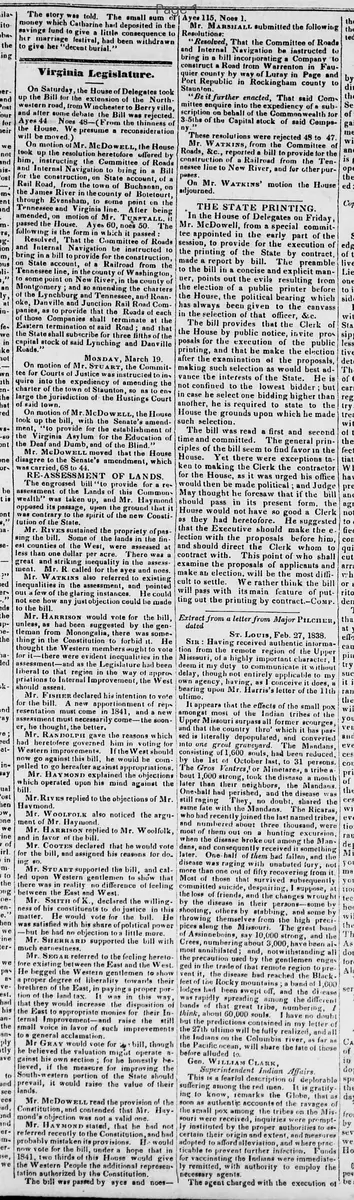
On Saturday, the House of Delegates took up the Bill for the extension of the North-western road, from Winchester to Berryville, and after some debate the Bill was rejected. Ayes 44 Noes 48—(From the thinness of the House. We presume a reconsideration will be moved.)
On motion of Mr. McDOWELL, the House took up the resolution heretofore offered by him, instructing the Committee of Roads and Internal Navigation to bring in a Bill for the construction, on State account, of a Rail Road, from the town of Buchanan, on the James River in the county of Botetourt, through Fincastle, to some point on the Tennessee and Virginia line. After being amended, on motion of Mr. TUNSTALL, it passed the House. Ayes 60, noes 50. The following is the form in which it passed:
Resolved, That the Committee of Roads and Internal Navigation be instructed to bring in a bill to provide for the construction, on State account, of a Railroad from the Tennessee line, in the county of Washington, to some point on New River, in the county of Montgomery; and so amending the charters of the Lynchburg and Tennessee, and Roanoke, Danville and Junction Rail Road Companies, as to provide that the Roads of each of those Companies shall terminate at the Eastern termination of said Road; and that the State shall subscribe for three fifths of the capital stock of said Lynchburg and Danville Roads.
Monday, March 19.
On motion of Mr. STUART, the Committee for Courts of Justice was instructed to inquire into the expediency of amending the charter of the town of Staunton, so as to enlarge the jurisdiction of the Hustings Court of said town.
On motion of Mr. McDOWELL, the House took up the bill, with the Senate's amendment, "to provide for the establishment of the Virginia Asylum for the Education of the Deaf and Dumb, and of the Blind."
Mr. McDOWELL moved that the House disagree to the Senate's amendment, which was carried, 68 to 44.
RE-ASSESSMENT OF LANDS.
The engrossed bill "to provide for a re-assessment of the Lands of this Commonwealth" was taken up, and Mr. Haymond opposed its passage, upon the ground that it was contrary to the spirit of the new Constitution of the State.
Mr. Rives sustained the propriety of passing the bill. Some of the lands in the finest counties of the West, were assessed at less than one dollar per acre. There was a great and striking inequality in the assessment. Mr. R. called for the ayes and noes.
Mr. Watkins also referred to existing inequalities in the assessment, and pointed out a few of the glaring instances. He could not see how any just objection could be made to the bill.
Mr. Harrison would vote for the bill, unless, as had been suggested by the gentleman from Monongalia, there was something in the Constitution to forbid it. He thought the Western members ought to vote for it—there were evident inequalities in the assessment—and as the Legislature had been liberal to that region in the way of appropriations to Internal Improvement, the West should assent.
Mr. Fisher declared his intention to vote for the bill. A new apportionment of representation must come in 1841, and a new assessment must necessarily come—the sooner, he thought, the better
Mr. Randolph gave the reasons which had heretofore governed him in voting for Western improvements. If the West should now go against this bill, he would be compelled to go hereafter against appropriations.
Mr. Haymond explained the objections which operated upon his mind against the bill.
Mr. Rives replied to the objections of Mr. Haymond.
Mr. Woolfolk also noticed the argument of Mr. Haymond
Mr. Harrison replied to Mr. Woolfolk, and in favor of the bill.
Mr. Coote declared that he would vote for the bill, and assigned his reasons for doing so.
Mr. Stuart supported the bill, and called upon Western gentlemen to show that there was in reality no difference of feeling between the East and West.
Mr. Smith of X., declared the willingness of his constituents to do justice in this matter. He would vote for the bill. He was satisfied with his share of political power—but he had no objection to a little more.
Mr. Sherrard supported the bill with much earnestness.
Mr. Segar referred to the feeling heretofore existing between the East and the West. He begged the Western gentlemen to show a proper degree of liberality towards their brethren of the East, in paying a proper portion of the land tax. It was in this way, that they would increase the disposition of the East to appropriate monies for their Internal Improvement—and raise the still small voice in favor of such improvements to a general acclamation.
Mr. Gray would vote for the bill, though he believed the valuation might operate against his own section; for he honestly believed, if the measure for improving the South-western portion of the State should prevail, it would raise the value of their lands.
Mr. McDOWELL read the provision of the Constitution, and contended that Mr. Haymond's objection was not a valid one.
Mr. Haymond stated that he had not referred recently to the Constitution, and had probably mistaken its provisions. He would now vote for the bill, under a hope that in 1841, two thirds of this House would give the Western People the additional representation authorized by the Constitution.
The bill was passed by ayes and noes—
( Ayes 115. Noes ].
Mr. MARSHALL submitted the following Resolutions:
" Resolved, That the Committee of Roads and Internal Navigation be instructed to bring in a bill incorporating a Company to construct a Road from Warrenton in Fauquier county by way of Luray in Page and Port Republic in Rockingham county to Staunton.
"Be it further enacted. That said Committee enquire into the expediency of a subscription on behalf of the Commonwealth for 3-5ths of the Capital stock of said Company
These resolutions were rejected 48 to 47.
Mr. Watkins, from the Committee of Roads, &c., reported a bill to provide for the construction of a Railroad from the Tennessee line to New River, and for other purposes.
On Mr. Watkins' motion the House adjourned.
What sub-type of article is it?
What keywords are associated?
What entities or persons were involved?
Where did it happen?
Domestic News Details
Primary Location
Virginia
Event Date
Saturday; Monday, March 19
Key Persons
Outcome
north-western road extension bill rejected (44-48); railroad resolution from buchanan amended and passed (60-50); staunton charter amendment inquiry instructed; senate amendment to deaf and blind asylum bill disagreed (68-44); land re-assessment bill passed (115 ayes); warrenton to staunton road resolutions rejected (48-47); tennessee to new river railroad bill reported.
Event Details
The Virginia House of Delegates discussed and voted on several bills and resolutions concerning road extensions, railroad constructions, town charter amendments, establishment of an education asylum, land re-assessment addressing inequalities between East and West, and other internal improvements.