Thank you for visiting SNEWPapers!
Sign up free
Literary
April 4, 1867
The Wyandot Pioneer
Upper Sandusky, Wyandot County, Ohio
What is this article about?
A man resolves to cancel his newspaper subscription to economize amid hard times, but his family misses the news, stories, and local updates. His business suffers without advertising, and he regrets the decision, reinstating it and planning to forgo ale and cigars instead.
Clipping
OCR Quality
95%
Excellent
Full Text
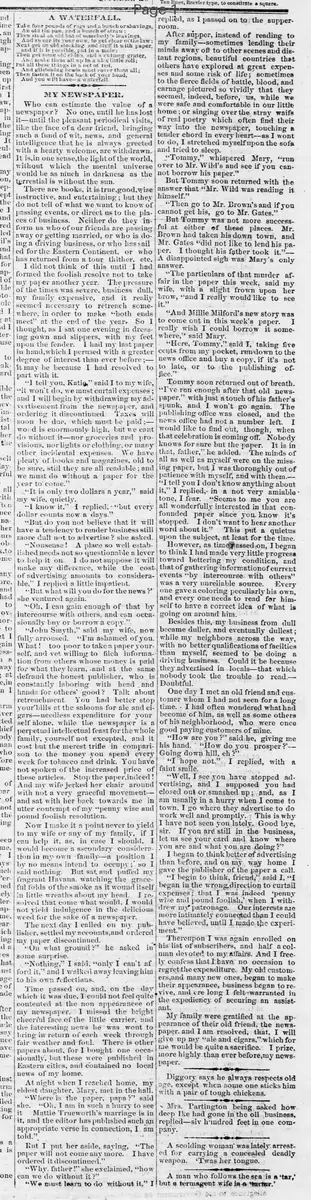
MY NEWSPAPER.
Who can estimate the value of a newspaper? No one, until he has lost it—until the pleasant periodical visits, like the face of a dear friend, bringing such a fund of wit, news, and general intelligence that he is always greeted with a hearty welcome, are withdrawn.
It is, in one sense, the light of the world, without which the mental universe would be as much in darkness as the terrestrial is without the sun.
There are books, it is true, good, wise instructive, and entertaining; but they do not tell of—what we want to know of passing events, or direct us to the places of business. Neither do they inform us who of our friends are passing away or getting married, or who is doing a driving business, or who has sailed for the Eastern Continent. or who has returned from a tour thither, etc.
I did not think of this until I had formed the foolish resolve not to take my paper another year. The pressure of the times was severe, business dull my family expensive, and it really seemed necessary to retrench some where, in order to make "both ends meet" at the end of the year, So I thought, as I sat one evening in dressing gown and slippers, with my feet upon the fender. I had my last paper in hand, which I perused with a greater degree of interest than ever before;— it may be because I had resolved to part with it.
"I tell you, Katie." said I to my wife, "it won't do, we must curtail expenses; and I will begin by withdrawing my advertisement from the newspaper, and ordering it discontinued. Taxes will soon be due, which must be paid:— wood is enormously high, but we cant do without it—nor groceries and provisions, nor lights or clothing, or many other incidental expenses. We have plenty of books and magazines, old to be sure, still they are all readable; and we must do without a paper for three year to come."
"It is only two dollars a year," said my wife, quietly.
I know it," I replied, "but every dollar counts now a days."
"But do you not believe that it will have a tendency to render business still more dull not to advertise? she asked.
Nonsense! A place so well established needs not so questionable a lever to help it on. I do not suppose it will make any difference, while the cost of advertising amounts to considerable," I replied a little impatient.
"But what will you do for the news?" she ventured again.
"Oh, I can gain enough of that by intercourse with others, and can occasionally buy or borrow a copy.'
"John Smyth," said my wife, now fully aroused. "I'm ashamed of you. What! too poor to take a paper yourself, and yet willing to filch information from others whose money is paid for what they learn. and at the same time defraud the honest publisher, who is constantly laboring with head and hands for others' good? Talk about retrenchment. You had better stop your bills at the saloons for ale and cigars—needless expenditure for yourself alone, while the newspaper is a perpetual intellectual feast for the whole family, yourself not excepted. and it cost but the merest trifle in comparison to the money you spend every week for tobacco and drink. You have not spoken of the increased price of these articles. Stop the paper, indeed!"
And my wife jerked her chair around with not a very graceful movement— and sat with her back towards me in utter contempt of my "penny wise and pound foolish resolution.
Now I make it a point never to yield to my wife or any of my family, if I can help it, as, in case I should, I would become a secondary consideration in my own family—a position I by no means intend to occupy; so I said nothing. But sat and puffed my fragrant Havana. watching the graceful folds of the smoke as it wound itself in little wreaths about my head. I resolved that come what would, I would not yield indulgence in the delicious weed for the sake of a newspaper.
The next day I called on my. publisher, settled my accounts, and ordered my paper discontinued.
"On what ground?" he asked in some surprise.
"Nothing," I said, "only I can't afford it," and I walked away leaving him to his own reflections.
Time passed on, and, on the day which it was due, I could not feel quite contented at the non appearance of my newspaper. I missed the bright cheerful face of the little carrier, and the interesting news he was wont to bring in return of each week through fair weather and foul. There is other papers about, for I bought one occasionally, but these were published in Eastern cities, and contained no local news of my home.
At night when I reached home, my eldest daughter, Mary, met in the hall.
"Where is the paper. papa?" said she. "Oh, I am in such a hurry to see it Mattie Trueworth's marriage is in it, and the editor has published such an appropriate verse in connection, I am told."
But I put her aside, saying,
"The paper will not come any more. I have ordered it discontinued."
"Why. father!" she exclaimed, "how can we do without it ?"
"We must learn to do without it."
replied, as I passed on to the supper-room.
After supper, instead of reading to my family—sometimes leading their minds away off to other scenes and distant regions, beautiful countries that others have explored at great expenses and some risk of life; sometimes to the fierce fields of battle, blood, and carnage pictured so vividly that they seemed, indeed, before, us, while we were safe and comfortable in our little home; or singing over the stray waifs of real poetry which often find their way into the newspaper, touching a tender chord in every heart—as I wont to do, I stretched myself upon the sofa and tried to sleep.
"Tommy," whispered Mary, "run over to Mr. Wild's and see if you can not borrow his paper."
But Tommy soon returned with the answer that "Mr. Wild was reading it himself."
"Then go to Mr. Brown's and if you cannot get his, go to Mr. Gates."
-But Tommy was not more successful at either of these places. Mr. Brown had taken his down town, and Mr. Gates "did not like to lend his paper. I thought his father took it."
A disappointed sigh was' Mary's only answer.
"The particulars of that murder affair in the paper this week, said my wife, with a slight frown upon her brow, "and I really would like to see it."
"And Milllie Milford's new story was to come out in this week's paper. I really wish I could borrow it somewhere," said Mary.
"Here, Tommy," said I, taking five cents from my pocket, run down to the news office and buy a copy, if it's not to late, or to the publishing office."
Tommy soon returned out of breath.
"I've run enough after that old newspaper." with just a touch of his father's spunk, and I won't go again. The publishing office was closed, and the news office had not a number left. I would like to find out, though, when that celebration is coming off. Nobody knows for sure but the paper. It is in that, father." The minds of all as well as myself were on the missing paper, but I was thoroughly out of patience with myself, and with them.—
"I tell you I don't know anything about it," I replied, in a not very amiable tone, I fear. "Seems to me you are all wonderfully interested in that confounded paper since you know it's stopped. I don't want to hear another word about it." This put a quietus upon the subject, at least for the time.
However, as time passed on, I began to think I had made very little progress toward bettering my condition, and that of gathering information of current events "by intercourse. with others" was a very unreliable source. Every one gave a coloring peculiarly his own, and every one needs to read for himself to have a correct idea of what is going on around him.
Besides this, my business from dull became duller, and eventually dullest; while my neighbors across the way, with no better qualifications of facilities than myself, seemed to be doing a driving business. Could it be because they advertised in the paper—that which nobody took the trouble to read.— Doubtful.
One day I met an old friend and customer whom I had not seen for a long time. . I had often wondered what had become of him, as well as some others of his neighborhood, who were once good paying customers of mine.
"How are you ?" said he, giving me his hand. "How do you prosper?'- Going down hill, eh?"
"I hope not." I replied, with a faint smile.
"Well, I see you have stopped advertising, and I supposed you had closed out or smashed up; and, as I am usually in a hurry when I come to town, I go where they advertise to do work well and promptly. This is why I have not seen you lately. Good bye, sir. If you are still in the business, let us see your card and know where you are and what you are doing?"
I began to think better of advertising than before, and on my way home I gave the publisher of the paper a call.
"I begin to think, friend,". said I, "I began in the wrong direction to curtail expenses; that I was indeed penny wise and pound foolish,' when I withdrew my patronage. Our interests are more intimately connected than I could have believed, until I made the experiment."
Thereupon I was again enrolled on his list of subscribers, and half a column devoted to my affairs. And I freely confess that I have no occasion to regret the expenditure. My old customers, and many new ones, began to make their appearance, business began to revive, and ere long I felt warranted in the expediency of securing an assistant.
My family were gratified at the appearance of their old friend, the newspaper. and I am resolved, that, I will give up my "ale and cigars," which for me would be quite a sacrifice. I prize, more highly than ever before, my newspaper.
Who can estimate the value of a newspaper? No one, until he has lost it—until the pleasant periodical visits, like the face of a dear friend, bringing such a fund of wit, news, and general intelligence that he is always greeted with a hearty welcome, are withdrawn.
It is, in one sense, the light of the world, without which the mental universe would be as much in darkness as the terrestrial is without the sun.
There are books, it is true, good, wise instructive, and entertaining; but they do not tell of—what we want to know of passing events, or direct us to the places of business. Neither do they inform us who of our friends are passing away or getting married, or who is doing a driving business, or who has sailed for the Eastern Continent. or who has returned from a tour thither, etc.
I did not think of this until I had formed the foolish resolve not to take my paper another year. The pressure of the times was severe, business dull my family expensive, and it really seemed necessary to retrench some where, in order to make "both ends meet" at the end of the year, So I thought, as I sat one evening in dressing gown and slippers, with my feet upon the fender. I had my last paper in hand, which I perused with a greater degree of interest than ever before;— it may be because I had resolved to part with it.
"I tell you, Katie." said I to my wife, "it won't do, we must curtail expenses; and I will begin by withdrawing my advertisement from the newspaper, and ordering it discontinued. Taxes will soon be due, which must be paid:— wood is enormously high, but we cant do without it—nor groceries and provisions, nor lights or clothing, or many other incidental expenses. We have plenty of books and magazines, old to be sure, still they are all readable; and we must do without a paper for three year to come."
"It is only two dollars a year," said my wife, quietly.
I know it," I replied, "but every dollar counts now a days."
"But do you not believe that it will have a tendency to render business still more dull not to advertise? she asked.
Nonsense! A place so well established needs not so questionable a lever to help it on. I do not suppose it will make any difference, while the cost of advertising amounts to considerable," I replied a little impatient.
"But what will you do for the news?" she ventured again.
"Oh, I can gain enough of that by intercourse with others, and can occasionally buy or borrow a copy.'
"John Smyth," said my wife, now fully aroused. "I'm ashamed of you. What! too poor to take a paper yourself, and yet willing to filch information from others whose money is paid for what they learn. and at the same time defraud the honest publisher, who is constantly laboring with head and hands for others' good? Talk about retrenchment. You had better stop your bills at the saloons for ale and cigars—needless expenditure for yourself alone, while the newspaper is a perpetual intellectual feast for the whole family, yourself not excepted. and it cost but the merest trifle in comparison to the money you spend every week for tobacco and drink. You have not spoken of the increased price of these articles. Stop the paper, indeed!"
And my wife jerked her chair around with not a very graceful movement— and sat with her back towards me in utter contempt of my "penny wise and pound foolish resolution.
Now I make it a point never to yield to my wife or any of my family, if I can help it, as, in case I should, I would become a secondary consideration in my own family—a position I by no means intend to occupy; so I said nothing. But sat and puffed my fragrant Havana. watching the graceful folds of the smoke as it wound itself in little wreaths about my head. I resolved that come what would, I would not yield indulgence in the delicious weed for the sake of a newspaper.
The next day I called on my. publisher, settled my accounts, and ordered my paper discontinued.
"On what ground?" he asked in some surprise.
"Nothing," I said, "only I can't afford it," and I walked away leaving him to his own reflections.
Time passed on, and, on the day which it was due, I could not feel quite contented at the non appearance of my newspaper. I missed the bright cheerful face of the little carrier, and the interesting news he was wont to bring in return of each week through fair weather and foul. There is other papers about, for I bought one occasionally, but these were published in Eastern cities, and contained no local news of my home.
At night when I reached home, my eldest daughter, Mary, met in the hall.
"Where is the paper. papa?" said she. "Oh, I am in such a hurry to see it Mattie Trueworth's marriage is in it, and the editor has published such an appropriate verse in connection, I am told."
But I put her aside, saying,
"The paper will not come any more. I have ordered it discontinued."
"Why. father!" she exclaimed, "how can we do without it ?"
"We must learn to do without it."
replied, as I passed on to the supper-room.
After supper, instead of reading to my family—sometimes leading their minds away off to other scenes and distant regions, beautiful countries that others have explored at great expenses and some risk of life; sometimes to the fierce fields of battle, blood, and carnage pictured so vividly that they seemed, indeed, before, us, while we were safe and comfortable in our little home; or singing over the stray waifs of real poetry which often find their way into the newspaper, touching a tender chord in every heart—as I wont to do, I stretched myself upon the sofa and tried to sleep.
"Tommy," whispered Mary, "run over to Mr. Wild's and see if you can not borrow his paper."
But Tommy soon returned with the answer that "Mr. Wild was reading it himself."
"Then go to Mr. Brown's and if you cannot get his, go to Mr. Gates."
-But Tommy was not more successful at either of these places. Mr. Brown had taken his down town, and Mr. Gates "did not like to lend his paper. I thought his father took it."
A disappointed sigh was' Mary's only answer.
"The particulars of that murder affair in the paper this week, said my wife, with a slight frown upon her brow, "and I really would like to see it."
"And Milllie Milford's new story was to come out in this week's paper. I really wish I could borrow it somewhere," said Mary.
"Here, Tommy," said I, taking five cents from my pocket, run down to the news office and buy a copy, if it's not to late, or to the publishing office."
Tommy soon returned out of breath.
"I've run enough after that old newspaper." with just a touch of his father's spunk, and I won't go again. The publishing office was closed, and the news office had not a number left. I would like to find out, though, when that celebration is coming off. Nobody knows for sure but the paper. It is in that, father." The minds of all as well as myself were on the missing paper, but I was thoroughly out of patience with myself, and with them.—
"I tell you I don't know anything about it," I replied, in a not very amiable tone, I fear. "Seems to me you are all wonderfully interested in that confounded paper since you know it's stopped. I don't want to hear another word about it." This put a quietus upon the subject, at least for the time.
However, as time passed on, I began to think I had made very little progress toward bettering my condition, and that of gathering information of current events "by intercourse. with others" was a very unreliable source. Every one gave a coloring peculiarly his own, and every one needs to read for himself to have a correct idea of what is going on around him.
Besides this, my business from dull became duller, and eventually dullest; while my neighbors across the way, with no better qualifications of facilities than myself, seemed to be doing a driving business. Could it be because they advertised in the paper—that which nobody took the trouble to read.— Doubtful.
One day I met an old friend and customer whom I had not seen for a long time. . I had often wondered what had become of him, as well as some others of his neighborhood, who were once good paying customers of mine.
"How are you ?" said he, giving me his hand. "How do you prosper?'- Going down hill, eh?"
"I hope not." I replied, with a faint smile.
"Well, I see you have stopped advertising, and I supposed you had closed out or smashed up; and, as I am usually in a hurry when I come to town, I go where they advertise to do work well and promptly. This is why I have not seen you lately. Good bye, sir. If you are still in the business, let us see your card and know where you are and what you are doing?"
I began to think better of advertising than before, and on my way home I gave the publisher of the paper a call.
"I begin to think, friend,". said I, "I began in the wrong direction to curtail expenses; that I was indeed penny wise and pound foolish,' when I withdrew my patronage. Our interests are more intimately connected than I could have believed, until I made the experiment."
Thereupon I was again enrolled on his list of subscribers, and half a column devoted to my affairs. And I freely confess that I have no occasion to regret the expenditure. My old customers, and many new ones, began to make their appearance, business began to revive, and ere long I felt warranted in the expediency of securing an assistant.
My family were gratified at the appearance of their old friend, the newspaper. and I am resolved, that, I will give up my "ale and cigars," which for me would be quite a sacrifice. I prize, more highly than ever before, my newspaper.
What sub-type of article is it?
Prose Fiction
What themes does it cover?
Commerce Trade
Moral Virtue
What keywords are associated?
Newspaper
Advertising
Frugality
Business
Family
News
Subscription
Literary Details
Title
My Newspaper.
Key Lines
"I'm Ashamed Of You. What! Too Poor To Take A Paper Yourself, And Yet Willing To Filch Information From Others Whose Money Is Paid For What They Learn. And At The Same Time Defraud The Honest Publisher..."
"I Begin To Think, Friend,". Said I, "I Began In The Wrong Direction To Curtail Expenses; That I Was Indeed Penny Wise And Pound Foolish,' When I Withdrew My Patronage."
I Prize, More Highly Than Ever Before, My Newspaper.