Thank you for visiting SNEWPapers!
Sign up free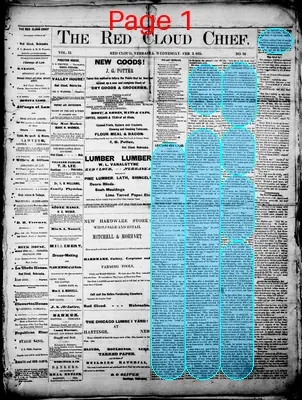
Story
February 3, 1875
The Red Cloud Chief
Red Cloud, Webster County, Nebraska
What is this article about?
Pauline Worthington visits her brother Herbert's home to care for his ill wife Essie, using the opportunity to exaggerate Herbert's fault-finding habits, teaching him to appreciate Essie's efforts and restore their marital harmony.
Clipping
OCR Quality
88%
Good
Full Text
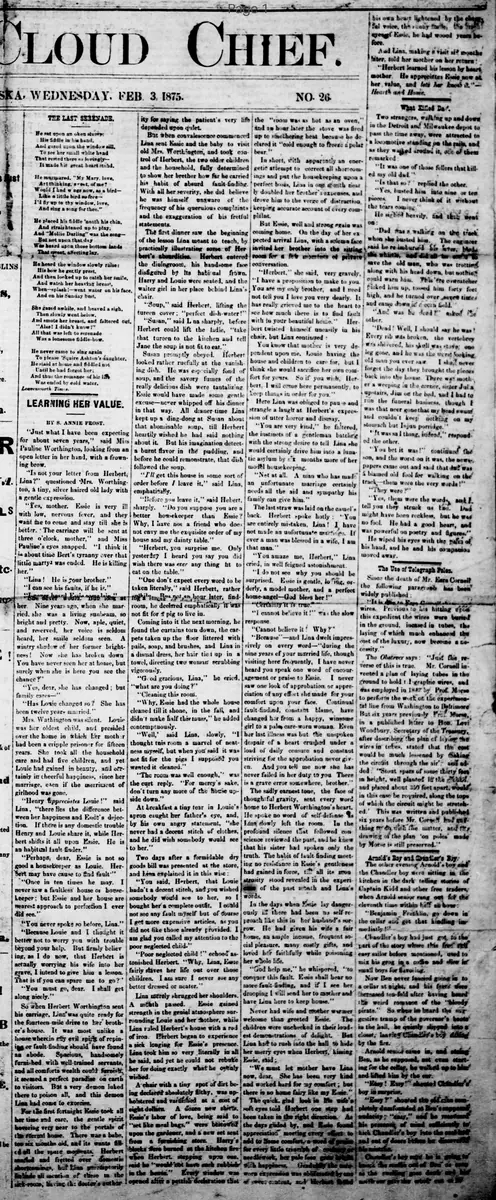
LEARNING HER VALUE.
BY S. ANNIE FROST.
'Just what I have been expecting for about seven years,' said Miss Pauline Worthington, looking from an open letter in her hand, with a frowning brow.
'Is not your letter from Herbert, Lina?' questioned Mrs. Worthington, a tiny, silver haired old lady with a gentle expression.
'Yes, mother. Essie is very ill with low, nervous fever, and they want me to come and stay till she is better. The carriage will be sent at three o'clock, mother,' and Miss Pauline's eyes snapped. 'I think it is about time Bert's tyranny over that little woman was ended. He is killing her.'
'Lina! He is your brother.'
'I can see his faults, if he is.'
'Louisa Dumfries married nine years ago, when she married, she was a living sunbeam, so bright and pretty. Now, pale, quiet, and reserved, her voice is seldom heard, her smile seldom seen. A wintry shadow of her former brightness! Now she has broken down. You have never seen her at home, but surely when she is here you see the change?'
'Yes, dear, she has changed; but family cares—'
'Has Lonie changed so? She has been twelve years married.'
Mrs. Worthington was silent. Lonie was her oldest child, and presided over the home in which her mother had been a cripple prisoner for fifteen years.
She took all the household care and had five children, and yet Louie had gained in beauty, and certainly in cheerful happiness, since her marriage, even if the merriment of girlhood was gone.
'Henry appreciates Louie!' said Lina, 'there lies the difference between her happiness and Essie's dejection. If there is any domestic trouble Henry and Louie share it, while Herbert shifts it all upon Essie. He is an habitual fault finder.'
'Perhaps, dear, Essie is not so good a housekeeper as Louie. Herbert may have cause to find fault.'
'Once in ten times he may. I never saw a faultless house or housekeeper; but Essie and her house are nearest approach to perfection I ever did see.'
'You never spoke so before, Lina.'
'Because Louie and I thought it better not to worry you with trouble beyond your help. But truly believing, as I do now, that Herbert is actually worrying his wife into her grave, I intend to give him a lesson. That is if you can spare me to go?'
'You must go, dear. I shall get along nicely.'
When Herbert Worthington's sister arrived at his carriage, Lina was quite ready for the twenty-mile drive to her brother's house. It was most unlike a house wherein Essie's frail spirit spoke of repose; or fault-finding should have found no abode. Spacious, handsomely furnished, with well-trained servants and all comforts really conducive to happiness, it seemed a perfect paradise on earth to visitors. But a very demon lurked there to poison all, and this demon was Herbert's cold tongue to exercise fault-finding. For the first fortnight Essie took all her time and care, the gentle spirit bearing very near to the portals of the eternal home. There was a babe, but six months old, and its wants filled the measure.
Domestic. Herbert fretted over a domestic r.
But when convalescence commenced Lina sent Essie and the baby to visit old Mrs. Worthington, and took control of Herbert, the two older children and the household, fully determined to show her brother how far he carried his habit of absurd fault-finding.
With all her severity, she did believe he was himself unaware of the frequency of his querulous complaints and the exaggeration of his fretful statements.
The first dinner saw the beginning of the lesson Lina wanted to teach, by practically illustrating some of Herbert's absurdities. Herbert entered the dining-room, his handsome face disfigured by its habitual frown. Harry and Louie were seated, and the waiter girl in her place behind Lina's chair.
Susan promptly obeyed. Herbert looked rather ruefully at the vanishing dish. He was especially fond of soup, and the savory fumes of the really delicious dish were tantalizing. Essie would have made some gentle excuse—never whipped off his dinner in that way. All dinner-time Lina kept up a ding-dong at Susan about that abominable soup, till Herbert heartily wished he had said nothing about it. But his imagination detected a burnt flavor in the pudding, and before he could remonstrate, that dish followed the soup.
'I'll get this house in some sort of order before I leave it,' said Lina, emphatically.
'Before you leave it,' said Herbert, sharply. 'Do you suppose you are a better housekeeper than Essie?
Why, I have not a friend who does not envy me the exquisite order of my house and my dainty table.'
'Herbert, you surprise me. Only yesterday I heard you say you did wish there was ever any thing fit to eat on the table.'
'One don't expect every word to be taken literally,' said Herbert, rather roughly.
An hour later, finding the drawing-room, he declared emphatically it was not fit for a pig to live in. Coming into it the next morning, he found the curtains torn down, the carpets taken up the floor littered with pails, soap, and brushes, and Lina in a dismal dress, her hair tied up in a towel, directing two women scrubbing vigorously.
'Good gracious, Lina,' he cried. 'what are you doing?'
'Cleaning this room. Why, Essie had the whole house cleaned till it shone, in the fall, and didn't make half this muss,' he added contemptuously.
'Well,' said Lina, slowly. 'I thought this room a marvel of neatness myself, but when you said it was not fit for the pigs I supposed you wanted it cleaned.''
'The room was well enough,' was the curt reply. 'For mercy's sake, don't turn any more of the house upside down.'
At breakfast a tiny tear in Louie's apron caught her father's eye, and, by his own angry statement, 'she never had a decent stitch of clothes and he did wish somebody would see to her.'
Two days after a formidable dry goods bill was presented at the store, and Lina explained it in this wise:
'You said, Herbert, that Louie hadn't a decent stitch, and you wished somebody would see to her, so I bought her a complete outfit, I could not see any fault myself but of course I get more expensive articles, as you did not like those already provided. I am glad you called my attention to the poor neglected child.'
'Poor neglected child!' echoed astonished Herbert. 'Why, Lina, Essie fairly slaves her life out over those children. I am sure I never see any better dressed or neater.'
Lina merely shrugged her shoulders.
A month passed. Essie gained strength in the genial atmosphere surrounding Louie and her mother, while Lina ruled Herbert's house with a rod of iron. Herbert began to experience a sick longing for Essie's presence. Lina took him so very literally in all he said, and yet he could not rebuke her for doing exactly what he orally wished.
A chair with a tiny spot of dirt being declared absolutely filthy, was upholstered and varnished at a cost of eight dollars. A dozen new shirts, Essie's labor of love, being said to 'set like meal bags,' were bestowed upon the gardener, and a new set sent from a furnishing store. Harry's blocks were burned at the kitchen fire when Herbert, stepping upon one, said he 'wouldn't have such rubbish in the house.' Every window was opened after a peevish declaration that 'the house was stuffy,' and an hour later the stove was fired up to smothering heat because he declared it 'cold enough to freeze a polar bear.'
In short, with apparently an energetic attempt to correct all shortcomings and put the housekeeping upon a perfect basis, Lina in one month nearly doubled her brother's expenses, and drove him to the verge of distraction, keeping accurate account of every complaint.
But Essie, well and strong again was coming home. On the day of her expected arrival Lina, with a solemn face invited her brother into the sitting room for a few moments of private conversation.
'Herbert,' she said, very gravely. 'I have a proposition to make to you.
You are my only brother, and I need not tell you I love you very dearly. It has really grieved me to the heart to see how much there is to find fault with in your beautiful home.' Herbert twisted himself uneasily in his chair, but Lina continued:
You know that mother is very dependent upon me, Louie having the house and children to care for, but I think she would sacrifice her own comfort for yours. So if you wish, Herbert, I will come here permanently, to keep things in order for you.'
Here Lina was obliged to pause and strangle a laugh at Herbert's expression of utter horror and dismay.
'You are very kind,' he faltered, the instincts of a gentleman battling with the strong desire to tell Lina she would certainly drive him into a lunatic asylum by six months more of her model housekeeping.
'Not at all. A man who has made an unfortunate marriage certainly needs all the aid and sympathy his family can give him.'
The last straw was laid on the camel's back. Herbert spoke hotly: 'You are entirely mistaken, Lina! I have not made an unfortunate marriage. If ever a man was blessed in a wife, I am that man.''
'You amaze me, Herbert,' Lina cried, in well feigned astonishment.
'I do not see why you should be surprised. Essie is gentle, loving, orderly, a model mother, and a perfect home-angel—God bless her!'
'Certainly it is true.'
'I cannot believe it!' was the slow response.
'Cannot believe it! Why?'
'Because'—and Lina dwelt impressively on every word—'during the nine years of your married life, though visiting here frequently, I have never heard you speak one word of encouragement or praise to Essie. I never saw one look of approbation or appreciation of any effort she made for your comfort upon your face. Continual fault-finding, constant blame, have changed her from a happy, winsome girl to a pale, care-worn woman. Even her last illness was but the unspoken despair of a heart crushed under a load of daily censure and constant striving for the approbation never given.
And you try to tell me she has never failed in her duty to you. There is a great error somewhere, brother,'
The kindly meant reproof, the tone of thoughtful charity, sent every word home to Herbert Worthington's heart.
He spoke no word of self-defense. He slowly left the room. In the profound silence that followed upon his sister's departure he made a thorough reviewal the past, and he knew that his sister had spoken only the truth. The habit of fault finding meeting no resistance in Essie's gentleness had gained in force, till all its true atrociousness stood revealed in the experience of the past month and Lina's words.
In the days when she lay dangerously ill there had been no self-reproach like this in her husband's sorrow. He had given his wife a fair home, an ample income, frequent social pleasure, many costly gifts, and loved her faithfully while poisoning her whole life.
'God help me,' he whispered. 'to conquer this fault. Essie shall bear no more fault-finding, and if I see her drooping I will send her to mother and have Lina here to keep house.'
Never had wife and mother warmer welcome than greeted Essie. The children were unchecked in their loudest demonstrations of delight. But Lina had to rush into the hall to hide her merry eyes when Herbert, kissing Essie, said:
'We must let mother have Lina now, dear. She has been very kind and worked hard for my comfort; but there is no home fairy like my Essie.'
The quick, glad look in his wife's soft eyes told Herbert one step had been taken in the right direction. As the days glided by, and Essie found appreciation meeting every effort to add to home comfort, for every little triumph do needlework, her pale face grew bright with happiness. The care-worn expression was obliterated by one of sweet content, and Herbert's own heart lightened by the cheery voice, the sunny smile the eyes of Essie, he had won years before.
And Lina, making a visit six months later, told her mother on her return:
'Herbert learned his lesson by heart mother. He appreciates Essie now at her true value, and lets her know it.'
Hearth and Home.
BY S. ANNIE FROST.
'Just what I have been expecting for about seven years,' said Miss Pauline Worthington, looking from an open letter in her hand, with a frowning brow.
'Is not your letter from Herbert, Lina?' questioned Mrs. Worthington, a tiny, silver haired old lady with a gentle expression.
'Yes, mother. Essie is very ill with low, nervous fever, and they want me to come and stay till she is better. The carriage will be sent at three o'clock, mother,' and Miss Pauline's eyes snapped. 'I think it is about time Bert's tyranny over that little woman was ended. He is killing her.'
'Lina! He is your brother.'
'I can see his faults, if he is.'
'Louisa Dumfries married nine years ago, when she married, she was a living sunbeam, so bright and pretty. Now, pale, quiet, and reserved, her voice is seldom heard, her smile seldom seen. A wintry shadow of her former brightness! Now she has broken down. You have never seen her at home, but surely when she is here you see the change?'
'Yes, dear, she has changed; but family cares—'
'Has Lonie changed so? She has been twelve years married.'
Mrs. Worthington was silent. Lonie was her oldest child, and presided over the home in which her mother had been a cripple prisoner for fifteen years.
She took all the household care and had five children, and yet Louie had gained in beauty, and certainly in cheerful happiness, since her marriage, even if the merriment of girlhood was gone.
'Henry appreciates Louie!' said Lina, 'there lies the difference between her happiness and Essie's dejection. If there is any domestic trouble Henry and Louie share it, while Herbert shifts it all upon Essie. He is an habitual fault finder.'
'Perhaps, dear, Essie is not so good a housekeeper as Louie. Herbert may have cause to find fault.'
'Once in ten times he may. I never saw a faultless house or housekeeper; but Essie and her house are nearest approach to perfection I ever did see.'
'You never spoke so before, Lina.'
'Because Louie and I thought it better not to worry you with trouble beyond your help. But truly believing, as I do now, that Herbert is actually worrying his wife into her grave, I intend to give him a lesson. That is if you can spare me to go?'
'You must go, dear. I shall get along nicely.'
When Herbert Worthington's sister arrived at his carriage, Lina was quite ready for the twenty-mile drive to her brother's house. It was most unlike a house wherein Essie's frail spirit spoke of repose; or fault-finding should have found no abode. Spacious, handsomely furnished, with well-trained servants and all comforts really conducive to happiness, it seemed a perfect paradise on earth to visitors. But a very demon lurked there to poison all, and this demon was Herbert's cold tongue to exercise fault-finding. For the first fortnight Essie took all her time and care, the gentle spirit bearing very near to the portals of the eternal home. There was a babe, but six months old, and its wants filled the measure.
Domestic. Herbert fretted over a domestic r.
But when convalescence commenced Lina sent Essie and the baby to visit old Mrs. Worthington, and took control of Herbert, the two older children and the household, fully determined to show her brother how far he carried his habit of absurd fault-finding.
With all her severity, she did believe he was himself unaware of the frequency of his querulous complaints and the exaggeration of his fretful statements.
The first dinner saw the beginning of the lesson Lina wanted to teach, by practically illustrating some of Herbert's absurdities. Herbert entered the dining-room, his handsome face disfigured by its habitual frown. Harry and Louie were seated, and the waiter girl in her place behind Lina's chair.
Susan promptly obeyed. Herbert looked rather ruefully at the vanishing dish. He was especially fond of soup, and the savory fumes of the really delicious dish were tantalizing. Essie would have made some gentle excuse—never whipped off his dinner in that way. All dinner-time Lina kept up a ding-dong at Susan about that abominable soup, till Herbert heartily wished he had said nothing about it. But his imagination detected a burnt flavor in the pudding, and before he could remonstrate, that dish followed the soup.
'I'll get this house in some sort of order before I leave it,' said Lina, emphatically.
'Before you leave it,' said Herbert, sharply. 'Do you suppose you are a better housekeeper than Essie?
Why, I have not a friend who does not envy me the exquisite order of my house and my dainty table.'
'Herbert, you surprise me. Only yesterday I heard you say you did wish there was ever any thing fit to eat on the table.'
'One don't expect every word to be taken literally,' said Herbert, rather roughly.
An hour later, finding the drawing-room, he declared emphatically it was not fit for a pig to live in. Coming into it the next morning, he found the curtains torn down, the carpets taken up the floor littered with pails, soap, and brushes, and Lina in a dismal dress, her hair tied up in a towel, directing two women scrubbing vigorously.
'Good gracious, Lina,' he cried. 'what are you doing?'
'Cleaning this room. Why, Essie had the whole house cleaned till it shone, in the fall, and didn't make half this muss,' he added contemptuously.
'Well,' said Lina, slowly. 'I thought this room a marvel of neatness myself, but when you said it was not fit for the pigs I supposed you wanted it cleaned.''
'The room was well enough,' was the curt reply. 'For mercy's sake, don't turn any more of the house upside down.'
At breakfast a tiny tear in Louie's apron caught her father's eye, and, by his own angry statement, 'she never had a decent stitch of clothes and he did wish somebody would see to her.'
Two days after a formidable dry goods bill was presented at the store, and Lina explained it in this wise:
'You said, Herbert, that Louie hadn't a decent stitch, and you wished somebody would see to her, so I bought her a complete outfit, I could not see any fault myself but of course I get more expensive articles, as you did not like those already provided. I am glad you called my attention to the poor neglected child.'
'Poor neglected child!' echoed astonished Herbert. 'Why, Lina, Essie fairly slaves her life out over those children. I am sure I never see any better dressed or neater.'
Lina merely shrugged her shoulders.
A month passed. Essie gained strength in the genial atmosphere surrounding Louie and her mother, while Lina ruled Herbert's house with a rod of iron. Herbert began to experience a sick longing for Essie's presence. Lina took him so very literally in all he said, and yet he could not rebuke her for doing exactly what he orally wished.
A chair with a tiny spot of dirt being declared absolutely filthy, was upholstered and varnished at a cost of eight dollars. A dozen new shirts, Essie's labor of love, being said to 'set like meal bags,' were bestowed upon the gardener, and a new set sent from a furnishing store. Harry's blocks were burned at the kitchen fire when Herbert, stepping upon one, said he 'wouldn't have such rubbish in the house.' Every window was opened after a peevish declaration that 'the house was stuffy,' and an hour later the stove was fired up to smothering heat because he declared it 'cold enough to freeze a polar bear.'
In short, with apparently an energetic attempt to correct all shortcomings and put the housekeeping upon a perfect basis, Lina in one month nearly doubled her brother's expenses, and drove him to the verge of distraction, keeping accurate account of every complaint.
But Essie, well and strong again was coming home. On the day of her expected arrival Lina, with a solemn face invited her brother into the sitting room for a few moments of private conversation.
'Herbert,' she said, very gravely. 'I have a proposition to make to you.
You are my only brother, and I need not tell you I love you very dearly. It has really grieved me to the heart to see how much there is to find fault with in your beautiful home.' Herbert twisted himself uneasily in his chair, but Lina continued:
You know that mother is very dependent upon me, Louie having the house and children to care for, but I think she would sacrifice her own comfort for yours. So if you wish, Herbert, I will come here permanently, to keep things in order for you.'
Here Lina was obliged to pause and strangle a laugh at Herbert's expression of utter horror and dismay.
'You are very kind,' he faltered, the instincts of a gentleman battling with the strong desire to tell Lina she would certainly drive him into a lunatic asylum by six months more of her model housekeeping.
'Not at all. A man who has made an unfortunate marriage certainly needs all the aid and sympathy his family can give him.'
The last straw was laid on the camel's back. Herbert spoke hotly: 'You are entirely mistaken, Lina! I have not made an unfortunate marriage. If ever a man was blessed in a wife, I am that man.''
'You amaze me, Herbert,' Lina cried, in well feigned astonishment.
'I do not see why you should be surprised. Essie is gentle, loving, orderly, a model mother, and a perfect home-angel—God bless her!'
'Certainly it is true.'
'I cannot believe it!' was the slow response.
'Cannot believe it! Why?'
'Because'—and Lina dwelt impressively on every word—'during the nine years of your married life, though visiting here frequently, I have never heard you speak one word of encouragement or praise to Essie. I never saw one look of approbation or appreciation of any effort she made for your comfort upon your face. Continual fault-finding, constant blame, have changed her from a happy, winsome girl to a pale, care-worn woman. Even her last illness was but the unspoken despair of a heart crushed under a load of daily censure and constant striving for the approbation never given.
And you try to tell me she has never failed in her duty to you. There is a great error somewhere, brother,'
The kindly meant reproof, the tone of thoughtful charity, sent every word home to Herbert Worthington's heart.
He spoke no word of self-defense. He slowly left the room. In the profound silence that followed upon his sister's departure he made a thorough reviewal the past, and he knew that his sister had spoken only the truth. The habit of fault finding meeting no resistance in Essie's gentleness had gained in force, till all its true atrociousness stood revealed in the experience of the past month and Lina's words.
In the days when she lay dangerously ill there had been no self-reproach like this in her husband's sorrow. He had given his wife a fair home, an ample income, frequent social pleasure, many costly gifts, and loved her faithfully while poisoning her whole life.
'God help me,' he whispered. 'to conquer this fault. Essie shall bear no more fault-finding, and if I see her drooping I will send her to mother and have Lina here to keep house.'
Never had wife and mother warmer welcome than greeted Essie. The children were unchecked in their loudest demonstrations of delight. But Lina had to rush into the hall to hide her merry eyes when Herbert, kissing Essie, said:
'We must let mother have Lina now, dear. She has been very kind and worked hard for my comfort; but there is no home fairy like my Essie.'
The quick, glad look in his wife's soft eyes told Herbert one step had been taken in the right direction. As the days glided by, and Essie found appreciation meeting every effort to add to home comfort, for every little triumph do needlework, her pale face grew bright with happiness. The care-worn expression was obliterated by one of sweet content, and Herbert's own heart lightened by the cheery voice, the sunny smile the eyes of Essie, he had won years before.
And Lina, making a visit six months later, told her mother on her return:
'Herbert learned his lesson by heart mother. He appreciates Essie now at her true value, and lets her know it.'
Hearth and Home.
What sub-type of article is it?
Family Drama
What themes does it cover?
Family
Moral Virtue
What keywords are associated?
Fault Finding
Family Lesson
Marital Appreciation
Housekeeping
Domestic Harmony
What entities or persons were involved?
Pauline Worthington
Herbert Worthington
Essie Worthington
Mrs. Worthington
Lonie Worthington
Henry Worthington
Where did it happen?
Herbert Worthington's House, Twenty Miles From Mrs. Worthington's Home
Story Details
Key Persons
Pauline Worthington
Herbert Worthington
Essie Worthington
Mrs. Worthington
Lonie Worthington
Henry Worthington
Location
Herbert Worthington's House, Twenty Miles From Mrs. Worthington's Home
Story Details
Pauline (Lina) visits her brother Herbert to care for his ill wife Essie, then exaggerates Herbert's fault-finding by taking his complaints literally, leading to chaos and increased expenses, ultimately teaching him to appreciate Essie's perfection as a wife and homemaker, restoring their happiness.