Thank you for visiting SNEWPapers!
Sign up free
The Virginian
Lynchburg, Virginia
What is this article about?
Newspaper article on the controversy involving Commodore Porter's investigation of Lieutenant Abbott's charges of peculation against Captain Hull and Navy Agent Binney at Charlestown, Mass. Abbott's unsubstantiated claims led to his arrest and two-year suspension by court-martial. Porter defends his actions against press accusations of stifling inquiry and intimidating editors, emphasizing justice and press limits. Dated August 1822.
Clipping
OCR Quality
Full Text
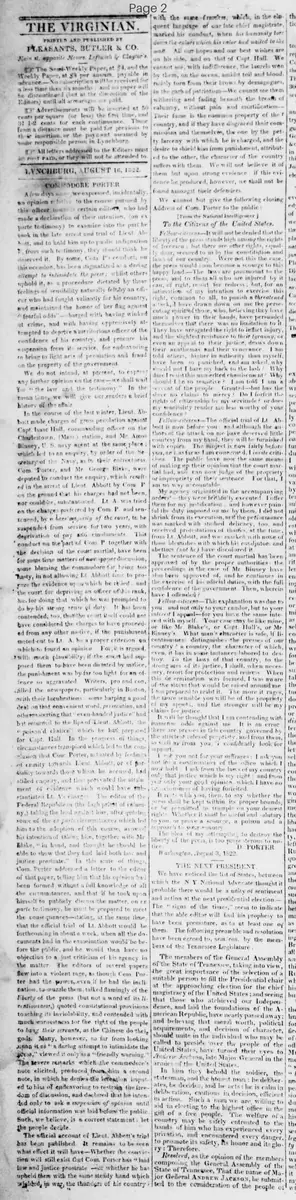
A few days since we expressed, incidentally, an opinion rather to the course pursued by this officer towards certain editors, who had made a declaration of their intention (on ex parte testimony) to examine into the part he took in the late arrest and trial of Lieut Abbott, and to hold him up to public indignation if, from such testimony, they should think he deserved it. By some, Com. Porter's conduct, on this occasion, has been stigmatized as a daring attempt to intimidate the press, whilst others uphold it, as a procedure dictated by those feelings of sensibility naturally felt by an officer who had fought valiantly for his country, and maintained the honor of her flag against "fearful odds"—charged with having winked at crime, and with having oppressively attempted to deprive a meritorious officer of the confidence of his country, and procure his suspension from its service, for endeavoring to bring to light acts of peculation and fraud on the property of the government.
We do not intend, at present, to express any further opinion on the case—we shall wait for "the law and the testimony." In the mean time, we will give our readers a brief history of the affair.
In the course of the last winter, Lieut. Abbott made charges of gross peculation against Capt. Isaac Hull, commanding officer on the Charlestown (Mass.) station, and Mr. Amos Binney, U.S. navy agent at the same place, which led to an enquiry, by order of the Secretary of the Navy, as to their correctness. Com. Porter, and Mr. George Blake, were deputed to conduct the enquiry, which resulted in the arrest of Lieut. Abbott by Com. P. on the ground that his charges had not been nor could be, substantiated. Lt. A. was tried on the charges preferred by Com. P., and sentenced, by a bare majority of the court, to be suspended from service for two years, with deprivation of pay and emoluments. This conduct on the part of Com. P., together with the decision of the court martial, have been for some time matters of newspaper discussion, some blaming the commodore for being too hasty, in not allowing Lt. Abbott time to produce the evidence upon which he relied, and the court for depriving an officer of his rank, &c. for doing that which he was prompted to do by his strong sense of duty. It has been contended, too, that the court itself could not have considered the charges to have proceeded from any other motive, if the punishment meted-out to Lt. A. be a proper criterion on which to found an opinion. For, it is argued, "with much plausibility, if the court had supposed them to have been dictated by malice, the punishment was by far too light for an officer so aggravated." Writers, pro and con, filled the newspapers, particularly in Boston, with their lucubrations; some harping a good deal on that convenient word, persecution, and others asserting that "even-handed justice" had but returned to the lips of Lieut. Abbott, the "poison'd chalice" which he had prepared for Capt. Hull. In the progress of things, circumstances transpired which led to the conclusion that Com. Porter, actuated by feelings of enmity towards Lieut. Abbott, or of partiality towards those whom he accused, had stifled enquiry, and thus prevented the attainment of evidence which would have substantiated Lt. A's charge. The editor of the Federal Republican (the high-priest of calumny,) taking the lead against him, after quoting some of the egregious circumstances which led him to the adoption of this course, avowed his intention of taking him, together with Mr. Blake, "in hand," and that he should be able to show that they had laid both law, and justice prostrate. In this state of things, Com. Porter addressed a letter to the editor of that paper, telling him that his opinion had been formed without a full knowledge of all the circumstances, and that if he took upon himself to publicly discuss the matter, on ex parte testimony, he must be prepared to meet the consequences; stating, at the same time, that the official trial of Lt. Abbott would be forthcoming in about a week, when all the documents had in the examination would be before the public, and he would then have no objection to a just criticism of his agency in the matter. The editors of several papers flew into a violent rage, as though Com. Porter had the power, even if he had the inclination, to muzzle them, talked flamingly of the liberty of the press (but not a word of its licentiousness,) quoted constitutional provisions touching its inviolability, and contended with much earnestness for the right of the people to hang their servants, as the Chinese do their gods. Many, however, so far from looking upon it as "a daring attempt to intimidate the press," viewed it only as a "friendly warning."
The severe remarks which the commodore's note elicited, produced from him a second note, in which he denies the intention imputed to him of endeavoring to restrain the freedom of discussion, and declared that he intended only to ask a suspension of opinion until official information was laid before the public. Such, we believe, is a correct statement: let the people decide.
The official account of Lieut. Abbott's trial has been published. It remains to be seen what effect it will have—Whether the conviction will still exist that Com. Porter has "laid law and justice prostrate"—or whether he has upheld them with the same steady hand which wielded, in war, the thunders of his country; with the same generosity, which, in the eloquent language of our late chief magistrate, marked his conduct, when his humanity tore down the colors which his valor had nailed to the mast. All our hopes and our best wishes are on his side, and on that of Capt. Hull. We cannot see, with indifference, the laurels won by them, on the ocean, amidst toil and blood, rudely torn from their brows by demagogues in the garb of patriotism. We cannot see them withering and fading beneath the breath of calumny, without pain and mortification—Their fame is the common property of the country, and if they have disgraced their commissions and themselves, the one by the petty larceny with which he is charged, and the desire to shield him from punishment, attributed to the other, the character of the country suffers with them. We will not believe it of them but upon strong evidence; if this evidence be produced, however, we shall not be found amongst their defenders.
We cannot but give the following closing Address of Com. Porter to the public:
[From the National Intelligencer]
To the Citizens of the United States.
Fellow-citizens—It will not be denied that the liberty of the press stands high among the rights of freemen, but there are other rights, equally dear, secured to us by the constitution and laws of our country. Were not this the case, the press would soon become a scourge to this happy land—The laws are paramount to the press, and to the man who is injured by it can, of right, resort for redress; but, for an intimation of my intention to exercise this right, common to all, to punish a threatened attack, I have drawn down on me the persecuting spirit of those, who, believing they have much power in their hands, have persuaded themselves that there was no limitation to it. They have arrogated the right to inflict injury and the slightest resistance to their tyranny, or even an appeal to their justice, draws down their anathemas and their vengeance. I am told others, higher in authority than myself, have been so punished, and am asked, why should not I bare my back to the lash? Why dare I resist this unmerited chastisement? Why should I be so sensitive? I am told I am a servant of the people. Granted—but has the slave no claims to mercy? Do I forfeit the rights of citizenship by my servitude? or does my sensibility render me less worthy of your confidence?
Fellow-citizens—The official trial of Lt. Abbott is now before you and although the authors of the attack on me have deserved little courtesy from my hand, they will be furnished with copies. The subject is now fairly before you, and, as far as I am concerned, I invite criticism. The public have now the same means of making up their opinion that the court martial had, and can now judge of the propriety or impropriety of their sentence. For that, I am no way accountable.
My agency originated in the accompanying orders—they were faithfully executed. I offer them for my justification; and however painful the duty imposed on me by them, I did not shrink from its execution, and the performance was marked with studied delicacy, too, and received protestations of thanks, at the time, from Lt. Abbott, and was marked with none of those blemishes with which his coadjutor and abettors (not he) have discolored it.
The sentence of the court martial has been approved of by the proper authorities: the proceedings in the case of Mr. Binney have also been approved of, and he continues in the exercise of his official duties, with the full confidence of the government. Then, wherein have I offended?
Fellow-citizens—This explanation was due to you: and not only to your candor, but to your interest. I appeal—for you have the same interest with myself. Your case may be like mine or like Mr. Blake's, or Capt. Hull's, or Mr. Binney's. What man's character is safe, if licentiousness distinguishes the presses of our country? a country, the character of which, even, it has in some instances labored to destroy. To the laws of that country, to the strong arm of its justice, I shall, when necessary, resort for protection and redress. When this determination was formed, I was aware of the storm that would be raise around me. I am prepared to resist it. The more it rages the more sensible you will be of the propriety of my appeal, and the stronger will be my claim for justice.
It will be thought that I am contending with immense odds against me. It is an error. There are presses in this country governed by the strictest rules of propriety, and from them, as well as from you, I confidently look for support.
I ask you not for your suffrages: I ask you not for a continuation of the office which I now hold. I ask from the laws of my country only that justice which is my right: and from you only your good opinion, which I have no consciousness of having forfeited.
It rests with you, then, to say whether the press shall be kept within its proper bounds, or be permitted to trample on your dearest right. Whether it shall be useful and salutary to you or prove a scourge, a poison and a reproach to your country.
The idea of my attempting to destroy the liberty of the press, is too preposterous to notice.
PORTER
Washington, August 3, 1822
What sub-type of article is it?
What themes does it cover?
What keywords are associated?
What entities or persons were involved?
Where did it happen?
Story Details
Key Persons
Location
Charlestown (Mass.), Boston, Washington
Event Date
Last Winter; August 3, 1822
Story Details
Lieut. Abbott charged Capt. Hull and Mr. Binney with peculation, leading to Navy inquiry by Com. Porter and Mr. Blake. Charges unsubstantiated, resulting in Abbott's arrest, trial, and two-year suspension. Press criticized Porter for hasty action and intimidating editors; Porter defended his conduct in letters and public address, upholding justice and limits on press licentiousness.