Thank you for visiting SNEWPapers!
Sign up free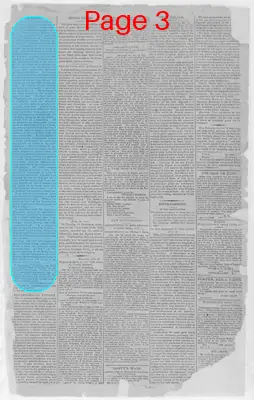
Editorial
January 1, 1814
Daily National Intelligencer
Washington, District Of Columbia
What is this article about?
An editorial comparing the costs, tonnage, profits, and safety of proposed Jersey and Delaware canals, arguing that national funds should invest in the Jersey canal due to higher returns and lower risks, citing Gallatin's report and others.
Clipping

OCR Quality
95%
Excellent
Full Text
ON CANALS.
FOR THE NATIONAL INTELLIGENCER.
In America the time has not yet arrived when canals can be worth the cost of making except for the purpose of opening communications between two extensive pieces of natural navigation, such for instance, as the Chesapeake and the Delaware—the Delaware and the Hudson. As appears from the surveys which have been made, the cost of these two canals would be nearly equal. That across Jersey would be 28 miles long with 100 feet lockage—across the Delaware the length 22 miles and 148 feet of lockage. Calculating, as Mr. Gallatin has done in his report, $20,000 per mile for execution and $125 per foot rise for lockage, the Jersey canal would cost $685,000, the Delaware $625,000. At this time it is perhaps not well ascertained which would cost the most, and for my present purpose it will be nigh enough the truth, to say that each will cost the same sum. The tonnage moving annually through each when made, I cannot admit would be equal. The products of the south arriving in the Delaware, where are they? They have come to Philadelphia, and can follow the river to Lamberton where the navigation ends: all above being fit only for a descending navigation. Arrived in the Hudson how wide the difference! Here is the city of New York and an extensive tide navigation running north of it 160 miles, taking on its way Hudson, Albany, Troy and Lansingburg. All the mountains are now passed, and you move on with facility to Lake Champlain or the great inland seas to the west. And this piece of natural navigation stretches to the east of New York still more extensively. But if it should be admitted that the thoroughfare on each of these canals would be equal, how unequal will the profits to the stockholders be. We are told that the carriage of a barrel of flour across the Delaware isthmus now costs 65 cents, and that on the canal it will cost but 2 cents. Over the Jersey isthmus the price is 150 cents; on the canal it will be, say 2 cents. Now the difference between these will be the nett gain of the canal owners. The Jersey company will (calling 10 barrels a ton) have $14 and 80 cents profit on every ton that passes their canal. The Delaware company $6 and 30 cents per ton. Each canal estimated equal in the tonnage passing and cost of making, yet the profits on the Jersey canal more than double that of the other. This is so plain that it is apparent to every one. If the funds of the nation are going to be invested in canal stock, it is plain where our interest lies. We may expect 12 per cent. on the Jersey stock, before 6 per cent. will be received on that of Delaware.
In comparing these two canals one thing more ought to be mentioned. The cost of repairs on the Jersey Canal will be much below the other on account of the great difference in the lockage. Locks, however well made, continually wear. It is suggested that the summit level may be taken 7 feet lower on the Jersey, leaving the whole lockage on this canal but 86 feet, while the Delaware cannot be made less than 148 feet.
Further reflection will engage the mind of a prudent man, considering in which of these two funds his money would be safest. A 'fort,' says Mr. Latrobe speaking of the Delaware canal, 'would be necessary to defend the mouth of the works against an enemy.' The Jersey canal will be out of the reach of all such danger.
* This peculiarity distinguishes the North river [Hudson] from all the other bays and rivers of the United States. The tide in no other, ascends higher than granite ridge. In the north river it breaks through the Blue Ridge at West Point, and ascends above the eastern termination of the Catskill or great western chain of mountains.
Gallatin's Report, page 40.
The Hon. Mr. Ingersoll's speech in Congress, Dec 29th, 1813.
Gallatin's Report, page 99.
FOR THE NATIONAL INTELLIGENCER.
In America the time has not yet arrived when canals can be worth the cost of making except for the purpose of opening communications between two extensive pieces of natural navigation, such for instance, as the Chesapeake and the Delaware—the Delaware and the Hudson. As appears from the surveys which have been made, the cost of these two canals would be nearly equal. That across Jersey would be 28 miles long with 100 feet lockage—across the Delaware the length 22 miles and 148 feet of lockage. Calculating, as Mr. Gallatin has done in his report, $20,000 per mile for execution and $125 per foot rise for lockage, the Jersey canal would cost $685,000, the Delaware $625,000. At this time it is perhaps not well ascertained which would cost the most, and for my present purpose it will be nigh enough the truth, to say that each will cost the same sum. The tonnage moving annually through each when made, I cannot admit would be equal. The products of the south arriving in the Delaware, where are they? They have come to Philadelphia, and can follow the river to Lamberton where the navigation ends: all above being fit only for a descending navigation. Arrived in the Hudson how wide the difference! Here is the city of New York and an extensive tide navigation running north of it 160 miles, taking on its way Hudson, Albany, Troy and Lansingburg. All the mountains are now passed, and you move on with facility to Lake Champlain or the great inland seas to the west. And this piece of natural navigation stretches to the east of New York still more extensively. But if it should be admitted that the thoroughfare on each of these canals would be equal, how unequal will the profits to the stockholders be. We are told that the carriage of a barrel of flour across the Delaware isthmus now costs 65 cents, and that on the canal it will cost but 2 cents. Over the Jersey isthmus the price is 150 cents; on the canal it will be, say 2 cents. Now the difference between these will be the nett gain of the canal owners. The Jersey company will (calling 10 barrels a ton) have $14 and 80 cents profit on every ton that passes their canal. The Delaware company $6 and 30 cents per ton. Each canal estimated equal in the tonnage passing and cost of making, yet the profits on the Jersey canal more than double that of the other. This is so plain that it is apparent to every one. If the funds of the nation are going to be invested in canal stock, it is plain where our interest lies. We may expect 12 per cent. on the Jersey stock, before 6 per cent. will be received on that of Delaware.
In comparing these two canals one thing more ought to be mentioned. The cost of repairs on the Jersey Canal will be much below the other on account of the great difference in the lockage. Locks, however well made, continually wear. It is suggested that the summit level may be taken 7 feet lower on the Jersey, leaving the whole lockage on this canal but 86 feet, while the Delaware cannot be made less than 148 feet.
Further reflection will engage the mind of a prudent man, considering in which of these two funds his money would be safest. A 'fort,' says Mr. Latrobe speaking of the Delaware canal, 'would be necessary to defend the mouth of the works against an enemy.' The Jersey canal will be out of the reach of all such danger.
* This peculiarity distinguishes the North river [Hudson] from all the other bays and rivers of the United States. The tide in no other, ascends higher than granite ridge. In the north river it breaks through the Blue Ridge at West Point, and ascends above the eastern termination of the Catskill or great western chain of mountains.
Gallatin's Report, page 40.
The Hon. Mr. Ingersoll's speech in Congress, Dec 29th, 1813.
Gallatin's Report, page 99.
What sub-type of article is it?
Infrastructure
Economic Policy
What keywords are associated?
Canals
Jersey Canal
Delaware Canal
Infrastructure Investment
Canal Profits
Gallatin Report
What entities or persons were involved?
Mr. Gallatin
Mr. Latrobe
Hon. Mr. Ingersoll
Jersey Company
Delaware Company
National Intelligencer
Editorial Details
Primary Topic
Comparison Of Jersey And Delaware Canals For Investment
Stance / Tone
Advocates Investment In Jersey Canal Over Delaware For Higher Profits And Safety
Key Figures
Mr. Gallatin
Mr. Latrobe
Hon. Mr. Ingersoll
Jersey Company
Delaware Company
National Intelligencer
Key Arguments
Costs Of Jersey And Delaware Canals Are Nearly Equal
Tonnage Through Jersey Canal Likely Higher Due To Hudson Navigation Advantages
Profits For Jersey Canal Stockholders More Than Double Those For Delaware
Repairs Cheaper For Jersey Due To Less Lockage
Jersey Canal Safer From Enemy Attack