Thank you for visiting SNEWPapers!
Sign up free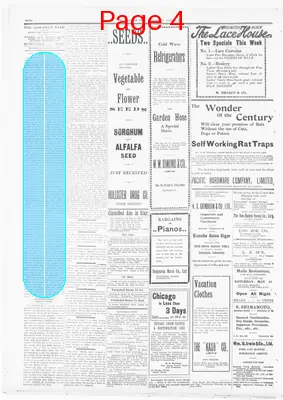
Story
June 18, 1902
The Hawaiian Star
Honolulu, Honolulu County, Hawaii
What is this article about?
Article by P. Austin observes the rising consumption of tropical products like sugar, coffee, fruits, and rubber in the US from 1870 to 1901, shifting from luxuries to necessities, and predicts self-sufficiency through developing territories like Philippines and Porto Rico.
Clipping

OCR Quality
98%
Excellent
Full Text
OUR TROPICAL PRODUCTS
In the Forum P. Austin writes that the increasing contributions of the tropics to the comforts and requirements of daily life among the people of the United States must have been observed by every thoughtful individual who compares the well-supplied table of today with that of a quarter of a century ago or contrasts the surroundings of his home or the conveniences of daily life with those of earlier years.
Tropical and sub-tropical fruits are now the ordinary accompaniments of the table, and in the hands and mouths of the very urchins upon the streets.
Sugar and coffee and tea and cacao, which by earlier generations were considered luxuries, are now necessities of daily life everywhere. The average consumption of sugar, which in the year 1870 was in the United States thirty-three pounds per capita, was in 1901 sixty-eight pounds per capita, and the quantity of coffee consumed has increased from six pounds per capita per annum in 1870 to nearly twelve pounds per capita in 1901; that of cacao is six times as great per capita as in 1870, while that of tea is still as great per capita as in 1870 despite the great increase in the use of coffee and cacao.
Silks and satins, which were luxuries only a generation or two ago, are now considered a necessary part of the wardrobes of a large share of the population. India rubber, which a generation ago was almost unknown is now utilized everywhere for clothing, for household requirements, for machinery and even for the tires of our carriages.
The increase in consumption of tropical articles and products will continue as long as the prosperity of the United States continues. We have by no means a supply of tropical products within our own borders equal to the demand, our beet sugar industry is in embryo, the amount of cane sugar to be brought from the Philippines will be restricted by the land laws which prevent the industry being carried on in an extended scale. All this is good for ourselves for Porto Rico and the Danish West Indies if we ever acquire them.
Our sugar and Porto Rican sugar will have a much better show now that the sugar bounty system is done away with in Germany. It will strengthen the sugar market immensely. But our coffee production will have to be fostered.
The United States aims with the aid of the beet manufacture to supply the home market entirely. Its next aim will be to so foster the coffee industry among its tropical islands that coffee will be largely raised within the boundaries of the United States.
The tropical islands which have devoted themselves to mainly one crop, will, under the persistent urging of the United States, develop many industries. We shall have vanilla, cacao and other products added to our output, and the other tropical islands will take up these industries with more earnestness than formerly. Our industries will need protection, and it will be realized that the strongest protection should be given to the tropical territories and possessions.
There is no reason why tea should not be grown here, nor why it should not be made a success of in the Philippines. There must be tracts there which would be of the greatest value as tea lands.
The United States has now some wonderful assets in the shape of tropical islands of phenomenal fertility. Her citizens have shown themselves eager and willing to develop these lands. They are developed here, they are fairly developed in Porto Rico and they will be developed in the Philippines.
The time is coming when the United States will raise its tropical products within its own borders. We have before us the most wonderful possibility of being the first commercial country, the first agricultural and pasturing country, and finally the most advanced country for tropical products in the world. It is a glorious prospect.
In the Forum P. Austin writes that the increasing contributions of the tropics to the comforts and requirements of daily life among the people of the United States must have been observed by every thoughtful individual who compares the well-supplied table of today with that of a quarter of a century ago or contrasts the surroundings of his home or the conveniences of daily life with those of earlier years.
Tropical and sub-tropical fruits are now the ordinary accompaniments of the table, and in the hands and mouths of the very urchins upon the streets.
Sugar and coffee and tea and cacao, which by earlier generations were considered luxuries, are now necessities of daily life everywhere. The average consumption of sugar, which in the year 1870 was in the United States thirty-three pounds per capita, was in 1901 sixty-eight pounds per capita, and the quantity of coffee consumed has increased from six pounds per capita per annum in 1870 to nearly twelve pounds per capita in 1901; that of cacao is six times as great per capita as in 1870, while that of tea is still as great per capita as in 1870 despite the great increase in the use of coffee and cacao.
Silks and satins, which were luxuries only a generation or two ago, are now considered a necessary part of the wardrobes of a large share of the population. India rubber, which a generation ago was almost unknown is now utilized everywhere for clothing, for household requirements, for machinery and even for the tires of our carriages.
The increase in consumption of tropical articles and products will continue as long as the prosperity of the United States continues. We have by no means a supply of tropical products within our own borders equal to the demand, our beet sugar industry is in embryo, the amount of cane sugar to be brought from the Philippines will be restricted by the land laws which prevent the industry being carried on in an extended scale. All this is good for ourselves for Porto Rico and the Danish West Indies if we ever acquire them.
Our sugar and Porto Rican sugar will have a much better show now that the sugar bounty system is done away with in Germany. It will strengthen the sugar market immensely. But our coffee production will have to be fostered.
The United States aims with the aid of the beet manufacture to supply the home market entirely. Its next aim will be to so foster the coffee industry among its tropical islands that coffee will be largely raised within the boundaries of the United States.
The tropical islands which have devoted themselves to mainly one crop, will, under the persistent urging of the United States, develop many industries. We shall have vanilla, cacao and other products added to our output, and the other tropical islands will take up these industries with more earnestness than formerly. Our industries will need protection, and it will be realized that the strongest protection should be given to the tropical territories and possessions.
There is no reason why tea should not be grown here, nor why it should not be made a success of in the Philippines. There must be tracts there which would be of the greatest value as tea lands.
The United States has now some wonderful assets in the shape of tropical islands of phenomenal fertility. Her citizens have shown themselves eager and willing to develop these lands. They are developed here, they are fairly developed in Porto Rico and they will be developed in the Philippines.
The time is coming when the United States will raise its tropical products within its own borders. We have before us the most wonderful possibility of being the first commercial country, the first agricultural and pasturing country, and finally the most advanced country for tropical products in the world. It is a glorious prospect.
What sub-type of article is it?
Historical Event
What themes does it cover?
Triumph
Exploration
Fortune Reversal
What keywords are associated?
Tropical Products
Sugar Consumption
Coffee
Us Territories
Economic Development
Philippines
Porto Rico
What entities or persons were involved?
P. Austin
Where did it happen?
United States
Story Details
Key Persons
P. Austin
Location
United States
Event Date
1870 To 1901
Story Details
P. Austin discusses the transformation of tropical products from luxuries to daily necessities in the US, with statistics on consumption increases, and envisions future self-sufficiency via development of tropical territories like the Philippines and Porto Rico.