Thank you for visiting SNEWPapers!
Sign up free
Story
October 15, 1830
Phenix Gazette
Alexandria, Virginia
What is this article about?
Article explores diverse national culinary tastes, from eating monkeys and centipedes in South America to rotten eggs in Cochin-China, and personal antipathies like aversions to cats, apples, or roses, including health effects from smells and cosmetics.
Clipping
OCR Quality
98%
Excellent
Full Text
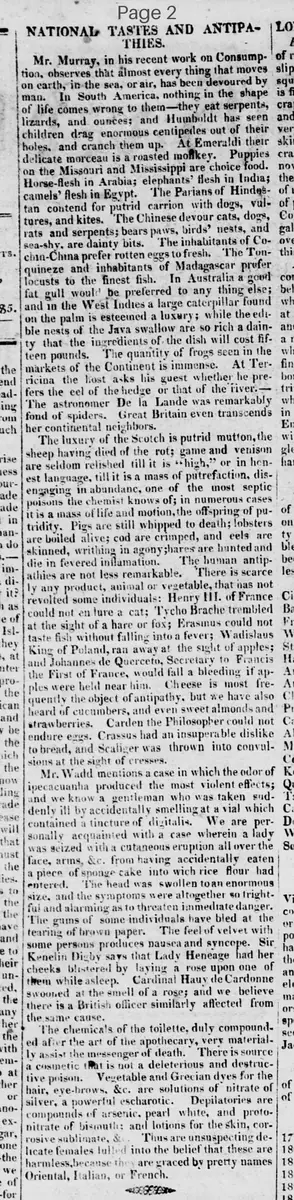
NATIONAL TASTES AND ANTIPATHIES.
Mr. Murray, in his recent work on Consumption, observes that almost every thing that moves on earth, in the sea, or air, has been devoured by man. In South America, nothing in the shape of life comes amiss to them--they eat serpents, lizards, and ounces; and Humboldt has seen children drag enormous centipedes out of their holes, and crunch them up. At Emeralds their delicate morceau is a roasted monkey. Puppies on the Missouri and Mississippi are choice food. Horse-flesh in Arabia; elephants' flesh in India; camels' flesh in Egypt. The Pariahs of Hindoostan contend for putrid carrion with dogs, vultures, and kites. The Chinese devour cats, dogs, rats and serpents; bears paws, birds' nests, and sea-slug, are dainty bits. The inhabitants of Cochin-China prefer rotten eggs to fresh. The Tonguese and inhabitants of Madagascar prefer locusts to the finest fish. In Australia a good fat gull would be preferred to any thing else; and in the West Indies a large caterpillar found on the palm is esteemed a luxury; while the edible nests of the Java swallow are so rich a dainty that the ingredients of the dish will cost fifteen pounds. The quantity of frogs seen in the markets of the Continent is immense. At Terracina the host asks his guest whether he prefers the eel of the hedge or that of the river.--The astronomer De la Lande was remarkably fond of spiders. Great Britain even transcends her continental neighbors.
The luxury of the Scotch is putrid mutton, the sheep having died of the rot; game and venison are seldom relished till it is "high," or in honest language, till it is a mass of putrefaction, disgorging in abundance, one of the most septic poisons the chemist knows of; in numerous cases it is a mass of life and motion, the offspring of putridity. Pigs are still whipped to death; lobsters are boiled alive; cod are crimped, and eels are skinned, writhing in agony; hares are hunted and die in fevered inflammation. The human antipathies are not less remarkable. There is scarcely any product, animal or vegetable, that has not revolted some individuals: Henry III. of France could not endure a cat: Tycho Brahe trembled at the sight of a hare or fox; Erasmus could not taste fish without falling into a fever; Wladislaus King of Poland, ran away at the sight of apples; and Johannes de Querceto, Secretary to Francis the First of France, would fall a bleeding if apples were held near him. Cheese is most frequently the object of antipathy, but we have also heard of cucumbers, and even sweet almonds and strawberries. Cardan the Philosopher could not endure eggs. Crassus had an insuperable dislike to bread, and Scaliger was thrown into convulsions at the sight of cresses.
Mr. Wadd mentions a case in which the odor of ipecacuanha produced the most violent effects; and we know a gentleman who was taken suddenly ill by accidentally smelling at a vial which contained a tincture of digitalis. We are personally acquainted with a case wherein a lady was seized with a cutaneous eruption all over the face, arms, &c. from having accidentally eaten a piece of sponge cake into which rice flour had entered. The head was swollen to an enormous size, and the symptoms were altogether so frightful and alarming as to threaten immediate danger. The gums of some individuals have bled at the tearing of brown paper. The feel of velvet with some persons produces nausea and syncope. Sir Kenelm Digby says that Lady Heneage had her cheeks blistered by laying a rose upon one of them while asleep. Cardinal Haut de Cardonne swooned at the smell of a rose: and we believe there is a British officer similarly affected from the same cause.
The chemicals of the toilette, duly compounded after the art of the apothecary, very materially assist the messenger of death. There is scarce a cosmetic that is not a deleterious and destructive poison. Vegetable and Grecian dyes for the hair, eye-brows, &c. are solutions of nitrate of silver, a powerful escharotic. Depilatories are compounds of arsenic, pearl white, and proto-nitrate of bismuth: and lotions for the skin, corrosive sublimate, &c. Thus are unsuspecting delicate females lulled into the belief that these are harmless, because they are graced by pretty names--Oriental, Italian, or French.
Mr. Murray, in his recent work on Consumption, observes that almost every thing that moves on earth, in the sea, or air, has been devoured by man. In South America, nothing in the shape of life comes amiss to them--they eat serpents, lizards, and ounces; and Humboldt has seen children drag enormous centipedes out of their holes, and crunch them up. At Emeralds their delicate morceau is a roasted monkey. Puppies on the Missouri and Mississippi are choice food. Horse-flesh in Arabia; elephants' flesh in India; camels' flesh in Egypt. The Pariahs of Hindoostan contend for putrid carrion with dogs, vultures, and kites. The Chinese devour cats, dogs, rats and serpents; bears paws, birds' nests, and sea-slug, are dainty bits. The inhabitants of Cochin-China prefer rotten eggs to fresh. The Tonguese and inhabitants of Madagascar prefer locusts to the finest fish. In Australia a good fat gull would be preferred to any thing else; and in the West Indies a large caterpillar found on the palm is esteemed a luxury; while the edible nests of the Java swallow are so rich a dainty that the ingredients of the dish will cost fifteen pounds. The quantity of frogs seen in the markets of the Continent is immense. At Terracina the host asks his guest whether he prefers the eel of the hedge or that of the river.--The astronomer De la Lande was remarkably fond of spiders. Great Britain even transcends her continental neighbors.
The luxury of the Scotch is putrid mutton, the sheep having died of the rot; game and venison are seldom relished till it is "high," or in honest language, till it is a mass of putrefaction, disgorging in abundance, one of the most septic poisons the chemist knows of; in numerous cases it is a mass of life and motion, the offspring of putridity. Pigs are still whipped to death; lobsters are boiled alive; cod are crimped, and eels are skinned, writhing in agony; hares are hunted and die in fevered inflammation. The human antipathies are not less remarkable. There is scarcely any product, animal or vegetable, that has not revolted some individuals: Henry III. of France could not endure a cat: Tycho Brahe trembled at the sight of a hare or fox; Erasmus could not taste fish without falling into a fever; Wladislaus King of Poland, ran away at the sight of apples; and Johannes de Querceto, Secretary to Francis the First of France, would fall a bleeding if apples were held near him. Cheese is most frequently the object of antipathy, but we have also heard of cucumbers, and even sweet almonds and strawberries. Cardan the Philosopher could not endure eggs. Crassus had an insuperable dislike to bread, and Scaliger was thrown into convulsions at the sight of cresses.
Mr. Wadd mentions a case in which the odor of ipecacuanha produced the most violent effects; and we know a gentleman who was taken suddenly ill by accidentally smelling at a vial which contained a tincture of digitalis. We are personally acquainted with a case wherein a lady was seized with a cutaneous eruption all over the face, arms, &c. from having accidentally eaten a piece of sponge cake into which rice flour had entered. The head was swollen to an enormous size, and the symptoms were altogether so frightful and alarming as to threaten immediate danger. The gums of some individuals have bled at the tearing of brown paper. The feel of velvet with some persons produces nausea and syncope. Sir Kenelm Digby says that Lady Heneage had her cheeks blistered by laying a rose upon one of them while asleep. Cardinal Haut de Cardonne swooned at the smell of a rose: and we believe there is a British officer similarly affected from the same cause.
The chemicals of the toilette, duly compounded after the art of the apothecary, very materially assist the messenger of death. There is scarce a cosmetic that is not a deleterious and destructive poison. Vegetable and Grecian dyes for the hair, eye-brows, &c. are solutions of nitrate of silver, a powerful escharotic. Depilatories are compounds of arsenic, pearl white, and proto-nitrate of bismuth: and lotions for the skin, corrosive sublimate, &c. Thus are unsuspecting delicate females lulled into the belief that these are harmless, because they are graced by pretty names--Oriental, Italian, or French.
What sub-type of article is it?
Curiosity
Medical Curiosity
What themes does it cover?
Social Manners
Misfortune
What keywords are associated?
National Tastes
Unusual Foods
Personal Antipathies
Cultural Delicacies
Food Aversions
Poisonous Cosmetics
What entities or persons were involved?
Mr. Murray
Humboldt
De La Lande
Henry Iii. Of France
Tycho Brahe
Erasmus
Wladislaus King Of Poland
Johannes De Querceto
Cardan
Crassus
Scaliger
Mr. Wadd
Sir Kenelm Digby
Lady Heneage
Cardinal Haut De Cardonne
Where did it happen?
South America, Missouri And Mississippi, Arabia, India, Egypt, Hindoostan, China, Cochin China, Madagascar, Australia, West Indies, Java, Continent, Terracina, Great Britain, Scotland
Story Details
Key Persons
Mr. Murray
Humboldt
De La Lande
Henry Iii. Of France
Tycho Brahe
Erasmus
Wladislaus King Of Poland
Johannes De Querceto
Cardan
Crassus
Scaliger
Mr. Wadd
Sir Kenelm Digby
Lady Heneage
Cardinal Haut De Cardonne
Location
South America, Missouri And Mississippi, Arabia, India, Egypt, Hindoostan, China, Cochin China, Madagascar, Australia, West Indies, Java, Continent, Terracina, Great Britain, Scotland
Story Details
The article details unusual foods consumed in various cultures worldwide and personal antipathies causing physical reactions, warning about poisonous cosmetics.