Thank you for visiting SNEWPapers!
Sign up free
The Patowmac Guardian, And Berkeley Advertiser
Martinsburg, Shepherdstown, Berkeley County, Jefferson County, West Virginia
What is this article about?
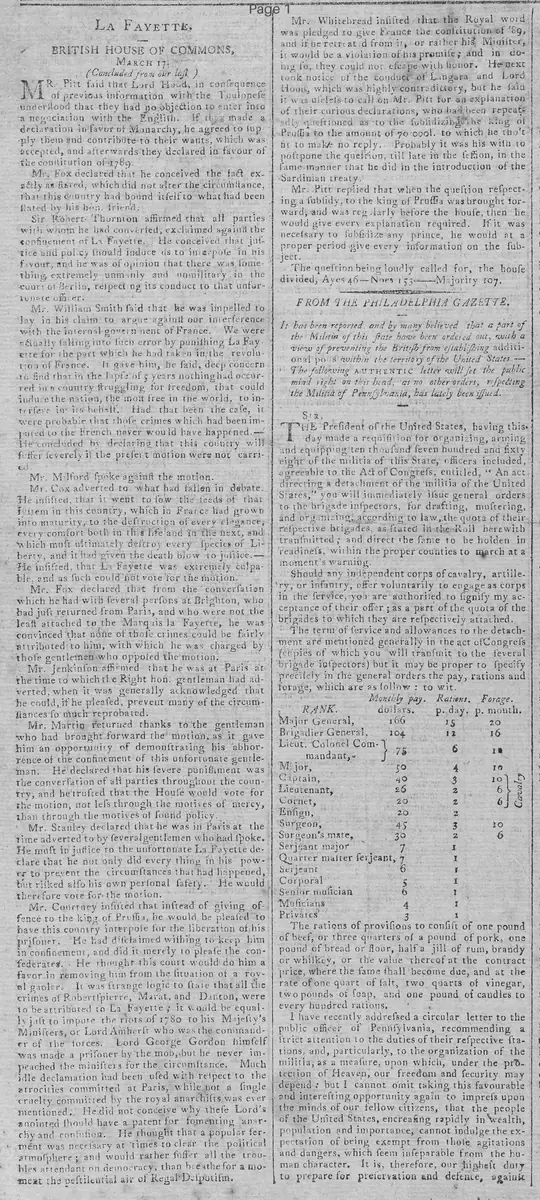
On March 17, the British House of Commons debated intervening to free the Marquis de Lafayette from Prussian imprisonment over his French Revolution role. MPs like Fox and Courtney supported the motion, citing mercy and policy, while others opposed, blaming him for revolutionary excesses. No vote outcome reported.
Clipping
OCR Quality
Full Text
BRITISH HOUSE OF COMMONS,
MARCH 17.
(Concluded from our last.)
Mr. H understood that they had no objection to enter into
a negociation with the English. If they made a
declaration in favor of Monarchy, he agreed to sup-
ply them and contribute to their wants, which was
accepted, and afterwards they declared in favour of
the constitution of 1789.
Mr. Fox declared that he conceived the fact ex-
actly as stated, which did not alter the circumstance
that this country had bound itself to what had been
stated by his hon. friend.
Sir Robert Thornton affirmed that all parties
with whom he had conversed, exclaimed against the
confinement of La Fayette. He conceived that jus-
tice and policy should induce us to interpose in his
favour, and he was of opinion that there was some-
thing extremely unmanly and unmilitary in the
court of Berlin, respecting its conduct to that unfor-
tunate officer.
Mr. William Smith said that he was impelled to
lay in his claim to argue against our interference
with the internal government of France. We were
actually falling into such error by punishing La Fay-
ette for the part which he had taken in the revolu-
tion of France. It gave him, he said, deep concern
to find that in the lapse of 5 years nothing had occur-
red in a country struggling for freedom, that could
induce the nation, the most free in the world, to in-
terfere in its behalf. Had that been the case, it
were probable that those crimes which had been im-
puted to the French never would have happened.
He concluded by declaring that this country will
suffer severely if the present motion were not carri-
ed.
Mr. Milf ord spoke against the motion.
Mr. Cox adverted to what had fallen in debate.
He insisted that it went to sow the seeds of that
system in this country, which in France had grown
into maturity, to the destruction of every elegance,
every comfort both in this life and in the next, and
which most ultimately destroy every species of Li-
berty, and it had given the death blow to justice.
He insisted that La Fayette was extremely culpa-
ble, and as such could not vote for the motion.
Mr. Fox declared that from the conversation
which he had with several persons at Brighton, who
had just returned from Paris, and who were not the
least attached to the Marquis la Fayette, he was
convinced that none of those crimes could be fairly
attributed to him, with which he was charged by
those gentlemen who opposed the motion.
Mr. Jenkinson affirmed that he was at Paris at
the time to which the Right hon. gentleman had ad-
verted, when it was generally acknowledged that
he could, if he pleased, prevent many of the circum-
stances so much reprobated.
Mr. Martin returned thanks to the gentleman
who had brought forward the motion, as it gave
him an opportunity of demonstrating his abhor-
rence of the confinement of this unfortunate gentle-
man. He declared that his severe punishment was
the conversation of all parties throughout the coun-
try, and he trusted that the House would vote for
the motion, not less through the motives of mercy,
than through the motives of sound policy.
Mr. Stanley declared that he was in Paris at the
time adverted to by several gentlemen who had spoke.
He must in justice to the unfortunate La Fayette de-
clare that he not only did every thing in his pow-
er to prevent the circumstances that had happened,
but risked also his own personal safety. He would
therefore vote for the motion.
Mr. Courtney insisted that instead of giving of-
fence to the king of Prussia, he would be pleased to
have this country interpose for the liberation of his
prisoner. He had disclaimed wishing to keep him
in confinement, and did it merely to please the con-
federates. He thought this court would do him a
favor in removing him from the situation of a roy-
al gaoler. It was strange logic to state that all the
crimes of Robespierre, Marat, and Danton, were
to be attributed to La Fayette; it would be equal-
ly just to impute the riots of 1780 to his Majesty's
Ministers, or Lord Amherst who was the command-
er of the forces. Lord George Gordon himself
was made a prisoner by the mob, but he never im-
peached the ministers for the circumstance. Much
idle declamation had been used with respect to the
atrocities committed at Paris, while not a single
cruelty committed by the royal anarchists was ever
mentioned. He did not conceive why these Lord's
anointed should have a patent for fomenting anar-
chy and confusion. He thought that a popular fer-
ment was necessary at times to clear the political
atmosphere; and would rather suffer all the trou-
bles attendant on democracy, than breathe for a mo-
ment the pestilential air of Regal Despotism.
What sub-type of article is it?
What keywords are associated?
What entities or persons were involved?
Where did it happen?
Foreign News Details
Primary Location
France
Event Date
March 17
Key Persons
Event Details
Debate in the British House of Commons on a motion to interpose for the release of La Fayette from Prussian confinement. Speakers including Mr. Fox, Sir Robert Thornton, Mr. William Smith, Mr. Milford, Mr. Cox, Mr. Jenkinson, Mr. Martin, Mr. Stanley, and Mr. Courtney argued for and against intervention, discussing La Fayette's role in the French Revolution, alleged crimes, and Britain's policy toward France.