Thank you for visiting SNEWPapers!
Sign up free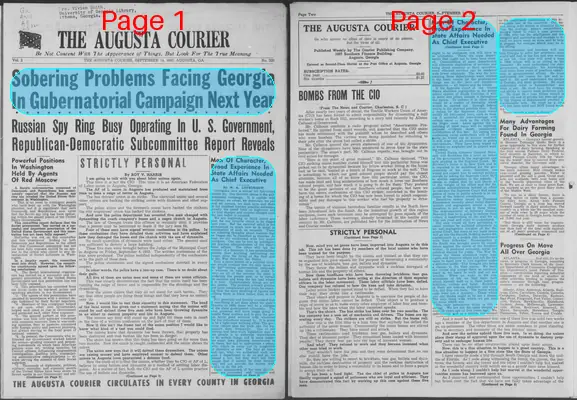
The Augusta Courier
Augusta, Richmond County, Georgia
What is this article about?
Editorial by W. A. LUF BURROW discusses sobering challenges for Georgia's 1954 gubernatorial campaign, including state fiscal crisis requiring efficient administration and potential Supreme Court abolition of school segregation, urging election of a experienced, integrity-driven governor to navigate changes.
Merged-components note: Continuation of the gubernatorial campaign story from page 1 to page 2; relabeled the continuation from 'editorial' to 'story' as it continues the narrative article on state politics.
Clippings
1 of 2
OCR Quality
Full Text
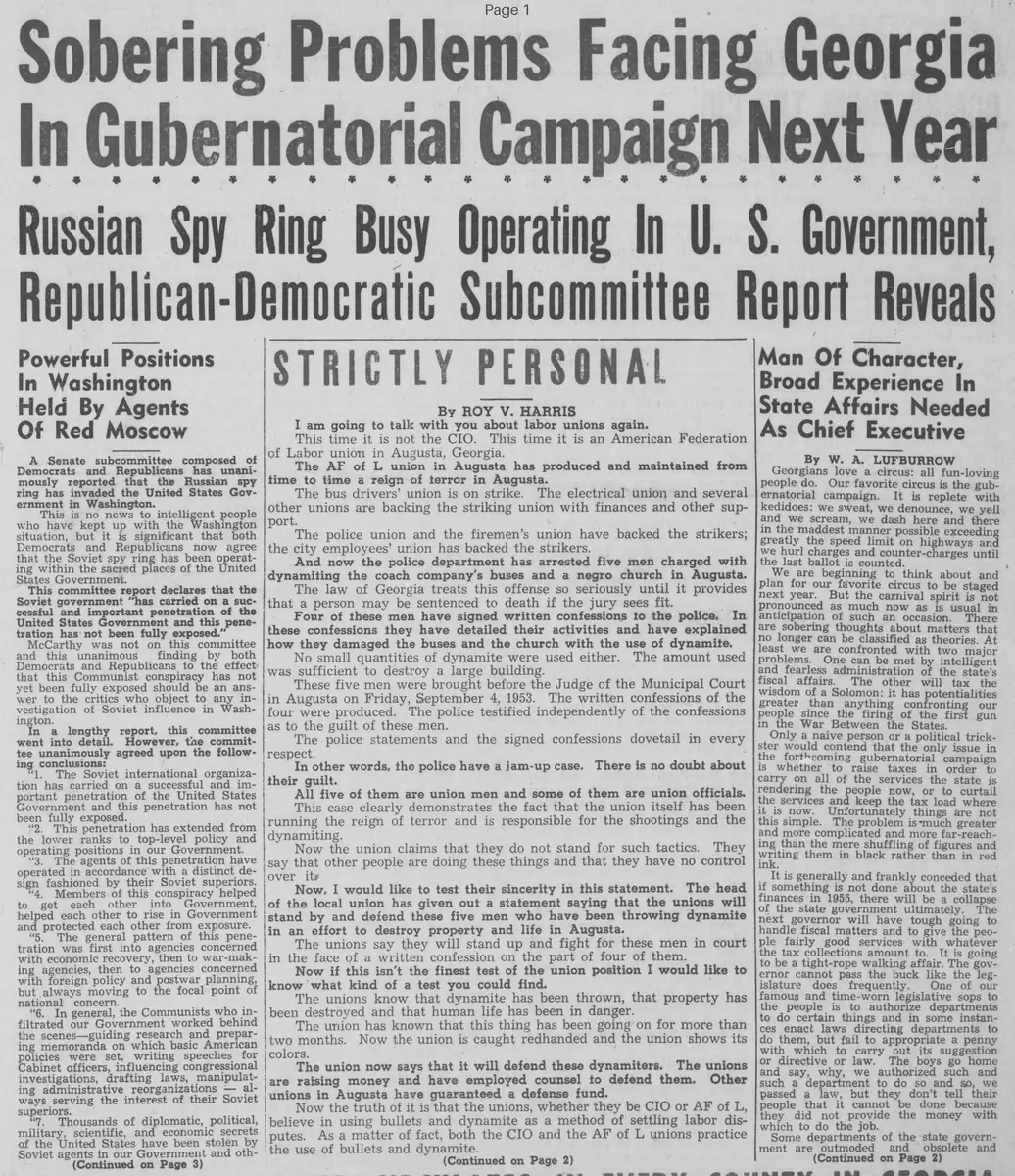
Man Of Character Broad Experience In State Affairs Needed As Chief Executive
By W. A. LUFBURROW
Georgians love a circus: all fun-loving people do. Our favorite circus is the gubernatorial campaign. It is replete with kedidoes: we sweat, we denounce, we yell and we scream, we dash here and there in the maddest manner possible exceeding greatly the speed limit on highways and we hurl charges and counter-charges until the last ballot is counted.
We are beginning to think about and plan for our favorite circus to be staged next year. But the carnival spirit is not pronounced as much now as is usual in anticipation of such an occasion. There are sobering thoughts about matters that no longer can be classified as theories. At least we are confronted with two major problems. One can be met by intelligent and fearless administration of the state's fiscal affairs. The other will tax the wisdom of a Solomon: it has potentialities greater than anything confronting our people since the firing of the first gun in the War Between the States.
Only a naive person or a political trickster would contend that the only issue in the forthcoming gubernatorial campaign is whether to raise taxes in order to carry on all of the services the state is rendering the people now, or to curtail the services and keep the tax load where it is now. Unfortunately things are not this simple. The problem is much greater and more complicated and more far-reaching than the mere shuffling of figures and writing them in black rather than in red ink.
It is generally and frankly conceded that if something is not done about the state's finances in 1955, there will be a collapse of the state government ultimately. The next governor will have tough going to handle fiscal matters and to give the people fairly good services with whatever the tax collections amount to. It is going to be a tight-rope walking affair. The governor cannot pass the buck like the legislature does frequently. One of our famous and time-worn legislative sops to the people is to authorize departments to do certain things and in some instances enact laws directing departments to do them, but fail to appropriate a penny with which to carry out its suggestion or directive or law. The boys go home and say, why, we authorized such and such a department to do so and so, we passed a law, but they don't tell their people that it cannot be done because they did not provide the money with which to do the job.
Some departments of the state government are outmoded and obsolete and
(Continued on Page 2)
Man Of Character, Broad Experience In State Affairs Needed As Chief Executive
(Continued from Page 1)
ought to be abolished, and will have to be ultimately.
There are some departments that ought not to have been created. Consolidation of some departments will eliminate duplication of services and bring about economy in their operation: more efficient services can be rendered with fewer employees. The way the laws creating these departments were written is the basic reason for the predicament things are in: the laws are legislative dinosaurs — all bodies and no brains.
If the Supreme Court of the United States abolishes segregation in the public school system of South Carolina, it will, in force and effect, abolish it throughout the nation. To enforce it in other states would be a matter of formality which would be carried out through federal courts in the shortest possible time. Such a ruling by the Supreme Court would nullify all anti-racial laws, such as making it unlawful for inter-marriage with certain races - such as the white and the Negro races. Laws against the co-habiting of these races will be nullified: physical evidence shows considerable nullification of this law. All zoning laws containing racial restrictions will of necessity be wiped out or severely modified.
It will wipe out all restrictions in public conveyances. They have been wiped out in travel on airplanes and in airport waiting rooms.
United States Attorney General Brownell will doubtless file a brief on behalf of the government in the segregation case now pending in the Supreme Court. Mr. Brownell's home is in New York and he is reported to be ambitious for the governorship of his state; therefore, one would not expect him to commit political suicide by asking the Supreme Court NOT to abolish segregation in the schools. It stands to reason that he will throw all of the weight of his office and the Republican administration behind an effort to convince the Supreme Court that segregation of races in public schools is in violation of the federal constitution.
Executive orders issued by President Eisenhower recently about racial discrimination and segregation reveal a determination to put an end to these things.
The announcement of Attorney General Brownell that he is going to enforce these orders, is handwriting on the wall for all who can read and want to understand.
Not only would all laws pertaining to racial matters be nullified ultimately by an anti-segregation decision of the Supreme Court, but some of our basic mores will go into the discard. Nothing nurses discontentment in a people like interference with their folkways. Emancipation in the South was brought about by outside forces against the mores of the Southern whites. It produced economic, social and political discord for years. The War Between the States abolished many legal rights and imposed others and left the two races to learn how to live together under a different order. This brought into being a change in the then mores. We learn our mores and accept them as unconsciously as we learn to walk and eat and breathe. When we wake to the consciousness of life we find them facts which already hold us in their bonds of tradition, custom and habit. Embodied in them are notions, doctrines and maxims, but they are facts. The mores which once were are a memory. Those which any one thinks ought to be are a dream.
The only thing with which we can deal are those which are.
The only permanent thing in life is change. We are not the same people we were 20 years ago or five years ago. We, individually and as a nation, are subject to the impersonal functioning of this irrevocable law of the universe. Our nation, along with others, is changing faster than the average person comprehends.
Georgia needs to elect a man governor in 1954, who has the intelligence and the integrity and leadership and courage to do what we know must be done and to help us prepare for changes which may be in the offing.
Hotheadedness and bombast will not help Georgia to solve her problems: such would add fuel to the fire and woe would be our lot. Our state will need a man in 1955 whose will is as strong as his character. He must understand our state government thoroughly: his knowledge must come from years of practical experience in governmental affairs. He must understand the reason for law and respect it. He must understand the people of Georgia and their problems. He must understand what is humanitarian and what is not. He must have the courage and ability to resolve basic problems justly. He must be a man whose record in public life and in private life does not carry the stigma of dishonorable conduct or questionable acts. He must be a man who has been tried and NOT found wanting.
There is such a man in Georgia.
What sub-type of article is it?
What themes does it cover?
What keywords are associated?
What entities or persons were involved?
Where did it happen?
Story Details
Key Persons
Location
Georgia
Event Date
1954
Story Details
The article warns of Georgia's fiscal crisis requiring departmental consolidation and efficient governance, and impending Supreme Court desegregation ruling that will nullify racial laws and alter social mores, advocating for an experienced, courageous governor to lead through these changes.