Thank you for visiting SNEWPapers!
Sign up free
Story
June 1, 1849
Anti Slavery Bugle
New Lisbon, Salem, Columbiana County, Ohio
What is this article about?
An article contrasts Massachusetts' legislative compensation of $2,000 to educator Horace Mann for his unpaid educational labors with the Senate's refusal to grant $500 to Zebulon Paine, a poor man wrongfully imprisoned for arson and later exonerated, decrying the injustice.
Clipping
OCR Quality
95%
Excellent
Full Text
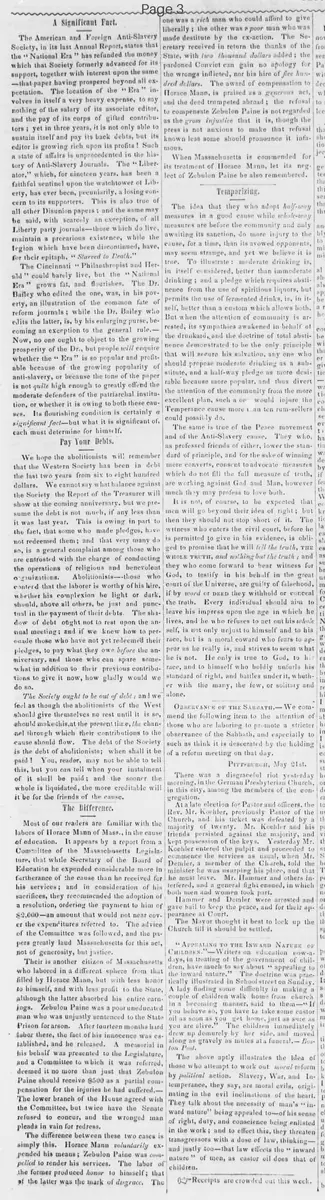
The Difference.
Most of our readers are familiar with the labors of Horace Mann of Mass., in the cause of education. It appears by a report from a Committee of the Massachusetts Legislature, that while Secretary of the Board of Education he expended considerably more in furtherance of the cause than he received for his services; and in consideration of his sacrifices, they recommended the adoption of a resolution, ordering the payment to him of $2,000—an amount that would not nearly cover the expenditures referred to. The advice of the Committee was followed, and the papers greatly laud Massachusetts for this act, not of generosity, but justice.
There is another citizen of Massachusetts who labored in a different sphere from that filled by Horace Mann, but with less honor to himself, and with less profit to the State, although the latter absorbed his entire earnings. Zebulon Paine was a poor uneducated man who was unjustly sentenced to the State Prison for arson. After fourteen months hard labor there, the fact of his innocence was established, and he released. A memorial in his behalf was presented to the Legislature, and a Committee to which it was referred, deemed it no more than just that Zebulon Paine should receive $500 as a partial compensation for the injuries he had suffered.— The lower branch of the House agreed with the Committee, but twice have the Senate refused to concur, and the wronged man pleads in vain for redress.
The difference between these two cases is simply this. Horace Mann voluntarily expended his means; Zebulon Paine was compelled to render his services. The labor of the former produced honor to himself; that of the latter was the mark of disgrace. The one was a rich man who could afford to give liberally; the other was a poor man who was made destitute by the exaction. The Secretary received in return the thanks of the State, with two thousand dollars added; the pardoned Convict can gain no apology for the wrongs inflicted, nor his hire of five hundred dollars. The award of compensation to Horace Mann, is praised as a generous act, and the deed trumpeted abroad; the refusal to compensate Zebulon Paine is not regarded as the gross injustice that it is, though the press is not anxious to make that refusal known lest some should pronounce it infamous.
When Massachusetts is commended for its treatment of Horace Mann, let its neglect of Zebulon Paine be also remembered.
Most of our readers are familiar with the labors of Horace Mann of Mass., in the cause of education. It appears by a report from a Committee of the Massachusetts Legislature, that while Secretary of the Board of Education he expended considerably more in furtherance of the cause than he received for his services; and in consideration of his sacrifices, they recommended the adoption of a resolution, ordering the payment to him of $2,000—an amount that would not nearly cover the expenditures referred to. The advice of the Committee was followed, and the papers greatly laud Massachusetts for this act, not of generosity, but justice.
There is another citizen of Massachusetts who labored in a different sphere from that filled by Horace Mann, but with less honor to himself, and with less profit to the State, although the latter absorbed his entire earnings. Zebulon Paine was a poor uneducated man who was unjustly sentenced to the State Prison for arson. After fourteen months hard labor there, the fact of his innocence was established, and he released. A memorial in his behalf was presented to the Legislature, and a Committee to which it was referred, deemed it no more than just that Zebulon Paine should receive $500 as a partial compensation for the injuries he had suffered.— The lower branch of the House agreed with the Committee, but twice have the Senate refused to concur, and the wronged man pleads in vain for redress.
The difference between these two cases is simply this. Horace Mann voluntarily expended his means; Zebulon Paine was compelled to render his services. The labor of the former produced honor to himself; that of the latter was the mark of disgrace. The one was a rich man who could afford to give liberally; the other was a poor man who was made destitute by the exaction. The Secretary received in return the thanks of the State, with two thousand dollars added; the pardoned Convict can gain no apology for the wrongs inflicted, nor his hire of five hundred dollars. The award of compensation to Horace Mann, is praised as a generous act, and the deed trumpeted abroad; the refusal to compensate Zebulon Paine is not regarded as the gross injustice that it is, though the press is not anxious to make that refusal known lest some should pronounce it infamous.
When Massachusetts is commended for its treatment of Horace Mann, let its neglect of Zebulon Paine be also remembered.
What sub-type of article is it?
Historical Event
Crime Story
What themes does it cover?
Justice
Misfortune
Crime Punishment
What keywords are associated?
Horace Mann
Zebulon Paine
Massachusetts Legislature
Wrongful Imprisonment
Compensation
Injustice
Arson Conviction
What entities or persons were involved?
Horace Mann
Zebulon Paine
Where did it happen?
Massachusetts
Story Details
Key Persons
Horace Mann
Zebulon Paine
Location
Massachusetts
Story Details
Contrast between compensation awarded to Horace Mann for educational sacrifices and denial of redress to Zebulon Paine after wrongful arson conviction and imprisonment.