Thank you for visiting SNEWPapers!
Sign up free
The Key West Citizen
Key West, Monroe County, Florida
What is this article about?
Account of the 1956 Hungarian Revolution: peaceful protests in Budapest escalated into armed revolt against Soviet forces, brief withdrawal followed by massive invasion crushing the uprising with heavy casualties.
Clipping
OCR Quality
Full Text
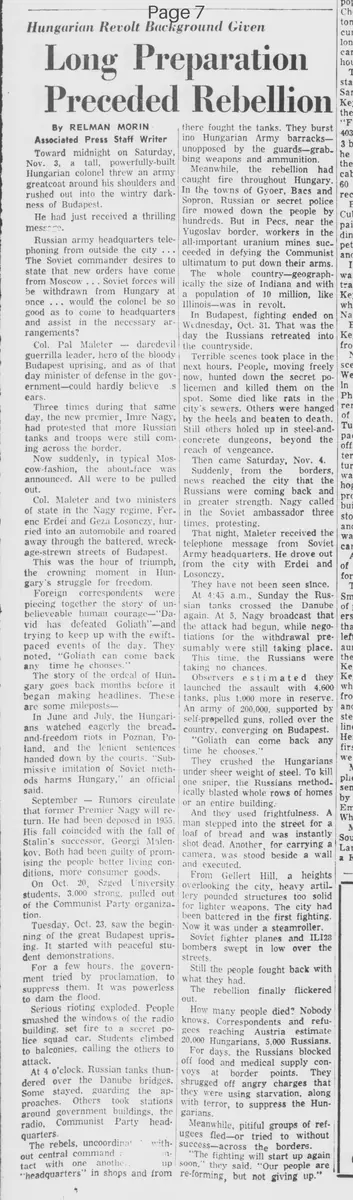
Long Preparation
Preceded Rebellion
Associated Press Staff Writer
Toward midnight on Saturday, Nov. 3, a tall, powerfully-built Hungarian colonel threw an army greatcoat around his shoulders and rushed out into the wintry darkness of Budapest.
He had just received a thrilling message Russian army headquarters telephoning from outside the city ...
The Soviet commander desires to state that new orders have come from Moscow ... Soviet forces will be withdrawn from Hungary at once ... would the colonel be so good as to come to headquarters and assist in the necessary arrangements?
Col. Pal Maleter - daredevil guerrilla leader, hero of the bloody Budapest uprising. and as of that day minister of defense in the government-could hardly believe his ears.
Three times during that same day. the new premier, Imre Nagy, had protested that more Russian tanks and troops were still coming across the border.
Now suddenly, in typical Moscow-fashion, the about-face was announced. All were to be pulled out.
Col. Maleter and two ministers of state in the Nagy regime, Ferenc Erdei and Geza Losonczy. hurried into an automobile and roared away through the battered. wreckage-strewn streets of Budapest.
This was the hour of triumph, the crowning moment in Hungary's struggle for freedom.
Foreign correspondents were piecing together the story of unbelievable human courage-"David has defeated Goliath"-and trying to keep up with the swift-paced events of the day. They noted. "Goliath can come back any time he chooses."
The story of the ordeal of Hungary goes back months before it began making headlines. These are some mileposts-
In June and July. the Hungarians watched eagerly the bread. and-freedom riots in Poznan. Poland, and the lenient sentences handed down by the courts. "Submissive imitation of Soviet methods harms Hungary," an official said.
September - Rumors circulate that former Premier Nagy will return. He had been deposed in 1955. His fall coincided with the fall of Stalin's successor. Georgi Malenkov. Both had been guilty of promising the people better living conditions, more consumer goods.
On Oct. 20, Szeged University students, 3.000 strong. pulled out of the Communist Party organization.
Tuesday, Oct. 23, saw the beginning of the great Budapest uprising. It started with peaceful student demonstrations.
For a few hours. the government tried by proclamation, to suppress them. It was powerless to dam the flood.
Serious rioting exploded. People smashed the windows of the radio building, set fire to a secret police squad car. Students climbed to balconies, calling the others to attack.
At 4 o'clock, Russian tanks thundered over the Danube bridges. Some stayed. guarding the approaches. Others took stations around government buildings. the radio, Communist Party headquarters.
The rebels, uncoordinated without central command tact with one another up "headquarters" in shops and from there fought the tanks. They burst into Hungarian Army barracks- unopposed by the guards-grabbing weapons and ammunition.
Meanwhile, the rebellion had caught fire throughout Hungary.
In the towns of Gyoer. Bacs and Sopron, Russian or secret police fire mowed down the people by hundreds. But in Pecs, near the Yugoslav border, workers in the all-important uranium mines succeeded in defying the Communist ultimatum to put down their arms.
The whole country-geographically the size of Indiana and with a population of 10 million, like Illinois-was in revolt.
In Budapest. fighting ended on Wednesday, Oct. 31. That was the day the Russians retreated into the countryside.
Terrible scenes took place in the next hours. People, moving freely now, hunted down the secret policemen and killed them on the spot. Some died like rats in the city's sewers. Others were hanged by the heels and beaten to death. Still others holed up in steel-and concrete dungeons, beyond the reach of vengeance.
Then came Saturday, Nov. 4. Suddenly. from the borders, news reached the city that the Russians were coming back and in greater strength. Nagy called in the Soviet ambassador three times. protesting.
That night. Maleter received the telephone message from Soviet Army headquarters. He drove out from the city with Erdei and Losonczy.
They have not been seen since.
At 4:45 a.m., Sunday the Russian tanks crossed the Danube again. At 5, Nagy broadcast that the attack had begun. while negotiations for the withdrawal presumably were still taking place.
This time. the Russians were taking no chances.
Observers estimated they launched the assault with 4,600 tanks. plus 1.000 more in reserve. An army of 200.000. supported by self-propelled guns, rolled over the country. converging on Budapest.
"Goliath can come back any time he chooses."
They crushed the Hungarians under sheer weight of steel. To kill one sniper. the Russians method. ically blasted whole rows of homes or an entire building.
And they used frightfulness. A man stepped into the street for a loaf of bread and was instantly shot dead. Another. for carrying a camera. was stood beside a wall and executed.
From Gellert Hill, a heights overlooking the city, heavy artillery pounded structures too solid for lighter weapons. The city had been battered in the first fighting. Now it was under a steamroller.
Soviet fighter planes and ILI28 bombers swept in low over the streets.
Still the people fought back with what they had.
The rebellion finally flickered out.
How many people died? Nobody knows. Correspondents and refugees reaching Austria estimate 20,000 Hungarians. 5.000 Russians.
For days. the Russians blocked off food and medical supply convoys at border points. They shrugged off angry charges that they were using starvation, along with terror, to suppress the Hungarians.
Meanwhile, pitiful groups of refugees fled-or tried to without success-across the borders.
1- "The fighting will start up again soon," they said. "Our people are re-forming. but not giving up."
What sub-type of article is it?
What keywords are associated?
What entities or persons were involved?
Where did it happen?
Foreign News Details
Primary Location
Hungary
Event Date
October November 1956
Key Persons
Outcome
soviets crushed the hungarian revolt with 4,600 tanks and 200,000 troops; estimates of 20,000 hungarian and 5,000 russian deaths; rebels suppressed, refugees fled borders.
Event Details
The Hungarian uprising began with student demonstrations in Budapest on Oct. 23, 1956, escalating into widespread revolt against Soviet control. Rebels fought Russian tanks and secret police, seizing weapons. Initial Soviet withdrawal was announced on Nov. 3, but on Nov. 4, a massive Soviet invasion crushed the rebellion, leading to heavy fighting and reprisals.