Thank you for visiting SNEWPapers!
Sign up free
The New Hampshire Gazette And General Advertiser
Portsmouth, Exeter, Rockingham County, New Hampshire
What is this article about?
A letter to the people of New Hampshire opposes making state securities legal tender for debts, arguing it would violate justice, honor, constitutional rights, and natural law, while devaluing property and commerce. It emphasizes punctuality in payments and jury oaths. Signed by Solicitor, Exeter, October 1783.
Merged-components note: This is a continuation of the letter to the editor across pages, signed SOLICITOR, discussing state securities and justice in payments.
Clippings
1 of 2
OCR Quality
Full Text
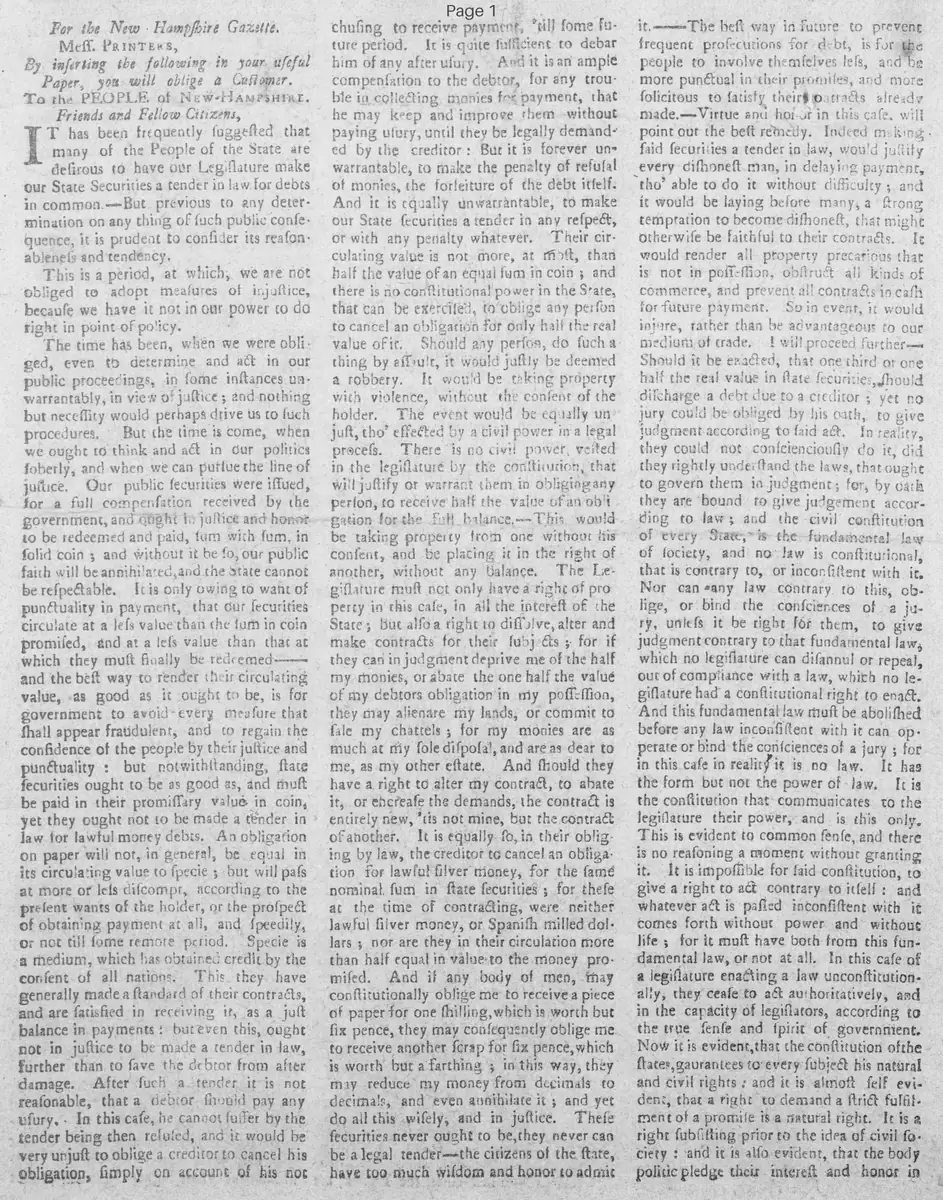
Mess. PRINTERS,
By inserting the following in your useful Paper, you will oblige a Customer.
To the PEOPLE of NEW-HAMPSHIRE.
Friends and Fellow Citizens,
It has been frequently suggested that many of the People of the State are desirous to have our Legislature make our State Securities a tender in law for debts in common. -- But previous to any determination on any thing of such public consequence, it is prudent to consider its reasonableness and tendency.
This is a period, at which, we are not obliged to adopt measures of injustice, because we have it not in our power to do right in point of policy.
The time has been, when we were obliged, even to determine and act in our public proceedings, in some instances unwarrantably, in view of justice; and nothing but necessity would perhaps drive us to such procedures. But the time is come, when we ought to think and act in Our politics soberly, and when we can pursue the line of justice. Our public securities were issued, for a full compensation received by the government, and ought in justice and honor to be redeemed and paid, sum for sum, in solid coin; and without it be so, our public faith will be annihilated, and the State cannot be respectable. It is only owing to want of punctuality in payment, that our securities circulate at a less value than the sum in coin promised, and at a less value than that at which they must finally be redeemed. -- and the best way to render their circulating value, as good as it ought to be, is for government to avoid every measure that shall appear fraudulent, and to regain the confidence of the people by their justice and punctuality: but notwithstanding, state securities ought to be as good as, and must be paid in their promissory value in coin. yet they ought not to be made a tender in law for lawful money debts. An obligation on paper will not, in general, be equal in its circulating value to specie; but will pass at more or less discount, according to the present wants of the holder, or the prospect of obtaining payment at all, and speedily. or not till some remote period. Specie is a medium, which has obtained credit by the consent of all nations. This they have generally made a standard of their contracts. and are satisfied in receiving it, as a just balance in payments: but even this, ought not in justice to be made a tender in law, further than to save the debtor from after damage. After such a tender it is not reasonable, that a debtor should pay any usury. -- In this case, he cannot suffer by the tender being then refused, and it would be very unjust to oblige a creditor to cancel his obligation, simply on account of his not choosing to receive payment, till some future period. It is quite sufficient to debar him of any after usury. And it is an ample compensation to the debtor, for any trouble in collecting monies for payment, that he may keep and improve them without paying usury, until they be legally demanded by the creditor: But it is forever unwarrantable, to make the penalty of refusal of monies, the forfeiture of the debt itself. And it is equally unwarrantable, to make our State securities a tender in any respect. or with any penalty whatever. Their circulating value is not more, at most, than half the value of an equal sum in coin; and there is no constitutional power in the State, that can be exercised, to oblige any person to cancel an obligation for only half the real value of it. Should any person do such a thing by assault, it would justly be deemed a robbery. It would be taking property with violence, without the consent of the holder. The event would be equally unjust, tho effected by a civil power in a legal process. There is no civil power, vested in the legislature by the constitution, that will justify or warrant them in obliging any person, to receive half the value of an obligation for the full balance. -- This would be taking property from one without his consent, and be placing it in the right of another, without any balance. The Legislature must not only have a right of property in this case, in all the interest of the State; but also a right to dissolve, alter and make contracts for their subjects: for if they can in judgment deprive me of the half my monies, or abate the one half the value of my debtor's obligation in my possession, they may alienate my lands, or commit to sale my chattels; for my monies are as much at my sole disposal, and are as dear to me, as my other estate. And should they have a right to alter my contract, to abate it, or decrease the demands, the contract is entirely new, tis not mine, but the contract of another. It is equally so, in their obliging by law, the creditor to cancel an obligation for lawful silver money, for the same nominal sum in state securities; for these at the time of contracting, were neither lawful silver money, or Spanish milled dollars; nor are they in their circulation more than half equal in value to the money promised. And if any body of men, may constitutionally oblige me to receive a piece of paper for one shilling, which is worth but six pence, they may consequently oblige me to receive another scrap for six pence, which is worth but a farthing; in this way, they may reduce my money from decimal to decimal, and even annihilate it; and yet do all this wisely, and in justice. These securities never ought to be, they never can be a legal tender -- the citizens of the state, have too much wisdom and honor to admit it. -- The best way in future to prevent frequent prosecutions for debt, is for the people to involve themselves less, and be more punctual in their promises, and more solicitous to satisfy their contracts already made. -- Virtue and honour in this case, will point out the best remedy. Indeed making said securities a tender in law, would justify every dishonest man, in delaying payment, tho' able to do it without difficulty; and it would be laying before many, a strong temptation to become dishonest, that might otherwise be faithful to their contracts. It would render all property precarious that is not in possession, obstruct all kinds of commerce, and prevent all contracts in cash for future payment. So in event, it would injure, rather than be advantageous to our medium of trade. I will proceed further -- Should it be enacted, that one third or one half the real value in state securities, should discharge a debt due to a creditor; yet no jury could be obliged by his oath, to give judgment according to said act. In reality, they could not conscientiously do it, did they rightly understand the laws, that ought to govern them in judgment; for, by oath they are bound to give judgement according to law; and the civil constitution of every State, is the fundamental law of society, and no law is constitutional, that is contrary to, or inconsistent with it. Nor can any law contrary to this, oblige, or bind the consciences of a jury, unless it be right for them, to give judgment contrary to that fundamental law: which no legislature can disannul or repeal, out of compliance with a law, which no legislature had a constitutional right to enact. And this fundamental law must be abolished before any law inconsistent with it can operate or bind the consciences of a jury; for in this case in reality it is no law. It has the form but not the power of law. It is the constitution that communicates to the legislature their power, and is this only. This is evident to common sense, and there is no reasoning a moment without granting it. It is impossible for said constitution, to give a right to act contrary to itself: and whatever act is passed inconsistent with it comes forth without power and without life; for it must have both from this fundamental law, or not at all. In this case of a legislature enacting a law unconstitutionally, they cease to act authoritatively, and in the capacity of legislators, according to the true sense and spirit of government. Now it is evident, that the constitution of the states, guarantees to every subject his natural and civil rights: and it is almost self evident, that a right to demand a strict fulfilment of a promise is a natural right. It is a right subsisting prior to the idea of civil society: and it is also evident, that the body politic pledge their interest and honor in its constitution. for the defence of this right.
Engage their assistance to enable individuals to recover it when infringed. "This every good subject can plead as a civil right. They can justly demand of the public the exercise of their power. to enable them to obtain a fulfilment of a promise made, both in its nature and extent : and should the public diminish the nominal sum of the public debt. or the value of the coin or commodity promised, either by acts in form of law. or by corrupt judgment in a jury. the citizen is defrauded, and the fundamental law of society is violated by the government.
SOLICITOR.
-Exeter, October 1783.
What sub-type of article is it?
What themes does it cover?
What keywords are associated?
What entities or persons were involved?
Letter to Editor Details
Author
Solicitor
Recipient
To The People Of New Hampshire
Main Argument
state securities should not be made legal tender for debts as they circulate at less than face value, violating justice, honor, constitutional rights, and natural law by effectively allowing debtors to pay only half the owed amount in coin equivalent.
Notable Details