Thank you for visiting SNEWPapers!
Sign up free
Letter to Editor
April 24, 1820
Daily National Intelligencer
Washington, District Of Columbia
What is this article about?
In 1820, a Virginia farmer critiques a prior solution to a will dispute involving twins and proposes a proportional estate division: four-sevenths to the son, two-sevenths to the wife, one-seventh to the daughter, to honor the testator's ratios.
Clipping
OCR Quality
95%
Excellent
Full Text
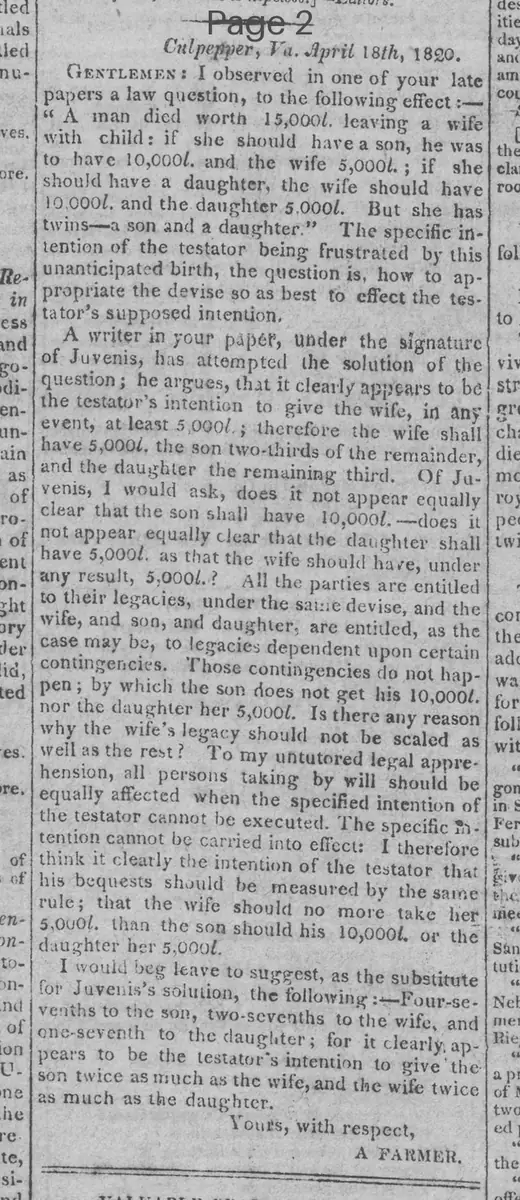
Culpepper, Va. April 18th, 1820.
Gentlemen: I observed in one of your late papers a law question, to the following effect:—
"A man died worth 15,000l. leaving a wife with child: if she should have a son, he was to have 10,000l. and the wife 5,000l.; if she should have a daughter, the wife should have 10,000l. and the daughter 5,000l. But she has twins—a son and a daughter." The specific intention of the testator being frustrated by this unanticipated birth, the question is, how to appropriate the devise so as to best effect the testator's supposed intention.
A writer in your paper, under the signature of Juvenis, has attempted the solution of the question; he argues, that it clearly appears to be the testator's intention to give the wife, in any event, at least 5,000l.; therefore the wife shall have 5,000l. the son two-thirds of the remainder, and the daughter the remaining third. Of Juvenis, I would ask, does it not appear equally clear that the son shall have 10,000l.,—does it not appear equally clear that the daughter shall have 5,000l. as that the wife should have, under any result, 5,000l.? All the parties are entitled to their legacies, under the same devise, and the wife, and son, and daughter, are entitled, as the case may be, to legacies dependent upon certain contingencies. Those contingencies do not happen; by which the son does not get his 10,000l. nor the daughter her 5,000l. Is there any reason why the wife's legacy should not be scaled as well as the rest? To my untutored legal apprehension, all persons taking by will should be equally affected when the specified intention of the testator cannot be executed. The specific intention cannot be carried into effect: I therefore think it clearly the intention of the testator that his bequests should be measured by the same rule; that the wife should no more take her 5,000l. than the son should his 10,000l. or the daughter her 5,000l.
I would beg leave to suggest, as the substitute for Juvenis's solution, the following:—Four-sevenths to the son, two-sevenths to the wife, and one-seventh to the daughter; for it clearly appears to be the testator's intention to give the son twice as much as the wife, and the wife twice as much as the daughter.
Yours, with respect,
A FARMER.
Gentlemen: I observed in one of your late papers a law question, to the following effect:—
"A man died worth 15,000l. leaving a wife with child: if she should have a son, he was to have 10,000l. and the wife 5,000l.; if she should have a daughter, the wife should have 10,000l. and the daughter 5,000l. But she has twins—a son and a daughter." The specific intention of the testator being frustrated by this unanticipated birth, the question is, how to appropriate the devise so as to best effect the testator's supposed intention.
A writer in your paper, under the signature of Juvenis, has attempted the solution of the question; he argues, that it clearly appears to be the testator's intention to give the wife, in any event, at least 5,000l.; therefore the wife shall have 5,000l. the son two-thirds of the remainder, and the daughter the remaining third. Of Juvenis, I would ask, does it not appear equally clear that the son shall have 10,000l.,—does it not appear equally clear that the daughter shall have 5,000l. as that the wife should have, under any result, 5,000l.? All the parties are entitled to their legacies, under the same devise, and the wife, and son, and daughter, are entitled, as the case may be, to legacies dependent upon certain contingencies. Those contingencies do not happen; by which the son does not get his 10,000l. nor the daughter her 5,000l. Is there any reason why the wife's legacy should not be scaled as well as the rest? To my untutored legal apprehension, all persons taking by will should be equally affected when the specified intention of the testator cannot be executed. The specific intention cannot be carried into effect: I therefore think it clearly the intention of the testator that his bequests should be measured by the same rule; that the wife should no more take her 5,000l. than the son should his 10,000l. or the daughter her 5,000l.
I would beg leave to suggest, as the substitute for Juvenis's solution, the following:—Four-sevenths to the son, two-sevenths to the wife, and one-seventh to the daughter; for it clearly appears to be the testator's intention to give the son twice as much as the wife, and the wife twice as much as the daughter.
Yours, with respect,
A FARMER.
What sub-type of article is it?
Persuasive
Informative
What themes does it cover?
Morality
What keywords are associated?
Inheritance
Will Interpretation
Testator Intention
Twins Birth
Estate Division
What entities or persons were involved?
A Farmer
Gentlemen
Letter to Editor Details
Author
A Farmer
Recipient
Gentlemen
Main Argument
the author argues against juvenis's proposed division of the estate, asserting that all legatees should be equally affected by the frustrated intention, and suggests instead dividing it as four-sevenths to the son, two-sevenths to the wife, and one-seventh to the daughter to reflect the testator's intended ratios.
Notable Details
References Original Law Question About A Will With Contingencies For Son Or Daughter But Resulting In Twins
Critiques Juvenis's Solution Giving Wife 5,000l., Son Two Thirds Remainder, Daughter One Third
Proposes Proportional Division Based On Son Twice Wife, Wife Twice Daughter