Thank you for visiting SNEWPapers!
Sign up free
Gazette Of The United States
New York, New York County, New York
What is this article about?
On September 24, M. Barnave presented a sketch of a colonial government system to the French National Assembly, outlining the Assembly's exclusive legislative rights on external matters like trade and defense, while granting colonial assemblies authority over internal issues such as the status of non-free persons, mulattoes, and free Negroes.
Clipping
OCR Quality
Full Text
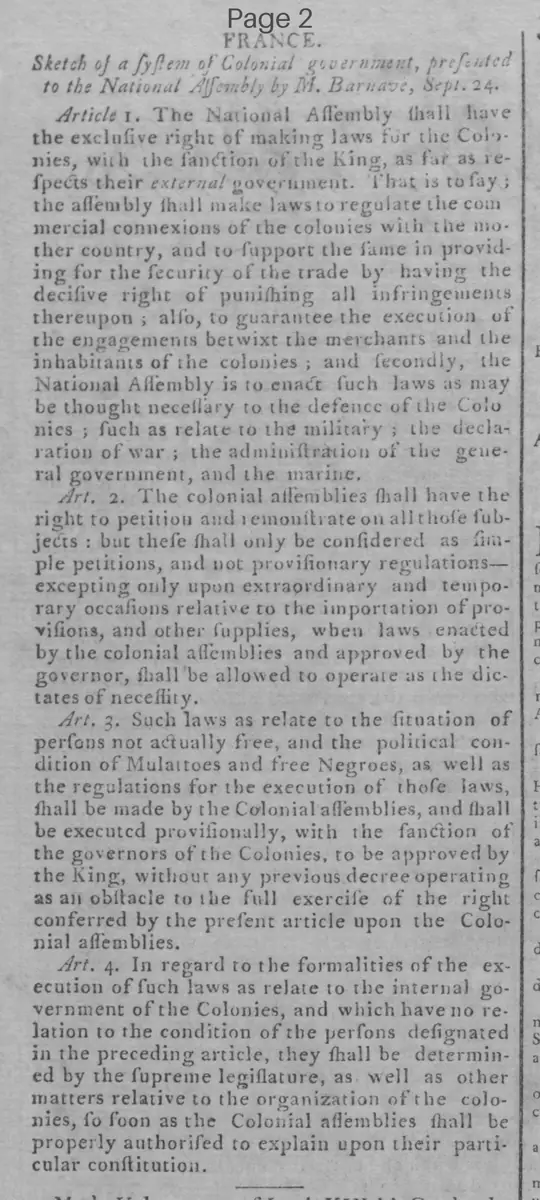
Sketch of a system of Colonial government, presented to the National Assembly by M. Barnave, Sept. 24.
Article I. The National Assembly shall have the exclusive right of making laws for the Colonies, with the sanction of the King, as far as it respects their external government. That is to say; the assembly shall make laws to regulate the commercial connections of the colonies with the mother country, and to support the same in providing for the security of the trade by having the decisive right of punishing all infringements thereupon; also, to guarantee the execution of the engagements betwixt the merchants and the inhabitants of the colonies; and secondly, the National Assembly is to enact such laws as may be thought necessary to the defence of the Colonies; such as relate to the military; the declaration of war; the administration of the general government, and the marine.
Art. 2. The colonial assemblies shall have the right to petition and remonstrate on all those subjects: but these shall only be considered as simple petitions, and not provisionary regulations—excepting only upon extraordinary and temporary occasions relative to the importation of provisions, and other supplies, when laws enacted by the colonial assemblies and approved by the governor, shall be allowed to operate as the dictates of necessity.
Art. 3. Such laws as relate to the situation of persons not actually free, and the political condition of Mulattoes and free Negroes, as well as the regulations for the execution of those laws, shall be made by the Colonial assemblies, and shall be executed provisionally, with the sanction of the governors of the Colonies, to be approved by the King, without any previous decree operating as an obstacle to the full exercise of the right conferred by the present article upon the Colonial assemblies.
Art. 4. In regard to the formalities of the execution of such laws as relate to the internal government of the Colonies, and which have no relation to the condition of the persons designated in the preceding article, they shall be determined by the supreme legislature, as well as other matters relative to the organization of the colonies, as soon as the Colonial assemblies shall be properly authorized to explain upon their particular constitution.
What sub-type of article is it?
What keywords are associated?
What entities or persons were involved?
Where did it happen?
Foreign News Details
Primary Location
France
Event Date
Sept. 24
Key Persons
Event Details
M. Barnave presented a sketch of a colonial government system to the National Assembly. Article I grants the Assembly exclusive rights over external government, including commercial regulations, trade security, and defense matters like military, war declarations, general administration, and marine. Article 2 allows colonial assemblies to petition on these but not enact provisional regulations, except temporarily for provisions and supplies with governor approval. Article 3 empowers colonial assemblies to make and provisionally execute laws on the status of non-free persons, mulattoes, and free Negroes, sanctioned by governors and approved by the King. Article 4 states that formalities for other internal government laws and colonial organization will be determined by the supreme legislature once colonial assemblies are authorized.