Thank you for visiting SNEWPapers!
Sign up free
Wheeling Register
Wheeling, Ohio County, West Virginia
What is this article about?
In US v. Rauscher, Justice Miller rules that under the 1842 US-UK extradition treaty, a person can only be tried for the specific offense for which extradited, per international law and US statutes (Rev. Stat. §§5272, 5275). Justice Gray concurs on statutory grounds.
Merged-components note: These two components form a single coherent story on the extradition opinion, with the second being the concurring opinion; sequential reading orders 6 and 7 confirm continuation.
Clipping
OCR Quality
Full Text
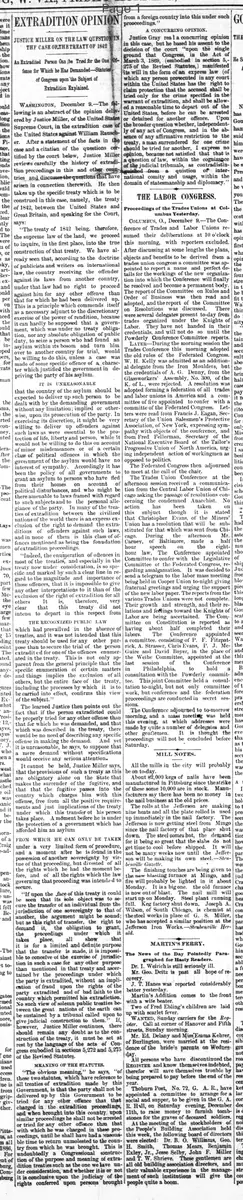
JUSTICE MILLER ON THE LAW QUESTION IN THE CASE OF THE TREATY OF 1842
An Extradited Person Can be Tried for the One Offense for Which he Has Demanded-Statutes of Congress upon the Subject of Extradition Explained.
WASHINGTON, December 9.-The following is an abstract of the opinion delivered by Justice Miller, of the United States Supreme Court, in the extradition case of the United States against William Rauscher. After a statement of the facts in the case and a citation of the questions certified by the court below, Justice Miller reviews carefully the history of extradition proceedings in this and other countries and discusses the questions that have arisen in connection therewith. He then takes up the specific treaty which is to be construed in this case, namely, the treaty of 1842, between the United States and Great Britain, and speaking for the Court, says:
"The treaty of 1842 being, therefore, the supreme law of the land, we proceed to inquire, in the first place, into the true construction of that treaty. We have already seen that, according to the doctrine of publicists and writers on international law, the country receiving the offender against its laws from another country, under that law had no right to proceed against him for any other offense than that for which he had been delivered up. This is a principle which commends itself as a necessary adjunct to the discretionary exercise of the power of rendition, because it can hardly be supposed that a government, which was under no treaty obligation, nor any absolute obligation of public duty, to seize a person who had found an asylum within its bosom and turn him over to another country for trial, would be willing to do this, unless a case was made of some specific offence of a character which justified the government in depriving the party of his asylum.
IT IS UNREASONABLE that the country of the asylum should be expected to deliver up such person to be dealt with by the demanding government without any limitation, implied or otherwise, upon its prosecution of the party. In exercising its discretion, it might be very willing to deliver up offenders against such laws as were essential to the protection of life, liberty and person, while it would not be willing to do this on account of minor misdemeanors or of a certain class of political offences in which the government of the asylum would have no interest or sympathy. Accordingly it has been the policy of all governments to grant an asylum to persons who have fled from their homes on account of political disturbances, and who might be there amenable to laws framed with regard to such subjects and to the personal allegiance of the party. In many of the treaties of extradition between the civilized nations of the world there is an express exclusion of the right to demand the extradition of offenders against such laws, and in none of them is this class of offences mentioned as being the foundation of extradition proceedings.
"Indeed, the enumeration of offences in most of the treaties, and especially in the treaty now under consideration, is so specific and marked by such a clear line in regard to the magnitude and importance of those offences, that it is impossible to give any other interpretation to it than of the exclusion of the right of extradition for all others. It is, therefore, very clear that this treaty did not intend to depart in this respect from THE RECOGNIZED PUBLIC LAW which had prevailed in the absence of treaties, and it was not intended that this treaty should be used for any other purpose than to secure the trial of the person extradited for one of the offences enumerated in the treaty. This is not only apparent from the general principle that the specific enumeration of certain matters and things implies the exclusion of all others, but the entire face of the treaty, including the processes by which it is to be carried into effect, confirms this view of the subject."
The learned Justice then points out the fact that if the person extradited could be properly tried for any other offense than that for which he was demanded, and that which was described in the treaty, there would be no need of describing any specific offense in making the demand. And yet it is unreasonable, he says, to suppose that a mere demand without specifications would receive any serious attention.
It cannot be held, Justice Miller says, that the provisions of such a treaty as this are obligatory alone on the State that makes the surrender of the fugitive, and that the fugitive passes into the country which charges him with this offense, free from all the positive requirements and just implications of the treaty under which this transfer of his person takes place. A moment before he is under the protection of a government which has afforded him an asylum FROM WHICH HE CAN ONLY BE TAKEN under a very limited form of procedure, and a moment after he is found in the possession of another sovereignty by virtue of that proceeding, but divested of all the rights which he had the moment before, and of all the rights which the law governing that proceeding was intended to secure.
"If upon the face of this treaty it could be seen that its sole object was to secure the transfer of an individual from the jurisdiction of one sovereignty to that of another, the argument might be sound; but as this right of transfer, the right to demand it, the obligation to grant, the proceedings under which it takes place, all show that it is for a limited and definite purpose that the transfer is made, it is impossible to conceive of the exercise of jurisdiction in such a case for any other purpose than mentioned in that treaty and ascertained by the proceedings under which the party is extradited, without an implication of fraud upon the rights of the party extradited and of bad faith to the country which permitted his extradition. No such view of solemn public treaties between the great nations of the earth can be sustained by a tribunal called upon to give judicial construction to them." If, however, Justice Miller continues, there should remain any doubt as to the construction of the treaty, it must be set at rest by the language of the acts of Congress embodied in sections 5,272 and 5,275 of the Revised Statutes.
MEANING OF THE STATUTES
"The obvious meaning," he says, "of these two statutes, which have reference to all treaties of extradition made by this Government, is that the party shall not be delivered up by this Government to be tried for any other offence than that charged in the extradition proceedings and when brought into this country upon similar proceedings he shall not be arrested or tried for any other offence than that with which he was charged in these proceedings, until he shall have had a reasonable time to return unmolested to the country from which he was brought. This is undoubtedly a Congressional construction of the purpose and meaning of extradition treaties such as the one we have under consideration, and whether it is or not it is conclusive upon the judiciary of the rights conferred upon persons brought from a foreign country into this under such proceedings."
A CONCURRING OPINION.
Justice Gray read a concurring opinion in this case, but he based his assent to the decision of the court upon the single ground that Congress, in the Act of March 3, 1869, (embodied in section 5,275 of the Revised Statutes,) manifested its will in the form of an express law (of which any person prosecuted in any court within the United States has the right to claim protection) that the accused shall be tried only for the crime specified in the warrant of extradition, and shall be allowed a reasonable time to depart out of the United States, before he can be arrested or detained for another offence. Upon the broader question whether, independently of any act of Congress, and in the absence of any affirmative restriction to the treaty, a man surrendered for one crime should be tried for another, I express no opinion, because not satisfied that that is a question of law, within the cognizance of the judicial tribunals, as distinguished from a question of international comity and usage, within the domain of statesmanship and diplomacy.
What sub-type of article is it?
What themes does it cover?
What keywords are associated?
What entities or persons were involved?
Where did it happen?
Story Details
Key Persons
Location
Washington
Event Date
December 9
Story Details
Justice Miller's Supreme Court opinion interprets the 1842 US-UK extradition treaty to limit trials of extradited persons to the specific offense charged, based on international law principles and US statutes; Justice Gray concurs on statutory grounds.