Thank you for visiting SNEWPapers!
Sign up free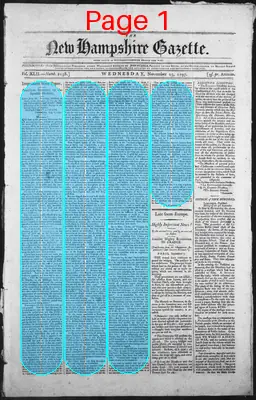
The New Hampshire Gazette
Portsmouth, Rockingham County, New Hampshire
What is this article about?
Diplomatic letter from U.S. Secretary Pickering to Spanish Minister Yrujo, dated Aug. 8, 1797, accusing Spanish governors in Louisiana of using pretenses to delay evacuating Mississippi River posts (Natchez, Walnut Hills, Chickasaw Bluffs) and running the U.S.-Spain boundary line as per the 1795 treaty, despite knowing the posts are U.S. territory.
Clipping
OCR Quality
Full Text
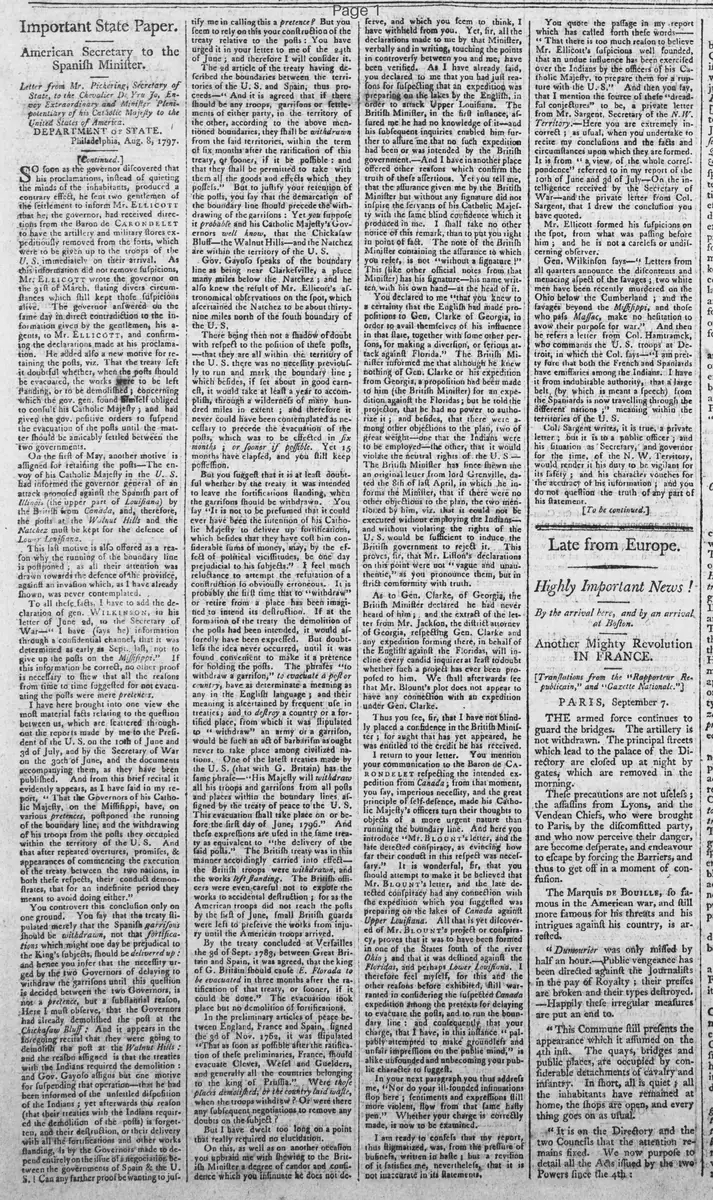
American Secretary to the Spanish Minister.
Letter from Mr. Pickering, Secretary of State, to the Chevalier De Yrujo, Extraordinary and Minister Plenipotentiary of his Catholic Majesty to the United States of America.
DEPARTMENT OF STATE,
Philadelphia, Aug. 8, 1797.
[Continued.]
As soon as the governor discovered that his proclamations, instead of quieting the minds of the inhabitants, produced a contrary effect, he sent two gentlemen of the settlement to inform Mr. Ellicott that he, the governor, had received directions from the Baron de Carondelet to have the artillery and military stores expeditiously removed from the forts, which were to be given up to the troops of the U. S. immediately on their arrival. As this information did not remove suspicions, Mr. Ellicott wrote the governor on the 31st of March, stating divers circumstances which still kept those suspicions alive. The governor answered on the same day in direct contradiction to the information given by the gentlemen, his agents, to Mr. Ellicott, and confirming the declarations made at his proclamation. He added also a new motive for retaining the posts, viz. That the treaty left it doubtful whether, when the posts should be evacuated, the works were to be left standing, or to be demolished; concerning which the gov. gen. found himself obliged to consult his Catholic Majesty; and had given the gov. positive orders to suspend the evacuation of the posts until the matter should be amicably settled between the two governments.
On the first of May, another motive is assigned for retaining the posts—The envoy of his Catholic Majesty in the U. S. had informed the governor general of an attack proposed against the Spanish part of Illinois (the upper part of Louisiana) by the British from Canada, and, therefore, the posts at the Walnut Hills and the Natchez must be kept for the defence of Lower Louisiana.
This last motive is also offered as a reason why the running of the boundary line is postponed; as all their attention was drawn towards the defence of the province, against an invasion which, as I have already shown, was never contemplated.
To all these facts, I have to add the declaration of Gen. Wilkinson, in his letter of June 2d, to the Secretary of War—'I have (says he) information through a confidential channel, that it was determined as early as Sept. last, not to give up the posts on the Mississippi.' If this information be correct, no other proof is necessary to show that all the reasons from time to time alleged for not evacuating the posts were mere pretences.
I have here brought into one view the most material facts relating to the question between us, which are scattered throughout the reports made by me to the President of the U. S. on the 10th of June and 3d of July, and by the Secretary of War on the 30th of June, and the documents accompanying them, as they have been published. And from this brief recital it evidently appears, as I have said in my report, That the Governors of his Catholic Majesty, on the Mississippi, have, on various pretences, postponed the running of the boundary line, and the withdrawing of his troops from the posts they occupied within the territory of the U. S. And that after repeated overtures, promises, & appearances of commencing the execution of the treaty between the two nations, in both these respects, their conduct demonstrates, that for an indefinite period they meant to avoid doing either.
You controvert this conclusion only on one ground. You say that the treaty stipulated merely that the Spanish garrisons should be withdrawn, not that fortifications which might one day be prejudicial to the King's subjects, should be delivered up: and hence you infer that the necessity urged by the two Governors of delaying to withdraw the garrisons until this question is decided between the two Governments, is not a pretence, but a substantial reason.
Here I must observe, that the Governors had already demolished the post at the Chickasaw Bluffs: And it appears in the foregoing recital that they were going to demolish the post at the Walnut Hills: and the reason assigned is that the treaties with the Indians required the demolition: and Gov. Gayoso assigns but one motive for suspending that operation—that he had been informed of the unsettled disposition of the Indians; yet afterwards this reason (that their treaties with the Indians required the demolition of the posts) is forgotten, and their destruction, or their delivery with all the fortifications and other works standing, is by the Governors made to depend entirely on the issue of a negotiation between the governments of Spain & the U. S. ! Can any farther proof be wanting to justify me in calling this a pretence? But you seem to rely on this your construction of the treaty relative to the posts: You have urged it in your letter to me of the 24th of June; and therefore I will consider it.
The 3d article of the treaty having described the boundaries between the territories of the U. S. and Spain, thus proceeds—'And it is agreed that if there should be any troops, garrisons or settlements of either party, in the territory of the other, according to the above mentioned boundaries, they shall be withdrawn from the said territories, within the term of six months after the ratification of this treaty, or sooner, if it be possible: and that they shall be permitted to take with them all the goods and effects which they possess.' But to justify your retention of the posts, you say that the demarcation of the boundary line should precede the withdrawing of the garrisons: Yet you suppose it probable and his Catholic Majesty's Governors well know, that the Chickasaw Bluffs—the Walnut Hills—and the Natchez are within the territory of the U. S.
Gov. Gayoso speaks of the boundary line as being near Clarksville, a place many miles below the Natchez; and he also knew the result of Mr. Ellicott's astronomical observations on the spot, which ascertained the Natchez to be about thirty-nine miles north of the south boundary of the U. S.
There being then not a shadow of doubt with respect to the position of these posts,—that they are all within the territory of the U. S. there was no necessity previously to run and mark the boundary line; which besides, if set about in good earnest, it would take at least a year to accomplish, through a wilderness of many hundred miles in extent; and therefore it never could have been contemplated as necessary to precede the evacuation of the posts, which was to be effected in six months; or sooner if possible. Yet 15 months have elapsed, and you still keep possession.
But you suggest that it is at least doubtful whether by the treaty it was intended to leave the fortifications standing, when the garrisons should be withdrawn. You say 'It is not to be presumed that it could ever have been the intention of his Catholic Majesty to deliver up fortifications, which besides that they have cost him considerable sums of money, may, by the effect of political vicissitudes, be one day prejudicial to his subjects.' I feel much reluctance to attempt the refutation of a construction so obviously erroneous. It is probably the first time that to 'withdraw' or retire from a place has been imagined to intend its destruction. If at the formation of the treaty the demolition of the posts had been intended, it would scarcely have been expressed. But doubtless the idea never occurred, until it was found convenient to make it a pretence for holding the posts. The phrases 'to withdraw a garrison,' to evacuate a post or country, have as determinate a meaning as any in the English language; and their meaning is ascertained by frequent use in treaties; and to destroy a country or a fortified place, from which it was stipulated to 'withdraw' an army or a garrison, would be such an act of barbarism as ought never to take place among civilized nations. One of the latest treaties made by the U. S. (that with G. Britain) has the same phrase—'His Majesty will withdraw all his troops and garrisons from all posts and places within the boundary lines, assigned by the treaty of peace to the U. S. This evacuation shall take place on or before the 1st day of June, 1796.' And these expressions are used in the same treaty as equivalent to 'the delivery of the said posts.' The British treaty was in this manner accordingly carried into effect—the British troops were withdrawn, and the works left standing. The British officers were even careful not to expose the works to accidental destruction; for as the American troops did not reach the posts by the 1st of June, small British guards were left to preserve the works from injury until the American troops arrived.
By the treaty concluded at Versailles the 3d of Sept. 1783, between Great Britain and Spain, it was agreed, that the king of G. Britain should cause E. Florida to be evacuated in three months after the ratification of that treaty, or sooner, if it could be done. The evacuation took place but no demolition of fortifications.
In the preliminary articles of peace between England, France and Spain, signed the 3d of Nov. 1762, it was stipulated 'That as soon as possible after the ratification of these preliminaries, France, should evacuate Cleves, Wesel and Guelders, and generally all the countries belonging to the king of Prussia.' Were those places demolished, or the country laid waste, when the troops withdrew? Or were there any subsequent negotiations to remove any doubts on the subject?
But I have dwelt too long on a point that really required no elucidation. On this, as well as on another occasion you upbraid me with showing to the British Minister a degree of candor and confidence which you insinuate he does not deserve, and which you seem to think, I have withheld from you. Yet, sir, all the declarations made to me by that Minister, verbally and in writing, touching the points in controversy between you and me, have been verified. As I have already said, you declared to me that you had just reasons for suspecting that an expedition was preparing on the lakes by the English, in order to attack Upper Louisiana. The British Minister, in the first instance, assured me he had no knowledge of it—and his subsequent inquiries enabled him further to assure me that no such expedition had been or was intended by the British government. And I have in another place offered other reasons which confirm the truth of these assertions. Yet you tell me, that the assurance given me by the British Minister but without any signature did not inspire the servants of his Catholic Majesty with the same blind confidence which it produced in me. I shall take no other notice of this remark, than to put you right in point of fact. The note of the British Minister containing the assurance to which you refer, is not 'without a signature!' This (like other official notes from that Minister) has his signature—his name written, with his own hand—at the head of it.
You declared to me 'that you knew to a certainty that the English had made propositions to Gen. Clarke of Georgia, in order to avail themselves of his influence in that state, together with some other persons, for making a diversion, or serious attack against Florida.' The British Minister informed me that although he knew nothing of Gen. Clarke or his expedition from Georgia, a proposition had been made to him (the British Minister) for an expedition against the Floridas; but he told the projector, that he had no power, to authorize it; and besides, that there were among other objections to the plan, two of great weight—one that the Indians were to be employed—the other, that it would violate the neutral rights of the U. S. The British Minister has since shown me an original letter from Lord Grenville, dated the 8th of last April, in which he informs the Minister, that if there were no other objections to the plan, the two mentioned by him, viz. that it could not be executed without employing the Indians—and without violating the rights of the U. S. would be sufficient to induce the British government to reject it. This proves, sir, that Mr. Liston's declarations on this point were not 'vague and unauthentic,' as you pronounce them, but in strict conformity with truth.
As to Gen. Clarke, of Georgia, the British Minister declared he had never heard of him; and the extract of the letter from Mr. Jackson, the district attorney of Georgia, respecting Gen. Clarke and any expedition forming there, in behalf of the English against the Floridas, will incline every candid inquirer at least to doubt whether such a project has ever been proposed to him. We shall afterwards see that Mr. Blount's plot does not appear to have any connection with an expedition under Gen. Clarke.
Thus you see, sir, that I have not blindly placed a confidence in the British Minister; for aught that has yet appeared, he was entitled to the credit he has received.
I return to your letter. You mention your communication to the Baron de Carondelet respecting the intended expedition from Canada; from that moment, you say, imperious necessity, and the great principle of self-defence, made his Catholic Majesty's officers turn their thoughts to objects of a more urgent nature than running the boundary line. And here you introduce 'Mr. Blount's letter, and the late detected conspiracy, as evincing how far their conduct in this respect was necessary.' It is wonderful, sir, that you should attempt to make it be believed that Mr. Blount's letter. and the late detected conspiracy had any connection with the expedition which you suggested was preparing on the lakes of Canada against Upper Louisiana. All that is yet discovered of Mr. Blount's project or conspiracy, proves that it was to have been formed in one of the States south of the river Ohio; and that it was destined against the Floridas, and perhaps Lower Louisiana. I therefore feel myself, for this and the other reasons before exhibited, still warranted in considering the suspected Canada expedition among the pretexts for delaying to evacuate the posts, and to run the boundary line: and consequently that your charge, that I have, in this instance 'palpably attempted to make groundless and unfair impressions on the public mind,' is alike unfounded and unbecoming your public character to suggest.
In your next paragraph you thus address me, 'Nor do your ill-founded insinuations stop here; sentiments and expressions ill more violent, flow from that same hasty pen.' Whether your charge is correctly made, is now to be examined.
I am ready to confess that my report thus stigmatized, was, from the pressure of business, written in haste: but a revision of it satisfies me, nevertheless, that it is not inaccurate in its statements,
You quote the passage in my report which has called forth these words: 'That there is too much reason to believe Mr. Ellicott's suspicions well founded, that an undue influence has been exercised over the Indians by the officers of his Catholic Majesty, to prepare them for a rupture with the U. S.' And then you say that I mention the source of these 'dreadful conjectures' to be, a private letter from Mr. Sargent, Secretary of the N. W. Territory. Here you are extremely incorrect: as usual, when you undertake to recite my conclusions and the facts and circumstances upon which they are formed.
It is from 'a view, of the whole correspondence' referred to in my report of the 10th of June and 3d of July—On the intelligence received by the Secretary of War—and the private letter from Col. Sargent, that I drew the conclusion you have quoted.
Mr. Ellicott formed his suspicions on the spot, from what was passing before him; and he is not a careless or undiscriminating observer.
Gen. Wilkinson says—'Letters from all quarters announce the discontents and menacing aspect of the savages; two white men have been recently murdered on the Ohio below the Cumberland; and the savages beyond the Mississippi, and those who pass Massac, make no hesitation to avow their purpose for war.' And then he refers a letter from Col. Hamtramck, who commands the U. S. troops at Detroit, in which the Col. says 'I am pretty sure that both the French and Spaniards have emissaries among the Indians. I have it from indubitable authority, that a large belt, (by which is meant a speech) from the Spaniards is now travelling through the different nations;' meaning within the territories of the U. S.
Col. Sargent writes, it is true, a private letter; but it is to a public officer; and his Situation as 'Secretary, and governor for the time, of the N. W. Territory, would render it his duty to be vigilant for its safety; and his character vouches for the accuracy of his information; and you do not question the truth of any part of his statement.
[To be continued.]
What sub-type of article is it?
What keywords are associated?
What entities or persons were involved?
Where did it happen?
Foreign News Details
Primary Location
Mississippi River Posts (Natchez, Walnut Hills, Chickasaw Bluffs)
Event Date
March To June 1797
Key Persons
Outcome
delays in evacuating spanish posts and running boundary line using pretenses; no evacuation after 15 months despite treaty stipulation of six months; fortifications left standing per treaty interpretation.
Event Details
U.S. Secretary Pickering accuses Spanish officials of delaying the evacuation of military posts in U.S. territory along the Mississippi and the demarcation of the boundary line, citing various pretenses including Indian treaties, fortification status, and alleged British threats from Canada, despite knowledge that the posts are within U.S. bounds per the treaty.