Thank you for visiting SNEWPapers!
Sign up free
Editorial
October 7, 1847
Lynchburg Virginian
Lynchburg, Virginia
What is this article about?
Editorial in the Lynchburg Virginian discusses recent U.S. victories in the Mexican War, confirmation of Gen. Scott's entry into Mexico City after breaking the armistice, doubts on rumors, and urges vigorous prosecution of the war with more troops and resources despite failed peace hopes.
Clipping
OCR Quality
98%
Excellent
Full Text
THE LYNCHBURG VIRGINIAN.
BLACKFORD, STRATTON & Dillard,
THURSDAY MORNING, OCTOBER 7, 1847
THE NEWS FROM MEXICO.
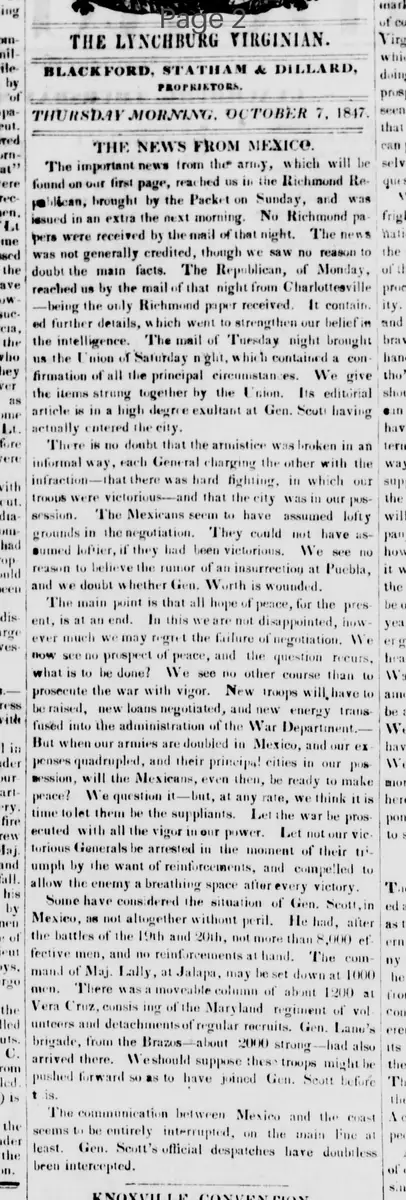
The important news from the army, which will be found on our first page, reached us in the Richmond Republican, brought by the Packet on Sunday, and was issued in an extra the next morning. No Richmond papers were received by the mail of that night. The news was not generally credited, though we saw no reason to doubt the main facts. The Republican, of Monday, reached us by the mail of that night from Charlottesville—being the only Richmond paper received. It contained further details, which went to strengthen our belief in the intelligence. The mail of Tuesday night brought us the Union of Saturday night, which contained a confirmation of all the principal circumstances. We give the items strung together by the Union. Its editorial article is in a high degree exultant at Gen. Scott having actually entered the city.
There is no doubt that the armistice was broken in an informal way, each General charging the other with the infraction—that there was hard fighting, in which our troops were victorious—and that the city was in our possession. The Mexicans seem to have assumed lofty grounds in the negotiation. They could not have assumed loftier, if they had been victorious. We see no reason to believe the rumor of an insurrection at Puebla, and we doubt whether Gen. Worth is wounded.
The main point is that all hope of peace, for the present, is at an end. In this we are not disappointed, however much we may regret the failure of negotiation. We now see no prospect of peace, and the question recurs, what is to be done? We see no other course than to prosecute the war with vigor. New troops will have to be raised, new loans negotiated, and new energy transfused into the administration of the War Department.— But when our armies are doubled in Mexico, and our expenses quadrupled, and their principal cities in our possession, will the Mexicans, even then, be ready to make peace? We question it—but, at any rate, we think it is time to let them be the suppliants. Let the war be prosecuted with all the vigor in our power. Let not our victorious Generals be arrested in the moment of their triumph by the want of reinforcements, and compelled to allow the enemy a breathing space after every victory.
Some have considered the situation of Gen. Scott, in Mexico, as not altogether without peril. He had, after the battles of the 19th and 20th, not more than 8,000 effective men, and no reinforcements at hand. The command of Maj. Lally, at Jalapa, may be set down at 1000 men. There was a moveable column of about 1200 at Vera Cruz, consisting of the Maryland regiment of volunteers and detachments of regular recruits. Gen. Lane's brigade, from the Brazos—about 2000 strong—had also arrived there. We should suppose these troops might be pushed forward so as to have joined Gen. Scott before this.
The communication between Mexico and the coast seems to be entirely interrupted, on the main line at least. Gen. Scott's official despatches have doubtless been intercepted.
BLACKFORD, STRATTON & Dillard,
THURSDAY MORNING, OCTOBER 7, 1847
THE NEWS FROM MEXICO.
The important news from the army, which will be found on our first page, reached us in the Richmond Republican, brought by the Packet on Sunday, and was issued in an extra the next morning. No Richmond papers were received by the mail of that night. The news was not generally credited, though we saw no reason to doubt the main facts. The Republican, of Monday, reached us by the mail of that night from Charlottesville—being the only Richmond paper received. It contained further details, which went to strengthen our belief in the intelligence. The mail of Tuesday night brought us the Union of Saturday night, which contained a confirmation of all the principal circumstances. We give the items strung together by the Union. Its editorial article is in a high degree exultant at Gen. Scott having actually entered the city.
There is no doubt that the armistice was broken in an informal way, each General charging the other with the infraction—that there was hard fighting, in which our troops were victorious—and that the city was in our possession. The Mexicans seem to have assumed lofty grounds in the negotiation. They could not have assumed loftier, if they had been victorious. We see no reason to believe the rumor of an insurrection at Puebla, and we doubt whether Gen. Worth is wounded.
The main point is that all hope of peace, for the present, is at an end. In this we are not disappointed, however much we may regret the failure of negotiation. We now see no prospect of peace, and the question recurs, what is to be done? We see no other course than to prosecute the war with vigor. New troops will have to be raised, new loans negotiated, and new energy transfused into the administration of the War Department.— But when our armies are doubled in Mexico, and our expenses quadrupled, and their principal cities in our possession, will the Mexicans, even then, be ready to make peace? We question it—but, at any rate, we think it is time to let them be the suppliants. Let the war be prosecuted with all the vigor in our power. Let not our victorious Generals be arrested in the moment of their triumph by the want of reinforcements, and compelled to allow the enemy a breathing space after every victory.
Some have considered the situation of Gen. Scott, in Mexico, as not altogether without peril. He had, after the battles of the 19th and 20th, not more than 8,000 effective men, and no reinforcements at hand. The command of Maj. Lally, at Jalapa, may be set down at 1000 men. There was a moveable column of about 1200 at Vera Cruz, consisting of the Maryland regiment of volunteers and detachments of regular recruits. Gen. Lane's brigade, from the Brazos—about 2000 strong—had also arrived there. We should suppose these troops might be pushed forward so as to have joined Gen. Scott before this.
The communication between Mexico and the coast seems to be entirely interrupted, on the main line at least. Gen. Scott's official despatches have doubtless been intercepted.
What sub-type of article is it?
War Or Peace
Military Affairs
What keywords are associated?
Mexican War
Gen Scott
Armistice Broken
Prosecute War
Peace Negotiations
Us Troops
Mexico City
What entities or persons were involved?
Gen. Scott
Gen. Worth
Maj. Lally
Gen. Lane
Mexicans
Us War Department
Editorial Details
Primary Topic
News From The Mexican War And Advocacy For Vigorous Prosecution
Stance / Tone
Resolute Support For Continuing The War Vigorously Despite Failed Peace Efforts
Key Figures
Gen. Scott
Gen. Worth
Maj. Lally
Gen. Lane
Mexicans
Us War Department
Key Arguments
Armistice Broken With Mutual Accusations, Leading To U.S. Victory And Possession Of Mexico City.
Rumors Of Puebla Insurrection And Gen. Worth's Wounding Are Doubted.
Peace Hopes Ended; War Must Be Prosecuted Vigorously With New Troops, Loans, And Administrative Energy.
Mexicans Unlikely To Seek Peace Even With U.S. Control Of Major Cities; Let Them Become Suppliants.
Gen. Scott's Forces Limited; Reinforcements From Jalapa, Vera Cruz, And Brazos Should Join Him.
Communication Lines Interrupted, Despatches Likely Intercepted.