Thank you for visiting SNEWPapers!
Sign up free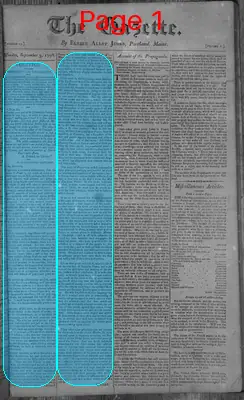
Editorial
September 3, 1798
The Gazette
Portland, Cumberland County, Maine
What is this article about?
A 1793 essay in the Columbian Centinel, republished to praise editor Benjamin Russell's consistent Federalist politics, critiques the French Revolution's shift from liberty to anarchy under leaders like Dumouriez and Jacobins, condemns agent Genet's interference in America, and advocates caution against unrestrained liberty leading to despotism.
Clipping
OCR Quality
95%
Excellent
Full Text
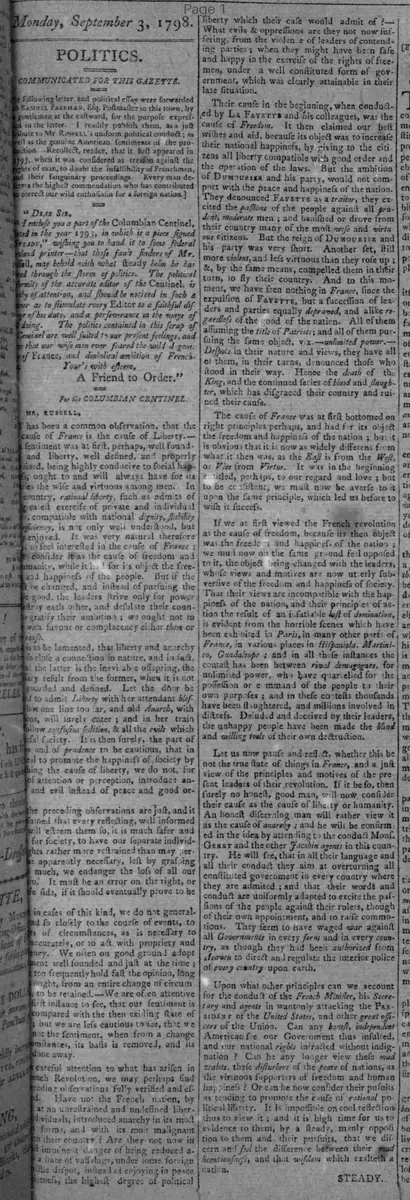
POLITICS.
COMMUNICATED FOR THIS GAZETTE.
The following letter, and political essay were forwarded to Samuel Freeman, Esq. Postmaster in this town, by a gentleman at the eastward, for the purpose expressed in the letter. I readily publish them, as a just tribute to Mr. Russell's uniform political conduct; as well as the genuine American sentiments of the production. -Recollect, reader, that it first appeared in 1793, when it was considered as treason against the rights of man, to doubt the infallibility of Frenchmen, and their sanguinary proceedings. Every man deserves the highest commendation who has contributed to correct our wild enthusiasm for a foreign nation.
"DEAR SIR,
I enclose you a part of the Columbian Centinel, printed in the year 1793, in which is a piece signed 'Freder,' wishing you to hand it to some federal land printer-that those fault finders of Mr. Russell, may behold with what steady helm he has steered through the storm of politics. The political conformity of the accurate editor of the Centinel, is worthy of attention, and should be noticed in such a manner as to stimulate every Editor to a faithful discharge of his duty, and a perseverance in the ways of uprightness. The politics contained in this scrap of Centinel are well suited to our present feelings, and to that our wise men ever feared the wild rage of France, and diabolical ambition of Frenchmen-
Yours with esteem,
A Friend to Order."
For the COLUMBIAN CENTINEL.
MR. RUSSELL,
It has been a common observation, that the cause of France is the cause of Liberty.-- This sentiment was at first, perhaps, well founded. For liberty, well defined, and properly restrained, being highly conducive to social happiness, ought to and will always have for its carriers the wise and virtuous among men. In this country, rational liberty, such as admits of the greatest exercise of private and individual rights, compatible with national dignity, stability and efficiency, is not only well understood, but enjoyed. It was very natural therefore to feel interested in the cause of France: to consider it as the cause of freedom and humanity, while it had for its object the freedom and happiness of the people. But if the war be changed, and instead of pursuing the general good, the leaders strive only for power, destroy each other, and desolate their country to gratify their ambition; we ought not to view with favour or complacency either them or their measures.
It is to be lamented, that liberty and anarchy to close a connection in nature, and in fact, that the latter is the inevitable offspring, the necessary result from the former, when it is not guarded and defined. Let the door be opened to admit Liberty with her attendant blessings, but one line too far, and old Anarchy, with her sons, will surely enter: and in her train follow confusion, sedition, & all the evils which befall society. It is then surely, the part of wisdom and of prudence to be cautious, that in our zeal to promote the happiness of society by cherishing the cause of liberty, we do not, for want of attention or perception, introduce anarchy and evil instead of peace and good order.
If the preceding observations are just, and it is presumed that every reflecting, well informed man will esteem them so, it is much safer and better for society, to have our separate individual rights rather more restrained than may apparently be necessary, lest by grasping too much, we endanger the loss of all our freedom. It must be an error on the right, or the left side, if it should eventually prove to be in cases of this kind, we do not generally attend so closely to those courses of events, to the train of circumstances, as is necessary to judge accurately, or to act with propriety and decency. We often on good ground adopt sentiments well founded and just at the time: too frequently hold fast the opinion, long after it ought from an entire change of circumstances to be retained. We are often inattentive to see, that our sentiment is compared with the then existing state of things; but we are less cautious to see, that we do not retain the sentiment, when from a change in circumstances, its basis is removed, and its support done away.
By a careful attention to what has arisen in the French Revolution, we may perhaps find the preceding observations fully verified and established. Have not the French nation, by acting on an unrestrained and undefined liberty of individuals, introduced anarchy in its worst forms, and with its most malignant effects to their country? Are they not now in imminent danger of being reduced as a state of vassalage, under some foreign despotic depot, instead of enjoying in peace and quietness, the highest degree of political liberty which their case would admit of?-- What evils & oppressions are they not now suffering, from the violence of leaders of contending parties; when they might have been safe and happy in the exercise of the rights of freemen, under a well constituted form of government, which was clearly attainable in their late situation.
Their cause in the beginning, when conducted by La Fayette and his colleagues, was the cause of Freedom. It then claimed our best wishes and aid, because its object was to increase their national happiness, by giving to the citizens all liberty compatible with good order and the operation of the laws. But the ambition of Dumourier and his party, would not comport with the peace and happiness of the nation. They denounced Fayette as a traitor, they excited the passions of the people against all prudent, moderate men; and banished or drove from their country many of the most wise and virtuous citizens. But the reign of Dumourier and his party was very short. Another set, still more violent, and less virtuous than they rose up; &, by the same means, compelled them in their turn, to fly their country. And to this moment, we have seen nothing in France, since the expulsion of Fayette, but a succession of leaders and parties equally depraved, and alike regardless of the good of the nation. All of them assuming the title of Patriots; and all of them pursuing the same object, viz.-unlimited power.- Despots in their nature and views, they have all of them, in their turns, denounced those who stood in their way. Hence the death of the King, and the continued series of blood and slaughter, which has disgraced their country and ruined their cause.
The cause of France was at first bottomed on right principles perhaps, and had for its object the freedom and happiness of the nation; but it is obvious that it is now as widely different from what it then was, as the East is from the West, or Vice from Virtue. It was in the beginning entitled, perhaps, to our regard and love; but to be consistent, we must now be averse to it upon the same principle, which led us before to wish it success.
If we at first viewed the French revolution as the cause of freedom, because its then object was the freedom and happiness of the nation; we must now on the same ground feel opposed to it, the object being changed with the leaders, whose views and motives are now utterly subversive of the freedom and happiness of society. That their views are incompatible with the happiness of the nation, and their principles of action the result of an insatiable lust of domination, is evident from the horrible scenes which have been exhibited in Paris, in many other parts of France, in various places in Hispaniola, Martinico, Guadaloupe; and in all these instances the contest has been between rival demagogues, for unlimited power, who have quarrelled for the possession or command of the people to their own purposes: and in these contests thousands have been slaughtered, and millions involved in distress. Deluded and deceived by their leaders, the unhappy people have been made the blind and willing tools of their own destruction.
Let us now pause and reflect. whether this be not the true state of things in France, and a just view of the principles and motives of the present leaders of their revolution. If it be so, then surely no honest, good man, will now consider their cause as the cause of liberty or humanity. An honest discerning man will rather view it as the cause of anarchy; and he will be confirmed in the idea by attending to the conduct Mon. Genet and the other Jacobin agents in this country. He will see, that in all their language and all their conduct they aim at overturning all constituted government in every country where they are admitted: and that their words and conduct are uniformly adapted to excite the passions of the people against their rulers, though of their own appointment, and to raise commotions. They seem to have waged war against all Governments in every form and in every country, as though they had been authorized from heaven to direct and regulate the interior police of every country upon earth,
Upon what other principles can we account for the conduct of the French Minister, his Secretary and agents in wantonly attacking the Presidency of the United States, and other great officers of the Union. Can any honest, independent American see our Government thus insulted, and our national rights infringed without indignation? Can he any longer view these mad zealots, these disturbers of the peace of nations, as the virtuous supporters of freedom and human happiness? Or can he now consider their pursuits as tending to promote the cause of rational political liberty. It is impossible on cool reflection thus to view it; and it is high time for us to give them evidence to them, by a steady, manly opposition to them and their pursuits. that we discern and feel the difference between their mad licentiousness, and that wisdom which exalteth a nation.
STEADY
COMMUNICATED FOR THIS GAZETTE.
The following letter, and political essay were forwarded to Samuel Freeman, Esq. Postmaster in this town, by a gentleman at the eastward, for the purpose expressed in the letter. I readily publish them, as a just tribute to Mr. Russell's uniform political conduct; as well as the genuine American sentiments of the production. -Recollect, reader, that it first appeared in 1793, when it was considered as treason against the rights of man, to doubt the infallibility of Frenchmen, and their sanguinary proceedings. Every man deserves the highest commendation who has contributed to correct our wild enthusiasm for a foreign nation.
"DEAR SIR,
I enclose you a part of the Columbian Centinel, printed in the year 1793, in which is a piece signed 'Freder,' wishing you to hand it to some federal land printer-that those fault finders of Mr. Russell, may behold with what steady helm he has steered through the storm of politics. The political conformity of the accurate editor of the Centinel, is worthy of attention, and should be noticed in such a manner as to stimulate every Editor to a faithful discharge of his duty, and a perseverance in the ways of uprightness. The politics contained in this scrap of Centinel are well suited to our present feelings, and to that our wise men ever feared the wild rage of France, and diabolical ambition of Frenchmen-
Yours with esteem,
A Friend to Order."
For the COLUMBIAN CENTINEL.
MR. RUSSELL,
It has been a common observation, that the cause of France is the cause of Liberty.-- This sentiment was at first, perhaps, well founded. For liberty, well defined, and properly restrained, being highly conducive to social happiness, ought to and will always have for its carriers the wise and virtuous among men. In this country, rational liberty, such as admits of the greatest exercise of private and individual rights, compatible with national dignity, stability and efficiency, is not only well understood, but enjoyed. It was very natural therefore to feel interested in the cause of France: to consider it as the cause of freedom and humanity, while it had for its object the freedom and happiness of the people. But if the war be changed, and instead of pursuing the general good, the leaders strive only for power, destroy each other, and desolate their country to gratify their ambition; we ought not to view with favour or complacency either them or their measures.
It is to be lamented, that liberty and anarchy to close a connection in nature, and in fact, that the latter is the inevitable offspring, the necessary result from the former, when it is not guarded and defined. Let the door be opened to admit Liberty with her attendant blessings, but one line too far, and old Anarchy, with her sons, will surely enter: and in her train follow confusion, sedition, & all the evils which befall society. It is then surely, the part of wisdom and of prudence to be cautious, that in our zeal to promote the happiness of society by cherishing the cause of liberty, we do not, for want of attention or perception, introduce anarchy and evil instead of peace and good order.
If the preceding observations are just, and it is presumed that every reflecting, well informed man will esteem them so, it is much safer and better for society, to have our separate individual rights rather more restrained than may apparently be necessary, lest by grasping too much, we endanger the loss of all our freedom. It must be an error on the right, or the left side, if it should eventually prove to be in cases of this kind, we do not generally attend so closely to those courses of events, to the train of circumstances, as is necessary to judge accurately, or to act with propriety and decency. We often on good ground adopt sentiments well founded and just at the time: too frequently hold fast the opinion, long after it ought from an entire change of circumstances to be retained. We are often inattentive to see, that our sentiment is compared with the then existing state of things; but we are less cautious to see, that we do not retain the sentiment, when from a change in circumstances, its basis is removed, and its support done away.
By a careful attention to what has arisen in the French Revolution, we may perhaps find the preceding observations fully verified and established. Have not the French nation, by acting on an unrestrained and undefined liberty of individuals, introduced anarchy in its worst forms, and with its most malignant effects to their country? Are they not now in imminent danger of being reduced as a state of vassalage, under some foreign despotic depot, instead of enjoying in peace and quietness, the highest degree of political liberty which their case would admit of?-- What evils & oppressions are they not now suffering, from the violence of leaders of contending parties; when they might have been safe and happy in the exercise of the rights of freemen, under a well constituted form of government, which was clearly attainable in their late situation.
Their cause in the beginning, when conducted by La Fayette and his colleagues, was the cause of Freedom. It then claimed our best wishes and aid, because its object was to increase their national happiness, by giving to the citizens all liberty compatible with good order and the operation of the laws. But the ambition of Dumourier and his party, would not comport with the peace and happiness of the nation. They denounced Fayette as a traitor, they excited the passions of the people against all prudent, moderate men; and banished or drove from their country many of the most wise and virtuous citizens. But the reign of Dumourier and his party was very short. Another set, still more violent, and less virtuous than they rose up; &, by the same means, compelled them in their turn, to fly their country. And to this moment, we have seen nothing in France, since the expulsion of Fayette, but a succession of leaders and parties equally depraved, and alike regardless of the good of the nation. All of them assuming the title of Patriots; and all of them pursuing the same object, viz.-unlimited power.- Despots in their nature and views, they have all of them, in their turns, denounced those who stood in their way. Hence the death of the King, and the continued series of blood and slaughter, which has disgraced their country and ruined their cause.
The cause of France was at first bottomed on right principles perhaps, and had for its object the freedom and happiness of the nation; but it is obvious that it is now as widely different from what it then was, as the East is from the West, or Vice from Virtue. It was in the beginning entitled, perhaps, to our regard and love; but to be consistent, we must now be averse to it upon the same principle, which led us before to wish it success.
If we at first viewed the French revolution as the cause of freedom, because its then object was the freedom and happiness of the nation; we must now on the same ground feel opposed to it, the object being changed with the leaders, whose views and motives are now utterly subversive of the freedom and happiness of society. That their views are incompatible with the happiness of the nation, and their principles of action the result of an insatiable lust of domination, is evident from the horrible scenes which have been exhibited in Paris, in many other parts of France, in various places in Hispaniola, Martinico, Guadaloupe; and in all these instances the contest has been between rival demagogues, for unlimited power, who have quarrelled for the possession or command of the people to their own purposes: and in these contests thousands have been slaughtered, and millions involved in distress. Deluded and deceived by their leaders, the unhappy people have been made the blind and willing tools of their own destruction.
Let us now pause and reflect. whether this be not the true state of things in France, and a just view of the principles and motives of the present leaders of their revolution. If it be so, then surely no honest, good man, will now consider their cause as the cause of liberty or humanity. An honest discerning man will rather view it as the cause of anarchy; and he will be confirmed in the idea by attending to the conduct Mon. Genet and the other Jacobin agents in this country. He will see, that in all their language and all their conduct they aim at overturning all constituted government in every country where they are admitted: and that their words and conduct are uniformly adapted to excite the passions of the people against their rulers, though of their own appointment, and to raise commotions. They seem to have waged war against all Governments in every form and in every country, as though they had been authorized from heaven to direct and regulate the interior police of every country upon earth,
Upon what other principles can we account for the conduct of the French Minister, his Secretary and agents in wantonly attacking the Presidency of the United States, and other great officers of the Union. Can any honest, independent American see our Government thus insulted, and our national rights infringed without indignation? Can he any longer view these mad zealots, these disturbers of the peace of nations, as the virtuous supporters of freedom and human happiness? Or can he now consider their pursuits as tending to promote the cause of rational political liberty. It is impossible on cool reflection thus to view it; and it is high time for us to give them evidence to them, by a steady, manly opposition to them and their pursuits. that we discern and feel the difference between their mad licentiousness, and that wisdom which exalteth a nation.
STEADY
What sub-type of article is it?
Foreign Affairs
Partisan Politics
War Or Peace
What keywords are associated?
French Revolution
Jacobin Agents
Political Anarchy
Federalist Politics
Edmond Genet
Benjamin Russell
American Liberty
French Ambition
What entities or persons were involved?
France
French Revolution
La Fayette
Dumourier
Mon. Genet
Jacobins
Mr. Russell
Columbian Centinel
Presidency Of The United States
Editorial Details
Primary Topic
Critique Of The French Revolution's Descent Into Anarchy And Opposition To Jacobin Influence In America
Stance / Tone
Anti Jacobin And Pro Stable Government, Praising Consistent Federalist Politics
Key Figures
France
French Revolution
La Fayette
Dumourier
Mon. Genet
Jacobins
Mr. Russell
Columbian Centinel
Presidency Of The United States
Key Arguments
Initial French Cause Was Liberty But Devolved Into Anarchy Due To Unrestrained Individual Liberty
Succession Of Violent Leaders Like Dumouriez Pursued Power Over National Happiness
Jacobin Agents Like Genet Incite Sedition Against Governments Including America's
American Liberty Is Rational And Restrained, Unlike French Chaos
Consistency In Political Views Is Vital; Praise For Russell's Steady Federalism
Opposition To French Revolution Now Required For Consistency With Liberty Principles