Thank you for visiting SNEWPapers!
Sign up free
Story
September 11, 1933
The Daily Alaska Empire
Juneau, Juneau County, Alaska
What is this article about?
Dr. H. B. Mavis summarizes Navy studies from the Second Polar Year, revealing that the stratosphere has varying temperatures, high-altitude winds affecting magnetic needles, auroras, radio, ozone, and weather in polar regions like Alaska.
Clipping
OCR Quality
98%
Excellent
Full Text
WINDS IN THE STRATOSPHERE.
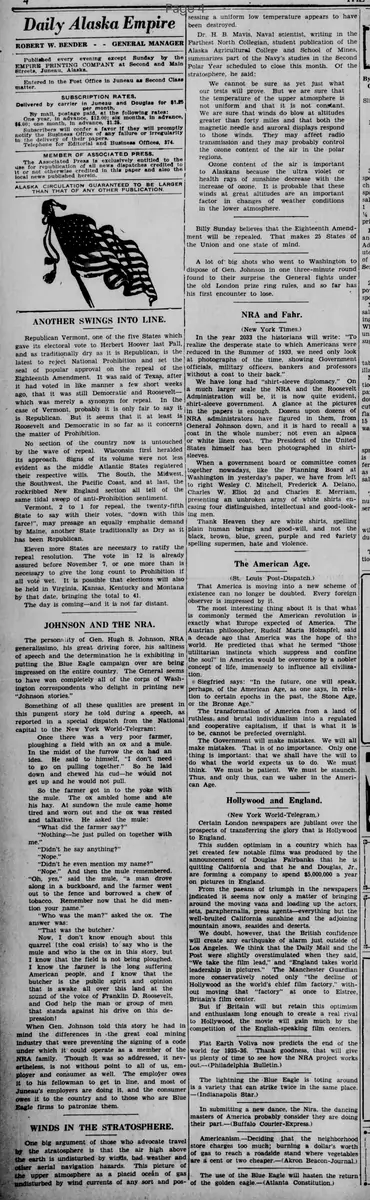
One big argument of those who advocate travel by the stratosphere is that the air high above the earth is undisturbed by winds, bad weather and other aerial navigation hazards. This picture of the upper atmosphere as a placid ocean of gas undisturbed by wind currents of any sort and possessing a uniform low temperature appears to have been destroyed.
Dr. H. B. Mavis, Naval scientist, writing in the Farthest North Collegian, student publication of the Alaska Agricultural College and School of Mines, summarizes part of the Navy's studies in the Second Polar Year scheduled to close this month. Of the stratosphere, he said:
We cannot be sure as yet just what our tests will prove. But we are sure that the temperature of the upper atmosphere is not uniform and that it is not constant.
We are sure that winds do blow at altitudes greater than forty miles and that both the magnetic needle and auroral displays respond to those winds. They may affect radio transmission and they may probably control the ozone content of the air in the polar regions.
Ozone content of the air is important to Alaskans because the ultra violet or health rays of sunshine decrease with the increase of ozone. It is probable that these winds at great altitudes are an important factor in changes of weather conditions in the lower atmosphere.
One big argument of those who advocate travel by the stratosphere is that the air high above the earth is undisturbed by winds, bad weather and other aerial navigation hazards. This picture of the upper atmosphere as a placid ocean of gas undisturbed by wind currents of any sort and possessing a uniform low temperature appears to have been destroyed.
Dr. H. B. Mavis, Naval scientist, writing in the Farthest North Collegian, student publication of the Alaska Agricultural College and School of Mines, summarizes part of the Navy's studies in the Second Polar Year scheduled to close this month. Of the stratosphere, he said:
We cannot be sure as yet just what our tests will prove. But we are sure that the temperature of the upper atmosphere is not uniform and that it is not constant.
We are sure that winds do blow at altitudes greater than forty miles and that both the magnetic needle and auroral displays respond to those winds. They may affect radio transmission and they may probably control the ozone content of the air in the polar regions.
Ozone content of the air is important to Alaskans because the ultra violet or health rays of sunshine decrease with the increase of ozone. It is probable that these winds at great altitudes are an important factor in changes of weather conditions in the lower atmosphere.
What sub-type of article is it?
Curiosity
What themes does it cover?
Nature
What keywords are associated?
Stratosphere Winds
Upper Atmosphere
Polar Year Studies
Ozone Content
Navy Research
Auroral Displays
What entities or persons were involved?
Dr. H. B. Mavis
Where did it happen?
Stratosphere, Polar Regions, Alaska
Story Details
Key Persons
Dr. H. B. Mavis
Location
Stratosphere, Polar Regions, Alaska
Event Date
Second Polar Year
Story Details
Scientific studies challenge the assumption of a calm stratosphere, revealing varying temperatures, high-altitude winds influencing magnetic fields, auroras, radio, ozone levels, and weather, as summarized by Dr. Mavis from Navy research.