Thank you for visiting SNEWPapers!
Sign up free
The East Hartford Gazette
New Britain, Hartford County, Connecticut
What is this article about?
Drew Pearson reports President Kennedy faces same Berlin showdown as Eisenhower in 1959, with Joint Chiefs warning airlift impossible and defense requires nuclear war or talks, citing massive Soviet army strength of 170-300 divisions and 70,000 tanks.
Clipping
OCR Quality
Full Text
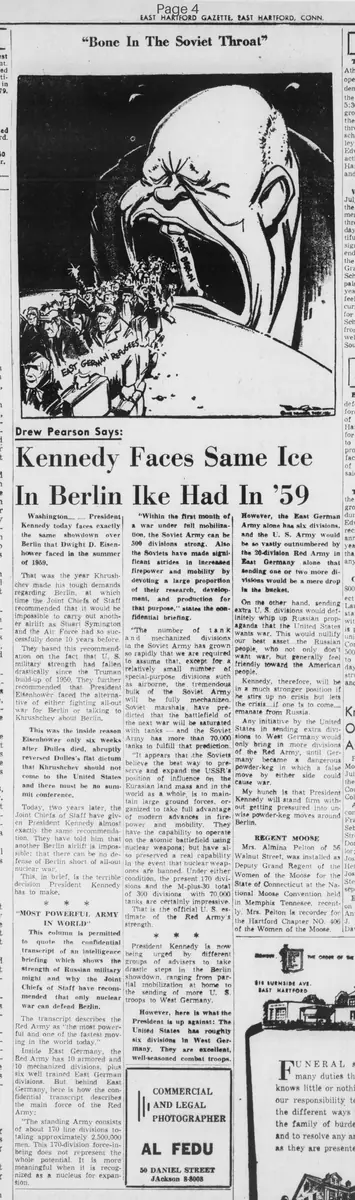
"Bomb in the Soviet Throat"
Drew Pearson Says:
Kennedy Faces Same Ice In Berlin Ike Had In '59
Washington - President Kennedy today faces exactly the same showdown over Berlin that Dwight D. Eisenhower faced in the summer of 1959.
That was the year Khrushchev made his tough demands regarding Berlin, at which time the Joint Chiefs of Staff recommended that it would be impossible to carry out another airlift as Stuart Symington and the Air Force had so successfully done 10 years before.
They based this recommendation on the fact that U. S. military strength had fallen drastically since the Truman build-up of 1950. They further recommended that President Eisenhower faced the alternative of either fighting all-out war for Berlin or talking to Khrushchev about Berlin.
This was the inside reason Eisenhower only six weeks after Dulles died, abruptly reversed Dulles's flat dictum that Khrushchev should not come to the United States and there must be no summit conference.
Today, two years later, the Joint Chiefs of Staff have given President Kennedy almost exactly the same recommendation. They have told him that another Berlin airlift is impossible; that there can be no defense of Berlin short of all-out nuclear war.
This, in brief, is the terrible decision President Kennedy has to make.
"MOST POWERFUL ARMY IN WORLD"
This column is permitted to quote the confidential transcript of an intelligence briefing which shows the strength of Russian military might and why the Joint Chiefs of Staff have recommended that only nuclear war can defend Berlin.
The transcript describes the Red Army as "the most powerful and one of the fastest moving in the world today."
Inside East Germany, the Red Army has 10 armored and 10 mechanized divisions, plus six well trained East German divisions.
But behind East Germany, here is how the confidential transcript describes the main force of the Red Army:
"The standing Army consists of about 170 line divisions totaling approximately 2,500,000 men. This 170-division force-in-being does not represent the whole potential. It is more meaningful when it is recognized as a nucleus for expansion.
"Within the first month of a war under full mobilization, the Soviet Army can be 300 divisions strong. Also the Soviets have made significant strides in increased firepower and mobility by devoting a large proportion of their research, development, and production for that purpose," states the confidential briefing.
"The number of tank and mechanized divisions in the Soviet Army has grown so rapidly that we are required to assume that, except for a relatively small number of special-purpose divisions such as airborne, the tremendous bulk of the Soviet Army will be fully mechanized.
Soviet marshals have predicted that the battlefield of the next war will be saturated with tanks - and the Soviet Army has more than 70,000 tanks to fulfill that prediction.
"It appears that the Soviets believe the best way to preserve and expand the USSR's position of influence on the Eurasian land mass and in the world as a whole, is to maintain large ground forces, organized to take full advantage of modern advances in firepower and mobility. They have the capability to operate on the atomic battlefield using nuclear weapons; but have also preserved a real capability in the event that nuclear weapons are banned. Under either condition, the present 170 divisions and the M-plus-30 total of 300 divisions with 70,000 tanks are certainly impressive.
That is the official U. S. estimate of the Red Army's strength.
President Kennedy is now being urged by different groups of advisers to take drastic steps in the Berlin showdown, ranging from partial mobilization at home to the sending of more U. S. troops to West Germany.
However, here is what the President is up against: The United States has roughly six divisions in West Germany.
They are excellent, well-seasoned combat troops.
However, the East German Army alone has six divisions, and the U. S. Army would be so vastly outnumbered by the 20-division Red Army in East Germany alone that sending one or two more divisions would be a mere drop in the bucket.
On the other hand, sending extra U. S. divisions would definitely whip up Russian propaganda that the United States wants war. This would nullify our best asset the Russian people, who not only don't want war, but generally feel friendly toward the American people.
Kennedy, therefore, will be in a much stronger position if he stirs up no crisis but lets the crisis if one is to come emanate from Russia.
Any initiative by the United States in sending extra divisions to West Germany would only bring in more divisions of the Red Army, until Germany became a dangerous powder-keg in which a false move by either side could cause war.
My hunch is that President Kennedy will stand firm without getting pressured into unwise powder-keg moves around Berlin.
What sub-type of article is it?
What keywords are associated?
What entities or persons were involved?
Where did it happen?
Foreign News Details
Primary Location
Berlin
Event Date
Summer Of 1959 And Today Two Years Later
Key Persons
Outcome
joint chiefs recommend no berlin airlift possible; defense requires all-out nuclear war or talks; soviet army estimated at 170 divisions expandable to 300 with 70,000 tanks
Event Details
Drew Pearson column compares Kennedy's Berlin crisis to Eisenhower's in 1959, where Khrushchev made demands; Joint Chiefs advised against airlift due to reduced US strength, leading to summit reversal after Dulles's death; current advice similar, highlighting Soviet military superiority in East Germany and beyond