Thank you for visiting SNEWPapers!
Sign up free
Story
December 10, 1900
Daily Kennebec Journal
Augusta, Kennebec County, Maine
What is this article about?
The fifth Atlanta Conference on Negro Problems at Atlanta University analyzed data from over 1,200 college-educated African Americans, showing they primarily work as teachers and ministers, own significant property, mostly stay in the South to uplift their race, and express strong hope for the future. (248 characters)
Clipping
OCR Quality
95%
Excellent
Full Text
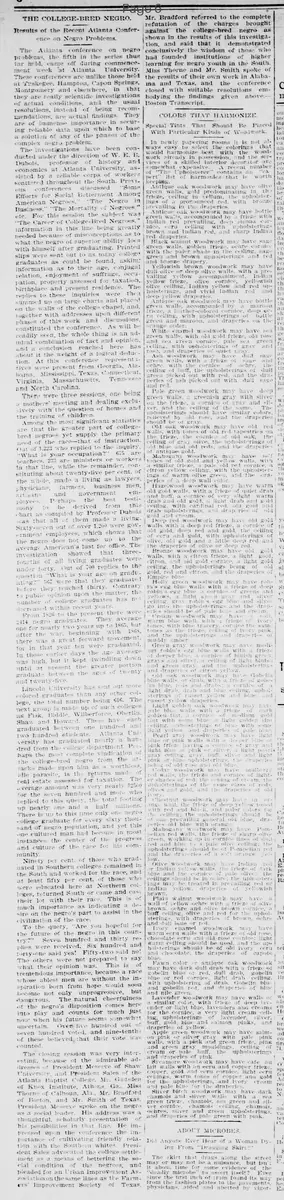
THE COLLEGE-BRED NEGRO.
Results of the Recent Atlanta Conference on Negro Problems.
The Atlanta conference on negro problems, the fifth in the series thus far held, came off during commencement week at Atlanta University. These conferences are unlike those held at Tuskegee, Hampton, Capon Springs, Montgomery and elsewhere, in that they are really scientific investigations of actual conditions, and the usual resolutions, instead of being recommendations, are actual findings. They are of immense importance in securing reliable data upon which to base a solution of any of the phases of the complex negro problem.
The investigations have been conducted under the direction of W. E. B. Dubois, professor of history and economics at Atlanta University, assisted by a reliable corps of workers scattered throughout the South. Previous conferences discussed "Some Efforts for Social Betterment Among American Negroes," "The Negro in Business," "The Mortality of Negroes," etc. For this session the subject was "The Career of College-Bred Negroes." information in this line being greatly needed because of misconceptions as to what the negro of superior ability does with himself after graduating. Printed slips were sent out to as many college graduates as could be found, asking information as to their age, conjugal relation, enjoyment of suffrage, occupation, property assessed for taxation, birthplace and present residence. The replies to these inquiries were then summed up on large charts and placed on the walls of the college chapel, and, together with addresses upon different phases of this work and discussions, constituted the conference. As will be readily seen, the whole thing is an admirable combination of fact and opinion, and a conclusion reached here has about it the weight of a logical deduction. At this conference representatives were present from Georgia, Alabama, Mississippi, Texas, Connecticut, Virginia, Massachusetts, Tennessee and North Carolina.
There were three sessions, one being a mothers' meeting and dealing exclusively with the question of homes and the training of children. Among the most significant statistics are that the greater part of college-bred negroes yet supply the primary need of the race-that of instruction. Out of 1,223 who replied to the inquiry, "What is your occupation?" 615 are teachers, 233 are ministers or workers in that line, while the remainder, constituting about twenty-five per cent. of the whole, made a living as lawyers, physicians, farmers, business men, artisans and government employees. Perhaps the best testimony to be derived from this was that all of them made a living. Sixty-seven out of over 1,200 were government employees, which shows that the average American's lust for office the negro does not come up to. The investigation showed that three-fourths of all living graduates were under forty. Out of 100 replies to the question "what is your age on graduating?" 567 were that they graduated before they reached thirty, contrary to public opinion upon the matter. The number of college graduates has not decreased within recent years. From 1866 to the present there were still negro graduates. They average one for nearly two years up to 1865, but after the war, beginning with 1866, there was a great forward movement, for in that year ten were graduated. In those earlier days the age average was high, but it kept dwindling down graduate between the ages of twenty and twenty-five until at present the greater portion. Lincoln university has sent out more colored graduates than any other college, the total number being 516. The next group is made up of such colleges as Fisk, Biddle, Wilberforce, Oberlin, Shaw and Howard. These have each graduated between one hundred and two hundred students. Atlanta University has graduated nearly a hundred from the college department. Perhaps the most complete vindication of the college-bred negro from the attacks made upon him as a worthless, idle parasite, is the returns made of real estate assessed for taxation. The average amount was very nearly $250 for the seven hundred and more who replied to this query, the total footing up nearly one and a half millions. There is up to this time only one negro college graduate for every sixty thousand of negro population, and yet this one cultured man had become in most instances the center of the progress and culture of the race for his community. Ninety per cent. of those who graduated in Southern colleges remained in the South and worked for the race, and at least fifty per cent. of those who were educated here at Northern colleges, returned South or came and cast their lot with their race. This is of much importance as indicating a desire on the negro's part to assist in the civilization of the race.
To the query, "Are you hopeful for the future of the negro in this country?" Seven hundred and thirty replies were received. Six hundred and forty-one said yes! Fifty-two said no! The others were not prepared to say what their opinion was. This is of tremendous importance, because a race whose ablest men are without the inspiration born from hope would soon become not only unprogressive, but dangerous. The natural cheerfulness of the negro's disposition comes here into play and counts for much just now when his future seems somewhat uncertain. Over five hundred out of seven hundred voted, and nine-tenths of these believed, that their vote was counted.
The closing session was very interesting, because of the admirable addresses of President Meserve of Shaw University, and President Sales of the Atlanta Baptist College, Mr. Gadsden of Knox Institute, Athens, Ga., Miss Thorne of Calhoun, Ala., Mr. Bradford of Boston, and Mr. Smith of Texas. President Meserve spoke on the negro as a social leader. His address was a thoughtful, scholarly presentation of his possibilities in that line. He impressed upon the conference the importance of cultivating friendly relations with the Southern whites. President Sales advocated the college settlement as a means of bettering the social condition of the negroes, and pleaded for an Urban Improvement Association on the same lines as the Farmers' Improvement Society of Texas.
Mr. Bradford referred to the complete refutation of the charges brought against the college-bred negro as shown in the results of this investigation, and said that it demonstrated conclusively the wisdom of those who had founded institutions of higher learning for negro youth in the South. Miss Thorne and Mr. Smith spoke of the results of their own work in Alabama and Texas, and the conference closed with suitable resolutions embodying the findings given above.
Boston Transcript.
Results of the Recent Atlanta Conference on Negro Problems.
The Atlanta conference on negro problems, the fifth in the series thus far held, came off during commencement week at Atlanta University. These conferences are unlike those held at Tuskegee, Hampton, Capon Springs, Montgomery and elsewhere, in that they are really scientific investigations of actual conditions, and the usual resolutions, instead of being recommendations, are actual findings. They are of immense importance in securing reliable data upon which to base a solution of any of the phases of the complex negro problem.
The investigations have been conducted under the direction of W. E. B. Dubois, professor of history and economics at Atlanta University, assisted by a reliable corps of workers scattered throughout the South. Previous conferences discussed "Some Efforts for Social Betterment Among American Negroes," "The Negro in Business," "The Mortality of Negroes," etc. For this session the subject was "The Career of College-Bred Negroes." information in this line being greatly needed because of misconceptions as to what the negro of superior ability does with himself after graduating. Printed slips were sent out to as many college graduates as could be found, asking information as to their age, conjugal relation, enjoyment of suffrage, occupation, property assessed for taxation, birthplace and present residence. The replies to these inquiries were then summed up on large charts and placed on the walls of the college chapel, and, together with addresses upon different phases of this work and discussions, constituted the conference. As will be readily seen, the whole thing is an admirable combination of fact and opinion, and a conclusion reached here has about it the weight of a logical deduction. At this conference representatives were present from Georgia, Alabama, Mississippi, Texas, Connecticut, Virginia, Massachusetts, Tennessee and North Carolina.
There were three sessions, one being a mothers' meeting and dealing exclusively with the question of homes and the training of children. Among the most significant statistics are that the greater part of college-bred negroes yet supply the primary need of the race-that of instruction. Out of 1,223 who replied to the inquiry, "What is your occupation?" 615 are teachers, 233 are ministers or workers in that line, while the remainder, constituting about twenty-five per cent. of the whole, made a living as lawyers, physicians, farmers, business men, artisans and government employees. Perhaps the best testimony to be derived from this was that all of them made a living. Sixty-seven out of over 1,200 were government employees, which shows that the average American's lust for office the negro does not come up to. The investigation showed that three-fourths of all living graduates were under forty. Out of 100 replies to the question "what is your age on graduating?" 567 were that they graduated before they reached thirty, contrary to public opinion upon the matter. The number of college graduates has not decreased within recent years. From 1866 to the present there were still negro graduates. They average one for nearly two years up to 1865, but after the war, beginning with 1866, there was a great forward movement, for in that year ten were graduated. In those earlier days the age average was high, but it kept dwindling down graduate between the ages of twenty and twenty-five until at present the greater portion. Lincoln university has sent out more colored graduates than any other college, the total number being 516. The next group is made up of such colleges as Fisk, Biddle, Wilberforce, Oberlin, Shaw and Howard. These have each graduated between one hundred and two hundred students. Atlanta University has graduated nearly a hundred from the college department. Perhaps the most complete vindication of the college-bred negro from the attacks made upon him as a worthless, idle parasite, is the returns made of real estate assessed for taxation. The average amount was very nearly $250 for the seven hundred and more who replied to this query, the total footing up nearly one and a half millions. There is up to this time only one negro college graduate for every sixty thousand of negro population, and yet this one cultured man had become in most instances the center of the progress and culture of the race for his community. Ninety per cent. of those who graduated in Southern colleges remained in the South and worked for the race, and at least fifty per cent. of those who were educated here at Northern colleges, returned South or came and cast their lot with their race. This is of much importance as indicating a desire on the negro's part to assist in the civilization of the race.
To the query, "Are you hopeful for the future of the negro in this country?" Seven hundred and thirty replies were received. Six hundred and forty-one said yes! Fifty-two said no! The others were not prepared to say what their opinion was. This is of tremendous importance, because a race whose ablest men are without the inspiration born from hope would soon become not only unprogressive, but dangerous. The natural cheerfulness of the negro's disposition comes here into play and counts for much just now when his future seems somewhat uncertain. Over five hundred out of seven hundred voted, and nine-tenths of these believed, that their vote was counted.
The closing session was very interesting, because of the admirable addresses of President Meserve of Shaw University, and President Sales of the Atlanta Baptist College, Mr. Gadsden of Knox Institute, Athens, Ga., Miss Thorne of Calhoun, Ala., Mr. Bradford of Boston, and Mr. Smith of Texas. President Meserve spoke on the negro as a social leader. His address was a thoughtful, scholarly presentation of his possibilities in that line. He impressed upon the conference the importance of cultivating friendly relations with the Southern whites. President Sales advocated the college settlement as a means of bettering the social condition of the negroes, and pleaded for an Urban Improvement Association on the same lines as the Farmers' Improvement Society of Texas.
Mr. Bradford referred to the complete refutation of the charges brought against the college-bred negro as shown in the results of this investigation, and said that it demonstrated conclusively the wisdom of those who had founded institutions of higher learning for negro youth in the South. Miss Thorne and Mr. Smith spoke of the results of their own work in Alabama and Texas, and the conference closed with suitable resolutions embodying the findings given above.
Boston Transcript.
What sub-type of article is it?
Historical Event
Curiosity
What themes does it cover?
Triumph
Social Manners
Moral Virtue
What keywords are associated?
Atlanta Conference
Negro Problems
College Graduates
Careers
Education
South
Hope
What entities or persons were involved?
W. E. B. Dubois
President Meserve
President Sales
Mr. Gadsden
Miss Thorne
Mr. Bradford
Mr. Smith
Where did it happen?
Atlanta University, South
Story Details
Key Persons
W. E. B. Dubois
President Meserve
President Sales
Mr. Gadsden
Miss Thorne
Mr. Bradford
Mr. Smith
Location
Atlanta University, South
Event Date
During Commencement Week
Story Details
The fifth Atlanta Conference investigated careers of college-bred Negroes, finding most are teachers or ministers, own property, remain in the South to aid their race, and are hopeful for the future despite challenges.