Thank you for visiting SNEWPapers!
Sign up free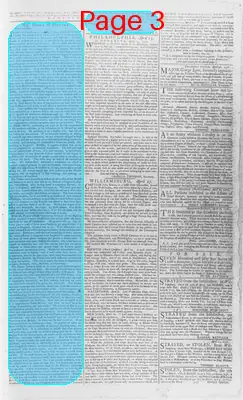
Letter to Editor
April 27, 1776
The Virginia Gazette
Richmond, Williamsburg, Richmond County, Virginia
What is this article about?
A Virginian rebuts a 'Planter's' advocacy for independence and free trade by defending British merchants' pricing, correcting tobacco duty drawbacks, and warning of the high costs of separation, including maintaining a standing army and fleet.
Clipping
OCR Quality
95%
Excellent
Full Text
Mess. Dixon & Hunter,
GENTLEMEN,
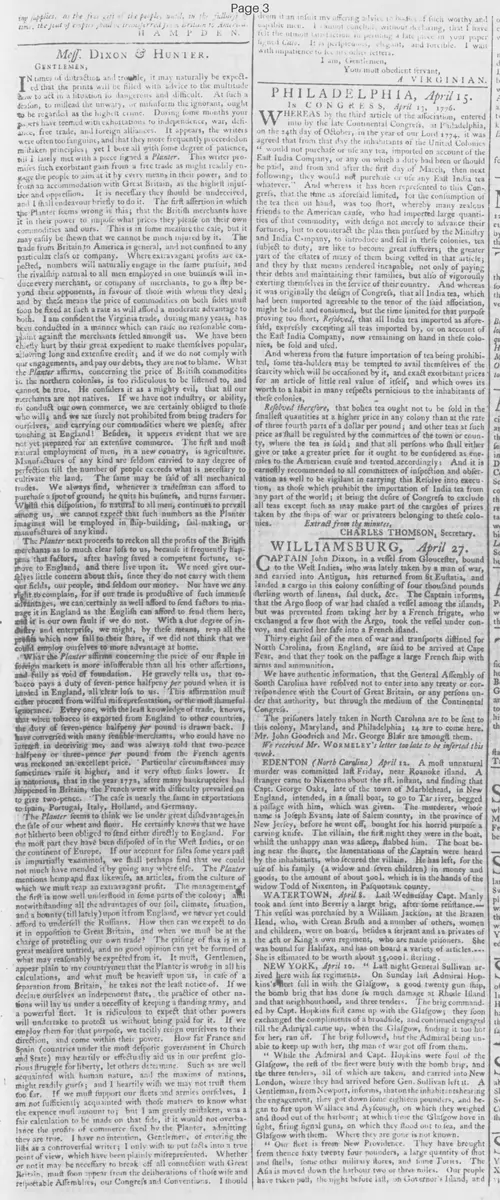
IN times of distraction and trouble, it may naturally be expected that the prints will be filled with advice to the multitude how to act in a situation so dangerous and difficult. At such a season, to mislead the unwary, or misinform the ignorant, ought to be regarded as the highest crime. During some months your papers have teemed with exhortations to independence, war, defiance, free trade, and foreign alliances. It appears, the writers were often too sanguine, and that they more frequently proceeded on mistaken principles; yet I bore all with some degree of patience, till I lately met with a piece signed a Planter. This writer promises such exorbitant gain from a free trade as might readily engage the people to aim at it by every means in their power, and to scorn an accommodation with Great Britain, as the highest injustice and oppression. It is necessary they should be undeceived. and I shall endeavour briefly to do it. The first assertion in which the Planter seems wrong is this; that the British merchants have it in their power to impose what prices they please on their own commodities and ours. This is in some measure the case, but it may easily be shewn that we cannot be much injured by it. The trade from Britain to America is general, and not confined to any particular class or company. Where extravagant profits are expected, numbers will naturally engage in the same pursuit, and the rivalry natural to all men employed in one business will induce every merchant, or company of merchants, to go a step beyond their opponents, in favour of those with whom they deal; and by these means the price of commodities on both sides must soon be fixed at such a rate as will afford a moderate advantage to both. I am confident the Virginia trade, during many years, has been conducted in a manner which can raise no reasonable complaint against the merchants settled amongst us. We have been chiefly hurt by their great expedient to make themselves popular, allowing long and extensive credit; and if we do not comply with our engagements, and pay our debts, they are not to blame. What the Planter affirms, concerning the price of British commodities in the northern colonies, is too ridiculous to be listened to, and cannot be true. He considers it as a mighty evil, that all our merchants are not natives. If we have not industry, or ability, to conduct our own commerce, we are certainly obliged to those who will; and we are surely not prohibited from being traders for ourselves, and carrying our commodities where we please, after touching at England! Besides, it appears evident that we are not yet prepared for an extensive commerce. The first and most natural employment of men, in a new country, is agriculture. Manufactures of any kind are seldom carried to any degree of perfection till the number of people exceeds what is necessary to cultivate the land. The same may be said of all mechanical trades. We always find, whenever a tradesman can afford to purchase a pot of ground, he quits his business, and turns farmer. Whilst this disposition, so natural to all men, continues to prevail among us, we cannot expect that such numbers as the Planter imagines will be employed in ship-building, sail-making, or manufactures of any kind.
The Planter next proceeds to reckon all the profits of the British merchants as so much clear loss to us, because it frequently happens that factors, after having saved a competent fortune, remove to England, and there live upon it. We need give ourselves little concern about this, since they do not carry with them our fields, our people, and seldom our money. Nor have we any right to complain, for if our trade is productive of such immense advantages, we can certainly as well afford to send factors to manage it in England as the English can afford to send them here, and it is our own fault if we do not. With a due degree of industry and enterprise, we might, by these means, reap all the profits which now fall to their share, if we did not think that we could employ ourselves to more advantage at home.
What the Planter affirms concerning the price of our staple in foreign markets is more insufferable than all his other assertions, and fully as void of foundation. He gravely tells us, that tobacco pays a duty of seven-pence halfpenny per pound when it is landed in England, all clear loss to us. This affirmation must either proceed from wilful misrepresentation, or the most shameful ignorance. Every one, with the least knowledge of trade, knows, that when tobacco is exported from England to other countries, the duty of seven-pence halfpenny per pound is drawn back. I have conversed with many sensible merchants, who could have no interest in deceiving me, and was always told that two-pence halfpenny or three-pence per pound from the French agents was reckoned an excellent price. Particular circumstances may sometimes raise it higher, and it very often sinks lower. It is notorious, that in the year 1772, after many bankruptcies had happened in Britain, the French were with difficulty prevailed on to give two-pence. The case is nearly the same in exportations to Spain, Portugal, Italy, Holland, and Germany.
The Planter seems to think we lie under great disadvantages in the sale of our wheat and flour. He certainly knows that we have not hitherto been obliged to send either directly to England. For the most part they have been disposed of in the West Indies, or on the continent of Europe. If our account of sales some years past is impartially examined, we shall perhaps find that we could not much have mended it by going any where else. The Planter mentions hemp and flax likewise, as articles, from the culture of which we must reap an extravagant profit. The management of the first is now well understood in some parts of the colony; and notwithstanding all the advantages of our soil, climate, situation, and a bounty (till lately) upon it from England, we never yet could afford to undersell the Russians. How then can we expect to do it in opposition to Great Britain, and when we must be at the charge of protecting our own trade? The raising of flax is in a great measure untried, and no good opinion can yet be formed of what may reasonably be expected from it. It must, Gentlemen, appear plain to my countrymen that the Planter is wrong in all his calculations, and what must be heaviest upon us, in case of a separation from Britain, he takes not the least notice of. If we declare ourselves an independent state, the practice of other nations will lay us under a necessity of keeping a standing army, and a powerful fleet. It is ridiculous to expect that other powers will undertake to protect us without being paid for it. If we employ them for that purpose, we tacitly resign ourselves to their direction, and come within their power. How far France and Spain (countries under the most despotic government in Church and State) may heartily or effectually aid us in our present glorious struggle for liberty, let others determine. Such as are well acquainted with human nature, and the maxims of nations, might readily guess; and I heartily wish we may not trust them too far. If we must support our fleets and armies ourselves, I am not sufficiently acquainted with those matters to know what the expense must amount to; but I am greatly mistaken, was a fair calculation to be made on that side, if it would not overbalance the profits of commerce fixed by the Planter, admitting they are true. I have no intention, Gentlemen, of entering the lists as a controversial writer; I only wish to put facts into a true point of view, which have been plainly misrepresented. Whether or not it may be necessary to break off all connection with Great Britain, must soon appear from the deliberations of those wise and respectable Assemblies, our Congress and Conventions. I should deem it an insult my offering advice to bodies of such worthy and capable men. I cannot conclude without declaring, that I have felt the utmost satisfaction in perusing a late piece in your paper signed Cato. It is pious, elegant, and forcible. I wait with impatience to know of its letters.
I am, Gentlemen,
Your most obedient servant,
A VIRGINIAN.
GENTLEMEN,
IN times of distraction and trouble, it may naturally be expected that the prints will be filled with advice to the multitude how to act in a situation so dangerous and difficult. At such a season, to mislead the unwary, or misinform the ignorant, ought to be regarded as the highest crime. During some months your papers have teemed with exhortations to independence, war, defiance, free trade, and foreign alliances. It appears, the writers were often too sanguine, and that they more frequently proceeded on mistaken principles; yet I bore all with some degree of patience, till I lately met with a piece signed a Planter. This writer promises such exorbitant gain from a free trade as might readily engage the people to aim at it by every means in their power, and to scorn an accommodation with Great Britain, as the highest injustice and oppression. It is necessary they should be undeceived. and I shall endeavour briefly to do it. The first assertion in which the Planter seems wrong is this; that the British merchants have it in their power to impose what prices they please on their own commodities and ours. This is in some measure the case, but it may easily be shewn that we cannot be much injured by it. The trade from Britain to America is general, and not confined to any particular class or company. Where extravagant profits are expected, numbers will naturally engage in the same pursuit, and the rivalry natural to all men employed in one business will induce every merchant, or company of merchants, to go a step beyond their opponents, in favour of those with whom they deal; and by these means the price of commodities on both sides must soon be fixed at such a rate as will afford a moderate advantage to both. I am confident the Virginia trade, during many years, has been conducted in a manner which can raise no reasonable complaint against the merchants settled amongst us. We have been chiefly hurt by their great expedient to make themselves popular, allowing long and extensive credit; and if we do not comply with our engagements, and pay our debts, they are not to blame. What the Planter affirms, concerning the price of British commodities in the northern colonies, is too ridiculous to be listened to, and cannot be true. He considers it as a mighty evil, that all our merchants are not natives. If we have not industry, or ability, to conduct our own commerce, we are certainly obliged to those who will; and we are surely not prohibited from being traders for ourselves, and carrying our commodities where we please, after touching at England! Besides, it appears evident that we are not yet prepared for an extensive commerce. The first and most natural employment of men, in a new country, is agriculture. Manufactures of any kind are seldom carried to any degree of perfection till the number of people exceeds what is necessary to cultivate the land. The same may be said of all mechanical trades. We always find, whenever a tradesman can afford to purchase a pot of ground, he quits his business, and turns farmer. Whilst this disposition, so natural to all men, continues to prevail among us, we cannot expect that such numbers as the Planter imagines will be employed in ship-building, sail-making, or manufactures of any kind.
The Planter next proceeds to reckon all the profits of the British merchants as so much clear loss to us, because it frequently happens that factors, after having saved a competent fortune, remove to England, and there live upon it. We need give ourselves little concern about this, since they do not carry with them our fields, our people, and seldom our money. Nor have we any right to complain, for if our trade is productive of such immense advantages, we can certainly as well afford to send factors to manage it in England as the English can afford to send them here, and it is our own fault if we do not. With a due degree of industry and enterprise, we might, by these means, reap all the profits which now fall to their share, if we did not think that we could employ ourselves to more advantage at home.
What the Planter affirms concerning the price of our staple in foreign markets is more insufferable than all his other assertions, and fully as void of foundation. He gravely tells us, that tobacco pays a duty of seven-pence halfpenny per pound when it is landed in England, all clear loss to us. This affirmation must either proceed from wilful misrepresentation, or the most shameful ignorance. Every one, with the least knowledge of trade, knows, that when tobacco is exported from England to other countries, the duty of seven-pence halfpenny per pound is drawn back. I have conversed with many sensible merchants, who could have no interest in deceiving me, and was always told that two-pence halfpenny or three-pence per pound from the French agents was reckoned an excellent price. Particular circumstances may sometimes raise it higher, and it very often sinks lower. It is notorious, that in the year 1772, after many bankruptcies had happened in Britain, the French were with difficulty prevailed on to give two-pence. The case is nearly the same in exportations to Spain, Portugal, Italy, Holland, and Germany.
The Planter seems to think we lie under great disadvantages in the sale of our wheat and flour. He certainly knows that we have not hitherto been obliged to send either directly to England. For the most part they have been disposed of in the West Indies, or on the continent of Europe. If our account of sales some years past is impartially examined, we shall perhaps find that we could not much have mended it by going any where else. The Planter mentions hemp and flax likewise, as articles, from the culture of which we must reap an extravagant profit. The management of the first is now well understood in some parts of the colony; and notwithstanding all the advantages of our soil, climate, situation, and a bounty (till lately) upon it from England, we never yet could afford to undersell the Russians. How then can we expect to do it in opposition to Great Britain, and when we must be at the charge of protecting our own trade? The raising of flax is in a great measure untried, and no good opinion can yet be formed of what may reasonably be expected from it. It must, Gentlemen, appear plain to my countrymen that the Planter is wrong in all his calculations, and what must be heaviest upon us, in case of a separation from Britain, he takes not the least notice of. If we declare ourselves an independent state, the practice of other nations will lay us under a necessity of keeping a standing army, and a powerful fleet. It is ridiculous to expect that other powers will undertake to protect us without being paid for it. If we employ them for that purpose, we tacitly resign ourselves to their direction, and come within their power. How far France and Spain (countries under the most despotic government in Church and State) may heartily or effectually aid us in our present glorious struggle for liberty, let others determine. Such as are well acquainted with human nature, and the maxims of nations, might readily guess; and I heartily wish we may not trust them too far. If we must support our fleets and armies ourselves, I am not sufficiently acquainted with those matters to know what the expense must amount to; but I am greatly mistaken, was a fair calculation to be made on that side, if it would not overbalance the profits of commerce fixed by the Planter, admitting they are true. I have no intention, Gentlemen, of entering the lists as a controversial writer; I only wish to put facts into a true point of view, which have been plainly misrepresented. Whether or not it may be necessary to break off all connection with Great Britain, must soon appear from the deliberations of those wise and respectable Assemblies, our Congress and Conventions. I should deem it an insult my offering advice to bodies of such worthy and capable men. I cannot conclude without declaring, that I have felt the utmost satisfaction in perusing a late piece in your paper signed Cato. It is pious, elegant, and forcible. I wait with impatience to know of its letters.
I am, Gentlemen,
Your most obedient servant,
A VIRGINIAN.
What sub-type of article is it?
Persuasive
Informative
Political
What themes does it cover?
Commerce Trade
Economic Policy
Politics
What keywords are associated?
Free Trade
British Merchants
Tobacco Duty
Independence Costs
Virginia Commerce
Planter Critique
Military Expenses
What entities or persons were involved?
A Virginian
Mess. Dixon & Hunter
Letter to Editor Details
Author
A Virginian
Recipient
Mess. Dixon & Hunter
Main Argument
the writer counters the planter's claims of exorbitant profits from free trade and independence, arguing that british merchants' practices are fair, tobacco duties are rebated on export, and separation would impose unaffordable military costs without foreign protection.
Notable Details
Critiques Planter's Assertions On British Commodity Prices
Explains Rivalry Among Merchants Fixes Moderate Prices
Notes Tobacco Duty Of Seven Pence Halfpenny Is Drawn Back On Export
Mentions French Agents Pay Two Pence Halfpenny Or Three Pence Per Pound
References 1772 Bankruptcies Lowering Prices
Discusses Challenges In Hemp, Flax, And Wheat/Flour Trade
Praises Cato's Piece As Pious, Elegant, And Forcible