Thank you for visiting SNEWPapers!
Sign up free
Weekly North Carolina Standard
Raleigh, Wake County, North Carolina
What is this article about?
Article from Chicago Press details experiments with Chinese sugar cane (sorghum) planted on 100,000 acres across US states, confirming its potential for high-quality sugar via chemical analysis and trials, promising economic boon to meet growing national demand amid Southern crop failures.
Clipping
OCR Quality
Full Text
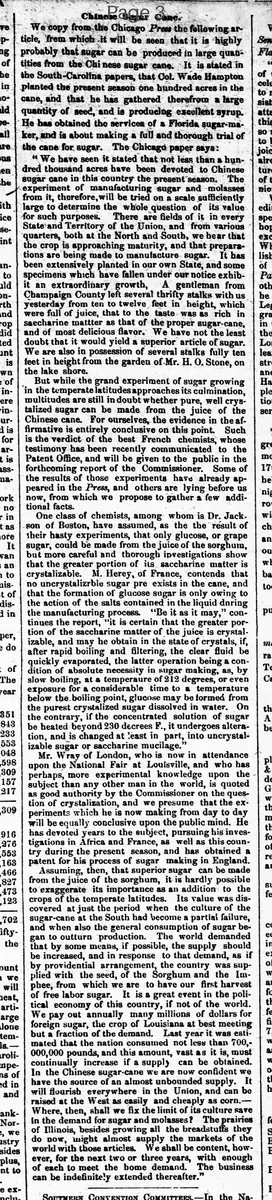
'We have seen it stated that not less than a hundred thousand acres have been devoted to Chinese sugar cane in this country the present season. The experiment of manufacturing sugar and molasses from it, therefore, will be tried on a scale sufficiently large to determine the whole question of its value for such purposes. There are fields of it in every State and Territory of the Union, and from various quarters, both at the North and South, we hear that the crop is approaching maturity, and that preparations are being made to manufacture sugar. It has been extensively planted in our own State, and some specimens which have fallen under our notice exhibit an extraordinary growth. A gentleman from Champaign County left several thrifty stalks with us yesterday from ten to twelve feet in height, which were full of juice, that to the taste was as rich in saccharine matter as that of the proper sugar-cane, and of most delicious flavor. We have not the least doubt that it would yield a superior article of sugar. We are also in possession of several stalks fully ten feet in height from the garden of Mr. H. O. Stone, on the lake shore.
But while the grand experiment of sugar growing in the temperate latitudes approaches its culmination, multitudes are still in doubt whether pure, well crystallized sugar can be made from the juice of the Chinese cane. For ourselves, the evidence in the affirmative is entirely conclusive on this point. Such is the verdict of the best French chemists, whose testimony has been recently communicated to the Patent Office, and will be given to the public in the forthcoming report of the Commissioner. Some of the results of those experiments have already appeared in the Press, and others are lying before us now, from which we propose to gather a few additional facts.
One class of chemists, among whom is Dr. Jackson of Boston, have assumed, as the result of their hasty experiments, that only glucose, or grape sugar, could be made from the juice of the sorghum, but more careful and thorough investigations show that the greater portion of its saccharine matter is crystalizable. M. Herey, of France, contends that no uncrystalizable sugar preexists in the cane, and that the formation of glucose sugar is only owing to the action of the salts contained in the liquid during the manufacturing process. "Be it as it may," continues the report, "it is certain that the greater portion of the saccharine matter of the juice is crystalizable, and may be obtained in the state of crystals, if, after rapid boiling and filtering, the clear fluid be quickly evaporated, the latter operation being a condition of absolute necessity in sugar making, as, by slow boiling, at a temperature of 212 degrees, or even exposure for a considerable time to a temperature below the boiling point, glucose may be formed from the purest crystallized sugar dissolved in water. On the contrary, if the concentrated solution of sugar be heated beyond 230 degrees F., it undergoes alteration, and is changed at least in part, into uncrystalizable sugar or saccharine mucilage."
Mr. Wray of London, who is now in attendance upon the National Fair at Louisville, and who has perhaps more experimental knowledge upon the subject than any other man in the world, is quoted as good authority by the Commissioner on the question of crystallization, and we presume that the experiments which he is now making from day to day will be equally conclusive upon the public mind. He has devoted years to the subject, pursuing his investigations in Africa and France, as well as this country during the present season, and has obtained a patent for his process of sugar making in England.
Assuming, then, that superior sugar can be made from the juice of the sorghum, it is hardly possible to exaggerate its importance as an addition to the crops of the temperate latitudes. Its value was discovered at just the period when the culture of the sugar-cane at the South had become a partial failure, and when also the general consumption of sugar began to outrun production. The world demanded that by some means, if possible, the supply should be increased, and in response to that demand, as if by providential arrangement, the country was supplied with the seed of the Sorghum and the Imphee, from which we are to have our first harvest of free labor sugar. It is a great event in the political economy of this country, if not of the world.
We pay out annually many millions of dollars for foreign sugar, the crop of Louisiana at best meeting but a fraction of the demand. Last year it was estimated that the nation consumed not less than 700,000,000 pounds, and this amount, vast as it is, must continually increase if a supply can be obtained. In the Chinese sugar-cane we are now confident we have the source of an almost unbounded supply. It will flourish everywhere in the Union, and can be raised at the West as easily and cheaply as corn. Where, then, shall we fix the limit of its culture save in the demand for sugar and molasses? The prairies of Illinois, besides growing all the breadstuffs they do now, might almost supply the markets of the world with those articles. We shall be content, however, for the next two or three years, with enough of each to meet the home demand. The business can be indefinitely extended thereafter.
What sub-type of article is it?
What themes does it cover?
What keywords are associated?
What entities or persons were involved?
Where did it happen?
Story Details
Key Persons
Location
United States (Illinois, South Carolina, Various States And Territories)
Event Date
Present Season
Story Details
Reports on widespread planting of Chinese sugar cane (sorghum) across the US, successful growth and juice quality, chemical confirmation of crystallizable sugar by French experts, trials by Col. Wade Hampton, and potential to revolutionize sugar supply through free labor production in temperate regions.