Thank you for visiting SNEWPapers!
Sign up free
The Republican
Oakland, Garrett County, Maryland
What is this article about?
Overview of the surname Wagner's English and German origins as an occupational name for wagon drivers or wheelwrights. Details immigrant arrivals in Pennsylvania and profiles notable figures including Revolutionary War veterans, philanthropist William Wagner, composer Richard Wagner, and modern academics and politicians.
Clipping
OCR Quality
Full Text
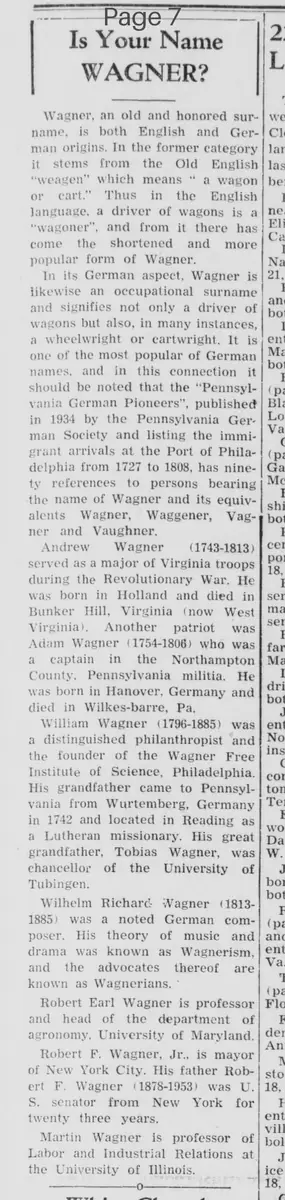
WAGNER?
Wagner, an old and honored surname, is both English and German origins. In the former category it stems from the Old English "weagen" which means a wagon or cart. Thus in the English language, a driver of wagons is a "wagoner", and from it there has come the shortened and more popular form of Wagner.
In its German aspect, Wagner is likewise an occupational surname and signifies not only a driver of wagons but also, in many instances, a wheelwright or cartwright. It is one of the most popular of German names, and in this connection it should be noted that the "Pennsylvania German Pioneers", published in 1934 by the Pennsylvania German Society and listing the immigrant arrivals at the Port of Philadelphia from 1727 to 1808, has ninety references to persons bearing the name of Wagner and its equivalents Wagner, Waggener, Vag ner and Vaughner.
Andrew Wagner (1743-1813) served as a major of Virginia troops during the Revolutionary War. He was born in Holland and died in Bunker Hill, Virginia (now West Virginia). Another patriot was Adam Wagner (1754-1806) who was a captain in the Northampton County, Pennsylvania militia. He was born in Hanover, Germany and died in Wilkes-barre, Pa.
William Wagner (1796-1885) was a distinguished philanthropist and the founder of the Wagner Free Institute of Science, Philadelphia. His grandfather came to Pennsylvania from Wurtemberg, Germany in 1742 and located in Reading as a Lutheran missionary. His great grandfather, Tobias Wagner, was chancellor of the University of Tubingen.
Wilhelm Richard Wagner (1813-1885) was a noted German composer. His theory of music and drama was known as Wagnerism, and the advocates thereof are known as Wagnerians.
Robert Earl Wagner is professor and head of the department of agronomy, University of Maryland.
Robert F. Wagner, Jr., is mayor of New York City. His father Robert F. Wagner (1878-1953) was U. S. senator from New York for twenty three years.
Martin Wagner is professor of Labor and Industrial Relations at the University of Illinois.
What sub-type of article is it?
What themes does it cover?
What keywords are associated?
What entities or persons were involved?
Where did it happen?
Story Details
Key Persons
Location
England, Germany, Pennsylvania, Virginia, Philadelphia, New York City, University Of Maryland, University Of Illinois
Event Date
1727 To 1808, 1743 1813, 1754 1806, 1796 1885, 1813 1885, 1878 1953
Story Details
The surname Wagner originates from Old English 'weagen' meaning wagon, denoting a wagon driver, and in German as an occupational name for wagon drivers, wheelwrights, or cartwrights. It is common among German immigrants to Pennsylvania from 1727-1808. Notable bearers include Revolutionary War major Andrew Wagner, captain Adam Wagner, philanthropist William Wagner who founded the Wagner Free Institute of Science, composer Wilhelm Richard Wagner, agronomy professor Robert Earl Wagner, New York mayor Robert F. Wagner Jr. and his senator father, and labor professor Martin Wagner.