Thank you for visiting SNEWPapers!
Sign up free
Story
August 22, 1839
South Branch Intelligencer
Romney, Hampshire County, West Virginia
What is this article about?
William J. Graves recounts in a speech to constituents his involvement in the fatal duel with Jonathan Cilley, triggered by a note from Col. Webb. Despite opposition to dueling, Graves acted as intermediary, leading to a challenge and Cilley's death, defending his honor and Kentucky's.
Clipping
OCR Quality
95%
Excellent
Full Text
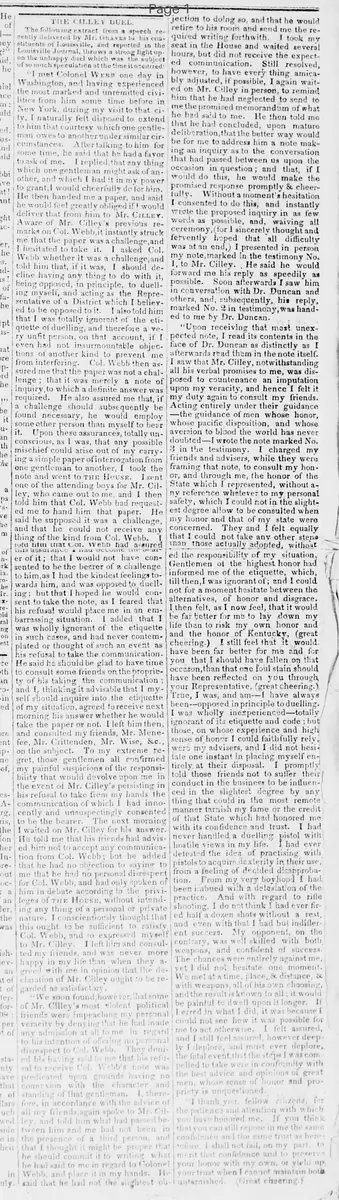
THE CILLEY DUEL.
The following extract from a speech recently delivered by Mr. Graves to his constituents at Louisville, and reported in the Louisville Journal, throws a strong light upon the unhappy duel which was the subject of so much speculation at the time it occurred.
"I met Colonel Webb one day in Washington, and having experienced the most marked and unremitted civilities from him some time before in New York, during my visit to that city, I naturally felt disposed to extend to him that courtesy which one gentleman owes to another under similar circumstances. After talking to him for some time, he said that he had a favor to ask of me. I replied, that any thing which one gentleman might ask of another, and which I had it in my power to grant, I would cheerfully do for him. He then handed me a paper, and said he would feel greatly obliged if I would deliver that from him to Mr. Cilley. Aware of Mr. Cilley's previous remarks on Col. Webb, it instantly struck me that the paper was a challenge, and I hesitated to take it. I asked Col. Webb whether it was a challenge, and told him that, if it was, I should decline having any thing to do with it, being opposed, in principle, to duelling myself, and acting as the Representative of a District which I believed to be opposed to it. I also told him that I was totally ignorant of the etiquette of duelling, and therefore a very unfit person, on that account, if I even had not insurmountable objections of another kind to prevent me from interfering. Col. Webb then assured me that the paper was not a challenge; that it was merely a note of inquiry, to which a definite answer was required. He also assured me that, if a challenge should subsequently be found necessary, he would employ some other person than myself to bear it. Upon these assurances, totally unconscious, as I was, that any possible mischief could arise out of my carrying a simple paper of interrogation from one gentleman to another, I took the note and went to the House. I sent one of the attending boys for Mr. Cilley, who came out to me, and I then told him that Col. Webb had requested me to hand him that paper. He said he supposed it was a challenge, and that he could not receive any thing of the kind from Col. Webb. I told him that Col. Webb had assured me it was not a challenge, and that I would not have consented to be the bearer of a challenge to him, as I had the kindest feelings towards him, and was opposed to duelling; but that I hoped he would consent to take the note, as I feared that his refusal would place me in an embarrassing situation. I added that I was wholly ignorant of the etiquette in such cases, and had never contemplated or thought of such an event as his refusal to take the communication. He said he should be glad to have time to consult some friends on the propriety of his taking the communication; and I, thinking it advisable that I myself should inquire into the etiquette of my situation, agreed to receive next morning his answer whether he would take the paper or not. I left him then, and consulted my friends, Mr. Menefee, Mr. Crittenden, Mr. Wise, &c., on the subject. To my extreme regret, those gentlemen all confirmed my painful suspicions of the responsibility that would devolve upon me in the event of Mr. Cilley's persisting in his refusal to take from my hands the communication of which I had innocently and unsuspectingly consented to be the bearer. The next morning I waited on Mr. Cilley for his answer. He told me that his friends had advised him not to accept any communication from Col. Webb: but he added that he had no objection to saying to me that he had no personal disrespect for Col. Webb, and had only spoken of him in debate according to the privileges of the House, without intending any thing of a personal or private nature. I conscientiously thought that this ought to be sufficient to satisfy Col. Webb, and so expressed myself to Mr. Cilley. I left him and consulted my friends, and was never more happy in my life than when they agreed with me in opinion that the declaration of Mr. Cilley ought to be regarded as satisfactory.
(Graves soon found, however, that some of Mr. Cilley's most violent political friends were impeaching my personal veracity by denying that he had made any admission at all to me in regard to his intention of offering no personal disrespect to Col. Webb. They denied he had said to me that his refusal to receive Col. Webb's note was predicated upon grounds having no connexion with the character and standing of that gentleman. I, therefore, in accordance with the advice of all my friends, again spoke to Mr. Cilley, and told him what had passed between him and me had not been in the presence of a third person, and that I thought it might be proper that he should commit it to writing what he had said to me in regard to Colonel Webb, and place it in my hands. He said that he had not the slightest objection to doing so, and that he would retire to his room and send me the required writing forthwith. I took my seat in the House and waited several hours, but did not receive the expected communication. Still resolved, however, to have every thing amicably adjusted, if possible, I again waited on Mr. Cilley in person, to remind him that he had neglected to send to me the promised memorandum of what he had said to me. He then told me that he had concluded, upon mature deliberation, that the better way would be for me to address him a note making an inquiry as to the conversation that had passed between us upon the occasion in question; and that, if I would do this, he would make the promised response promptly & cheerfully. Without a moment's hesitation I consented to do this, and instantly wrote the proposed inquiry in as few words as possible, and, waiving all ceremony, (for I sincerely thought and fervently hoped that all difficulty was at an end,) I presented in person my note, marked in the testimony No. 1, to Mr. Cilley. He said he would forward me his reply as speedily as possible. Soon afterwards I saw him in conversation with Dr. Duncan and others, and, subsequently, his reply, marked No. 2 in testimony, was handed to me by Dr. Duncan.
"Upon receiving that most unexpected note, I read its contents in the face of Dr. Duncan as distinctly as I afterwards read them in the note itself. I saw that Mr. Cilley, notwithstanding all his verbal promises to me, was disposed to countenance an imputation upon my veracity, and hence I felt it my duty again to consult my friends. Acting entirely under their guidance--the guidance of men whose honor, whose pacific disposition, and whose aversion to blood the world has never doubted--I wrote the note marked No. 3 in the testimony. I charged my friends and advisers, while they were framing that note, to consult my honor, and through me, the honor of the State which I represented, without any reference whatever to my personal safety, which I could not in the slightest degree allow to be consulted when my honor and that of my state were concerned. They and I felt equally that I could not take any other steps than those actually adopted, without evading the responsibility of my situation. Gentlemen of the highest honor had informed me of the etiquette, which, till then, I was ignorant of; and I could not for a moment hesitate between the alternatives, of honor and disgrace. I then felt, as I now feel, that it would be far better for me to lay down my life than to risk my own honor and the honor of Kentucky, (great cheering.) I still feel that it would have been far better for me and for you that I should have fallen on that occasion, than that one foul stain should have been reflected on you through your Representative, (great cheering.) True, I was, and am--I have always been--opposed in principle to duelling. I was wholly inexperienced--totally ignorant of its etiquette and code; but those, on whose experience and high sense of honor I could faithfully rely, were my advisers, and I did not hesitate one instant in placing myself entirely at their disposal. I promptly told those friends not to suffer their conduct in the business to be influenced in the slightest degree by any thing that could in the most remote manner tarnish my fame or the credit of that State which had honored me with its confidence and trust. I had never handled a duelling pistol with hostile views in my life. I had ever detested the idea of practising with pistols to acquire dexterity in their use, from a feeling of decided disapprobation. From my very boyhood I had been imbued with a detestation of the practice. And with regard to rifle shooting, I do not think I had ever fired half a dozen shots without a rest, and even with that I had but indifferent success. My opponent, on the contrary, was well skilled with both weapons, and confident of success. The chances were entirely against me, yet I did not hesitate one moment. We met at a time, place, & distance, & with weapons, all of his own choosing, and the result is known to all; it would be painful to dwell upon it longer. If I erred in what I did, it was because I could not see how it was possible for me to act otherwise. I felt assured, and I still feel assured, however deep I deplore, and must ever deplore, the fatal event, that the steps I was compelled to take were in conformity with the best advice and opinions of great men, whose sense of honor and propriety is unquestioned.
I thank you, fellow-citizens, for the patience and attention with which you have honored me. If you think that you can still repose in me the same confidence and the same trust as heretofore, I shall not fail, on my part, to merit that confidence and to preserve your honor with my own, or yield up your trust when I cannot maintain both untarnished. (Great cheering.)"
The following extract from a speech recently delivered by Mr. Graves to his constituents at Louisville, and reported in the Louisville Journal, throws a strong light upon the unhappy duel which was the subject of so much speculation at the time it occurred.
"I met Colonel Webb one day in Washington, and having experienced the most marked and unremitted civilities from him some time before in New York, during my visit to that city, I naturally felt disposed to extend to him that courtesy which one gentleman owes to another under similar circumstances. After talking to him for some time, he said that he had a favor to ask of me. I replied, that any thing which one gentleman might ask of another, and which I had it in my power to grant, I would cheerfully do for him. He then handed me a paper, and said he would feel greatly obliged if I would deliver that from him to Mr. Cilley. Aware of Mr. Cilley's previous remarks on Col. Webb, it instantly struck me that the paper was a challenge, and I hesitated to take it. I asked Col. Webb whether it was a challenge, and told him that, if it was, I should decline having any thing to do with it, being opposed, in principle, to duelling myself, and acting as the Representative of a District which I believed to be opposed to it. I also told him that I was totally ignorant of the etiquette of duelling, and therefore a very unfit person, on that account, if I even had not insurmountable objections of another kind to prevent me from interfering. Col. Webb then assured me that the paper was not a challenge; that it was merely a note of inquiry, to which a definite answer was required. He also assured me that, if a challenge should subsequently be found necessary, he would employ some other person than myself to bear it. Upon these assurances, totally unconscious, as I was, that any possible mischief could arise out of my carrying a simple paper of interrogation from one gentleman to another, I took the note and went to the House. I sent one of the attending boys for Mr. Cilley, who came out to me, and I then told him that Col. Webb had requested me to hand him that paper. He said he supposed it was a challenge, and that he could not receive any thing of the kind from Col. Webb. I told him that Col. Webb had assured me it was not a challenge, and that I would not have consented to be the bearer of a challenge to him, as I had the kindest feelings towards him, and was opposed to duelling; but that I hoped he would consent to take the note, as I feared that his refusal would place me in an embarrassing situation. I added that I was wholly ignorant of the etiquette in such cases, and had never contemplated or thought of such an event as his refusal to take the communication. He said he should be glad to have time to consult some friends on the propriety of his taking the communication; and I, thinking it advisable that I myself should inquire into the etiquette of my situation, agreed to receive next morning his answer whether he would take the paper or not. I left him then, and consulted my friends, Mr. Menefee, Mr. Crittenden, Mr. Wise, &c., on the subject. To my extreme regret, those gentlemen all confirmed my painful suspicions of the responsibility that would devolve upon me in the event of Mr. Cilley's persisting in his refusal to take from my hands the communication of which I had innocently and unsuspectingly consented to be the bearer. The next morning I waited on Mr. Cilley for his answer. He told me that his friends had advised him not to accept any communication from Col. Webb: but he added that he had no objection to saying to me that he had no personal disrespect for Col. Webb, and had only spoken of him in debate according to the privileges of the House, without intending any thing of a personal or private nature. I conscientiously thought that this ought to be sufficient to satisfy Col. Webb, and so expressed myself to Mr. Cilley. I left him and consulted my friends, and was never more happy in my life than when they agreed with me in opinion that the declaration of Mr. Cilley ought to be regarded as satisfactory.
(Graves soon found, however, that some of Mr. Cilley's most violent political friends were impeaching my personal veracity by denying that he had made any admission at all to me in regard to his intention of offering no personal disrespect to Col. Webb. They denied he had said to me that his refusal to receive Col. Webb's note was predicated upon grounds having no connexion with the character and standing of that gentleman. I, therefore, in accordance with the advice of all my friends, again spoke to Mr. Cilley, and told him what had passed between him and me had not been in the presence of a third person, and that I thought it might be proper that he should commit it to writing what he had said to me in regard to Colonel Webb, and place it in my hands. He said that he had not the slightest objection to doing so, and that he would retire to his room and send me the required writing forthwith. I took my seat in the House and waited several hours, but did not receive the expected communication. Still resolved, however, to have every thing amicably adjusted, if possible, I again waited on Mr. Cilley in person, to remind him that he had neglected to send to me the promised memorandum of what he had said to me. He then told me that he had concluded, upon mature deliberation, that the better way would be for me to address him a note making an inquiry as to the conversation that had passed between us upon the occasion in question; and that, if I would do this, he would make the promised response promptly & cheerfully. Without a moment's hesitation I consented to do this, and instantly wrote the proposed inquiry in as few words as possible, and, waiving all ceremony, (for I sincerely thought and fervently hoped that all difficulty was at an end,) I presented in person my note, marked in the testimony No. 1, to Mr. Cilley. He said he would forward me his reply as speedily as possible. Soon afterwards I saw him in conversation with Dr. Duncan and others, and, subsequently, his reply, marked No. 2 in testimony, was handed to me by Dr. Duncan.
"Upon receiving that most unexpected note, I read its contents in the face of Dr. Duncan as distinctly as I afterwards read them in the note itself. I saw that Mr. Cilley, notwithstanding all his verbal promises to me, was disposed to countenance an imputation upon my veracity, and hence I felt it my duty again to consult my friends. Acting entirely under their guidance--the guidance of men whose honor, whose pacific disposition, and whose aversion to blood the world has never doubted--I wrote the note marked No. 3 in the testimony. I charged my friends and advisers, while they were framing that note, to consult my honor, and through me, the honor of the State which I represented, without any reference whatever to my personal safety, which I could not in the slightest degree allow to be consulted when my honor and that of my state were concerned. They and I felt equally that I could not take any other steps than those actually adopted, without evading the responsibility of my situation. Gentlemen of the highest honor had informed me of the etiquette, which, till then, I was ignorant of; and I could not for a moment hesitate between the alternatives, of honor and disgrace. I then felt, as I now feel, that it would be far better for me to lay down my life than to risk my own honor and the honor of Kentucky, (great cheering.) I still feel that it would have been far better for me and for you that I should have fallen on that occasion, than that one foul stain should have been reflected on you through your Representative, (great cheering.) True, I was, and am--I have always been--opposed in principle to duelling. I was wholly inexperienced--totally ignorant of its etiquette and code; but those, on whose experience and high sense of honor I could faithfully rely, were my advisers, and I did not hesitate one instant in placing myself entirely at their disposal. I promptly told those friends not to suffer their conduct in the business to be influenced in the slightest degree by any thing that could in the most remote manner tarnish my fame or the credit of that State which had honored me with its confidence and trust. I had never handled a duelling pistol with hostile views in my life. I had ever detested the idea of practising with pistols to acquire dexterity in their use, from a feeling of decided disapprobation. From my very boyhood I had been imbued with a detestation of the practice. And with regard to rifle shooting, I do not think I had ever fired half a dozen shots without a rest, and even with that I had but indifferent success. My opponent, on the contrary, was well skilled with both weapons, and confident of success. The chances were entirely against me, yet I did not hesitate one moment. We met at a time, place, & distance, & with weapons, all of his own choosing, and the result is known to all; it would be painful to dwell upon it longer. If I erred in what I did, it was because I could not see how it was possible for me to act otherwise. I felt assured, and I still feel assured, however deep I deplore, and must ever deplore, the fatal event, that the steps I was compelled to take were in conformity with the best advice and opinions of great men, whose sense of honor and propriety is unquestioned.
I thank you, fellow-citizens, for the patience and attention with which you have honored me. If you think that you can still repose in me the same confidence and the same trust as heretofore, I shall not fail, on my part, to merit that confidence and to preserve your honor with my own, or yield up your trust when I cannot maintain both untarnished. (Great cheering.)"
What sub-type of article is it?
Historical Event
Biography
Tragedy
What themes does it cover?
Bravery Heroism
Moral Virtue
Tragedy
What keywords are associated?
Cilley Duel
Graves Speech
Dueling Etiquette
Political Honor
Fatal Duel
Congressional Debate
What entities or persons were involved?
Mr. Graves
Mr. Cilley
Col. Webb
Mr. Menefee
Mr. Crittenden
Mr. Wise
Dr. Duncan
Where did it happen?
Washington
Story Details
Key Persons
Mr. Graves
Mr. Cilley
Col. Webb
Mr. Menefee
Mr. Crittenden
Mr. Wise
Dr. Duncan
Location
Washington
Story Details
Mr. Graves, opposed to dueling, acts as intermediary for Col. Webb's note to Mr. Cilley, leading to misunderstandings, written exchanges impugning honor, and ultimately a fatal duel where Graves kills Cilley despite inexperience.