Thank you for visiting SNEWPapers!
Sign up free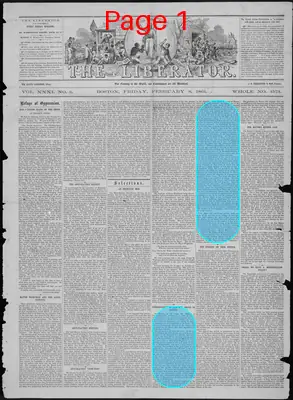
Editorial
February 8, 1861
The Liberator
Boston, Suffolk County, Massachusetts
What is this article about?
Editorial advocates for transferring Boston's police control from city authorities to state-appointed commissioners to curb mob violence against anti-slavery meetings, ensure free speech, and counter the growing influence of Irish immigrant voters in elections. References recent incidents involving Wendell Phillips and the Massachusetts Anti-Slavery Society.
Clipping
OCR Quality
95%
Excellent
Full Text
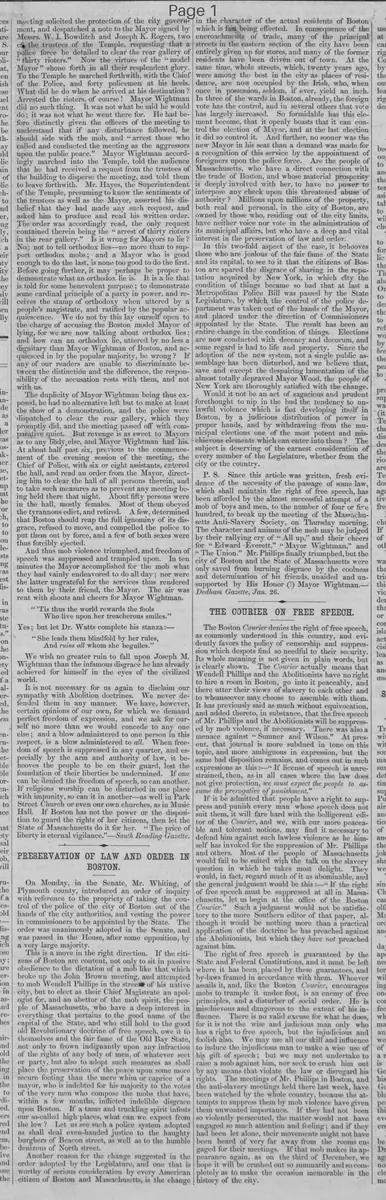
PRESERVATION OF LAW AND ORDER IN
BOSTON.
On Monday, in the Senate, Mr. Whiting, of
Plymouth county, introduced an order of inquiry
with reference to the propriety of taking the con-
trol of the police of the city of Boston out of the
hands of the city authorities, and vesting the power
in commissioners to be appointed by the State. The
order was unanimously adopted in the Senate, and
was passed in the House, after some opposition, by
a very large majority.
This is a move in the right direction. If the citi-
zens of Boston are content, not only to sit in passive
obedience to the dictation of a mob like that which
broke up the John Brown meeting, and attempted
to mob Wendell Phillips in the street of his native
city, but to elect as their Chief Magistrate an apol-
ogist for, and an abettor of the mob spirit, the peo-
ple of Massachusetts, who have a deep interest in
everything that pertains to the good name of the
capital of the State, and who still hold to the good
old Revolutionary doctrine of free speech, owe it to
themselves and the fair fame of the Old Bay State,
not only to frown indignantly upon any infraction
of the rights of any body of men, of whatever sect
or party, but also to adopt such measures as shall
place the preservation of the peace upon some more
secure footing than the mere whim or caprice of a
mayor, who is indebted for his majority to the votes
of the very men who compose the mobs that have,
within a few months, inflicted indelible disgrace
upon Boston. If a tame and truckling spirit infests
our so-called high places, what can we expect from
the low? Let us see such a police system adopted
as shall deal even-handed justice to the haughty
burghers of Beacon street, as well as to the humble
denizens of North street.
Another reason for the change suggested in the
order adopted by the Legislature, and one that is
worthy of serious consideration by every American
citizen of Boston and Massachusetts, is the change
in the character of the actual residents of Boston
which is fast being effected. In consequence of the
encroachments of trade, many of the principal
streets in the eastern section of the city have been
entirely given up for stores, and many of the former
residents have been driven out of town. At the same
time, whole streets, which, twenty years ago,
were among the best in the city as places of resi-
dence, are now occupied by the Irish, who, when
once in possession, seldom, if ever, yield an inch.
In three of the wards in Boston, already, the foreign
vote has the control, and in several others that vote
has largely increased. So formidable has this ele-
ment become, that it openly boasts that it can con-
trol the election of Mayor, and at the last election
it did so control it. And further, no sooner was the
new Mayor in his seat than a demand was made for
a recognition of this service by the appointment of
foreigners upon the police force. Are the people of
Massachusetts, who have a direct connection with
the trade of Boston, and whose material prosperity
is deeply involved with her, to have no power to
interpose any check upon this threatened abuse of
authority? Millions upon millions of the property,
both real and personal, in the city of Boston, are
owned by those who, residing out of the city limits,
have neither voice nor vote in the administration of
its municipal affairs, but who have a deep and vital
interest in the preservation of law and order.
In this two-fold aspect of the case, it behooves
those who are jealous of the fair fame of the State
and its capital, to see to it that the citizens of Bos-
ton are spared the disgrace of sharing in the repu-
tation acquired by New York, in which city the
condition of things became so bad that at last a
Metropolitan Police Bill was passed by the State
Legislature, by which the control of the police de-
partment was taken out of the hands of the Mayor,
and placed under the direction of Commissioners
appointed by the State. The result has been an
entire change in the condition of things. Elections
are now conducted with decency and decorum, and
some regard is had to life and property. Since the
adoption of the new system, not a single public as-
semblage has been disturbed, and we believe that,
save and except the despairing lamentation of the
almost totally depraved Mayor Wood, the people of
New York are thoroughly satisfied with the change.
Would it not be an act of sagacious and prudent
forethought to nip in the bud the tendency to un-
lawful violence which is fast developing itself in
Boston, by a judicious distribution of power in
proper hands, and by withdrawing from the mu-
nicipal elections one of the most potent and mis-
chievous elements which can enter into them? The
subject is deserving of the earnest consideration of
every member of the Legislature, whether from the
city or the country.
P. S. Since this article was written, fresh evi-
dence of the necessity of the passage of some law,
which shall maintain the right of free speech, has
been afforded by the almost successful attempt of a
mob of boys and men, to the number of four or five
hundred, to break up the meeting of the Massachu-
setts Anti-Slavery Society, on Thursday morning.
The character and animus of the mob may be judged
by their rallying cry of "All up," and their cheers
for "Edward Everett," "Mayor Wightman," and
"The Union." Mr. Phillips finally triumphed, but the
city of Boston and the State of Massachusetts were
only saved from burning disgrace by the coolness
and determination of his friends, unaided and un-
supported by His Honor (!) Mayor Wightman.—
Dedham Gazette, Jan. 26.
BOSTON.
On Monday, in the Senate, Mr. Whiting, of
Plymouth county, introduced an order of inquiry
with reference to the propriety of taking the con-
trol of the police of the city of Boston out of the
hands of the city authorities, and vesting the power
in commissioners to be appointed by the State. The
order was unanimously adopted in the Senate, and
was passed in the House, after some opposition, by
a very large majority.
This is a move in the right direction. If the citi-
zens of Boston are content, not only to sit in passive
obedience to the dictation of a mob like that which
broke up the John Brown meeting, and attempted
to mob Wendell Phillips in the street of his native
city, but to elect as their Chief Magistrate an apol-
ogist for, and an abettor of the mob spirit, the peo-
ple of Massachusetts, who have a deep interest in
everything that pertains to the good name of the
capital of the State, and who still hold to the good
old Revolutionary doctrine of free speech, owe it to
themselves and the fair fame of the Old Bay State,
not only to frown indignantly upon any infraction
of the rights of any body of men, of whatever sect
or party, but also to adopt such measures as shall
place the preservation of the peace upon some more
secure footing than the mere whim or caprice of a
mayor, who is indebted for his majority to the votes
of the very men who compose the mobs that have,
within a few months, inflicted indelible disgrace
upon Boston. If a tame and truckling spirit infests
our so-called high places, what can we expect from
the low? Let us see such a police system adopted
as shall deal even-handed justice to the haughty
burghers of Beacon street, as well as to the humble
denizens of North street.
Another reason for the change suggested in the
order adopted by the Legislature, and one that is
worthy of serious consideration by every American
citizen of Boston and Massachusetts, is the change
in the character of the actual residents of Boston
which is fast being effected. In consequence of the
encroachments of trade, many of the principal
streets in the eastern section of the city have been
entirely given up for stores, and many of the former
residents have been driven out of town. At the same
time, whole streets, which, twenty years ago,
were among the best in the city as places of resi-
dence, are now occupied by the Irish, who, when
once in possession, seldom, if ever, yield an inch.
In three of the wards in Boston, already, the foreign
vote has the control, and in several others that vote
has largely increased. So formidable has this ele-
ment become, that it openly boasts that it can con-
trol the election of Mayor, and at the last election
it did so control it. And further, no sooner was the
new Mayor in his seat than a demand was made for
a recognition of this service by the appointment of
foreigners upon the police force. Are the people of
Massachusetts, who have a direct connection with
the trade of Boston, and whose material prosperity
is deeply involved with her, to have no power to
interpose any check upon this threatened abuse of
authority? Millions upon millions of the property,
both real and personal, in the city of Boston, are
owned by those who, residing out of the city limits,
have neither voice nor vote in the administration of
its municipal affairs, but who have a deep and vital
interest in the preservation of law and order.
In this two-fold aspect of the case, it behooves
those who are jealous of the fair fame of the State
and its capital, to see to it that the citizens of Bos-
ton are spared the disgrace of sharing in the repu-
tation acquired by New York, in which city the
condition of things became so bad that at last a
Metropolitan Police Bill was passed by the State
Legislature, by which the control of the police de-
partment was taken out of the hands of the Mayor,
and placed under the direction of Commissioners
appointed by the State. The result has been an
entire change in the condition of things. Elections
are now conducted with decency and decorum, and
some regard is had to life and property. Since the
adoption of the new system, not a single public as-
semblage has been disturbed, and we believe that,
save and except the despairing lamentation of the
almost totally depraved Mayor Wood, the people of
New York are thoroughly satisfied with the change.
Would it not be an act of sagacious and prudent
forethought to nip in the bud the tendency to un-
lawful violence which is fast developing itself in
Boston, by a judicious distribution of power in
proper hands, and by withdrawing from the mu-
nicipal elections one of the most potent and mis-
chievous elements which can enter into them? The
subject is deserving of the earnest consideration of
every member of the Legislature, whether from the
city or the country.
P. S. Since this article was written, fresh evi-
dence of the necessity of the passage of some law,
which shall maintain the right of free speech, has
been afforded by the almost successful attempt of a
mob of boys and men, to the number of four or five
hundred, to break up the meeting of the Massachu-
setts Anti-Slavery Society, on Thursday morning.
The character and animus of the mob may be judged
by their rallying cry of "All up," and their cheers
for "Edward Everett," "Mayor Wightman," and
"The Union." Mr. Phillips finally triumphed, but the
city of Boston and the State of Massachusetts were
only saved from burning disgrace by the coolness
and determination of his friends, unaided and un-
supported by His Honor (!) Mayor Wightman.—
Dedham Gazette, Jan. 26.
What sub-type of article is it?
Crime Or Punishment
Slavery Abolition
Immigration
What keywords are associated?
Boston Police Reform
Mob Violence
Anti Slavery Meetings
Free Speech
Irish Vote
Law And Order
State Commissioners
What entities or persons were involved?
Mr. Whiting
Wendell Phillips
Mayor Wightman
John Brown
Edward Everett
Massachusetts Anti Slavery Society
Irish Immigrants
Mayor Wood
Editorial Details
Primary Topic
State Control Of Boston Police To Preserve Law And Order
Stance / Tone
Strongly Supportive Of Police Reform And Free Speech Protection Against Mobs
Key Figures
Mr. Whiting
Wendell Phillips
Mayor Wightman
John Brown
Edward Everett
Massachusetts Anti Slavery Society
Irish Immigrants
Mayor Wood
Key Arguments
Boston Mobs Have Disrupted Anti Slavery Meetings And Free Speech
Elected Mayor Apologizes For And Abets Mob Spirit
Growing Irish Immigrant Vote Controls Elections And Demands Police Appointments
State Intervention Needed To Protect Property Owners Without City Vote
New York Metropolitan Police Bill Successfully Reformed Similar Issues
Recent Mob Attempt On Anti Slavery Society Meeting Highlights Urgency