Thank you for visiting SNEWPapers!
Sign up free
Domestic News
February 8, 1805
Norfolk Gazette And Publick Ledger
Norfolk, Virginia
What is this article about?
Commentary from the Baltimore Federal Gazette criticizes Aaron Burr's interruption of Judge Chase during his impeachment trial in the U.S. Senate, arguing it violated legal precedents and fairness principles, drawing parallels to British impeachment cases like Earl Danby's.
Clipping
OCR Quality
95%
Excellent
Full Text
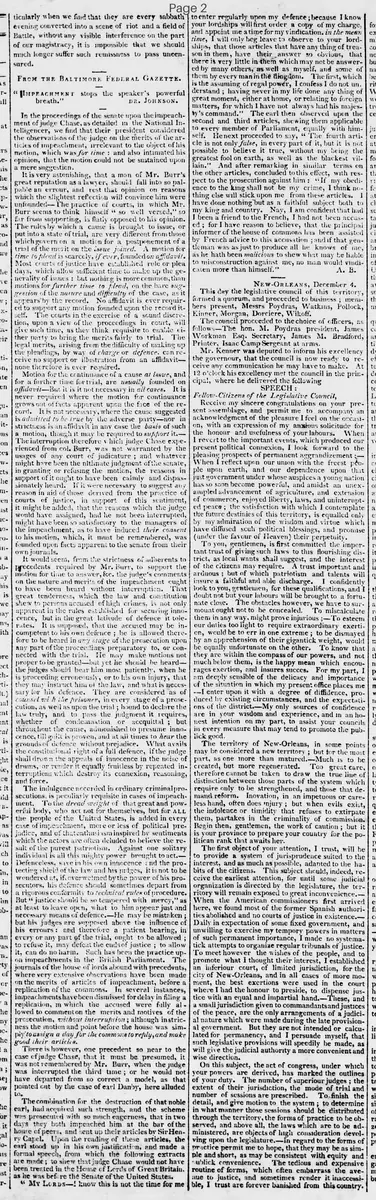
FROM THE BALTIMORE FEDERAL GAZETTE.
"IMPEACHMENT stops the speaker's powerful breath."
DR. JOHNSON.
In the proceedings of the senate upon the impeachment of judge Chase, as detailed in the National Intelligencer, we find that their president considered the observations of the judge on the merits of the articles of impeachment, irrelevant to the object of his motion, which was for time: and also intimated his opinion, that the motion could not be sustained upon a mere suggestion.
It is very astonishing, that a man of Mr. Burr's great reputation as a lawyer, should fall into so palpable an error, and rest that opinion on reasons which the slightest reflection will convince him were unfounded—The practice of courts, in which Mr. Burr seems to think himself "so well versed," so far from supporting, is flatly opposed to his opinion. The rules by which a cause is brought to issue, or put into a state of trial, are very different from those which govern on a motion for a postponement of a trial of the merit on the issue joined. A motion for time to file a plea is scarcely, if ever, founded on affidavit. Most courts of justice have established rule or plea days, which allow sufficient time to make up the generality of issues: but nothing is more common, than motions for further time to plead, on the bare suggestion of the nature and difficulty of the case, as it appears by the record. No affidavit is ever required to support any motion founded upon the record itself. The courts in the exercise of a sound discretion, upon a view of the proceedings in court, will give such time, as they think requisite to enable either party to bring the merits fairly to trial. The legal merits, arising from the difficulty of making up the pleadings, by way of charge or defence, can receive no support or illustration from an affidavit—none therefore is ever required.
Motion for the continuance of a cause at issue, and for a further time for trial, are usually founded on affidavit—But it is not necessary in all cases. It is never required where the motion for continuance grows out of facts apparent upon the face of the record. It is not necessary, where the cause suggested is admitted to be true by the adverse party—nor in strictness is an affidavit in any case the basis of such a motion, though it may be required to support it.—The interruption therefore which judge Chase experienced from col. Burr, was not warranted by the usages of any court of judicature; and whatever might have been the ultimate judgment of the senate, in granting or refusing the motion, the reasons in support of it ought to have been calmly and dispassionately heard. If it were necessary to suggest any reason in aid of those derived from the practice of courts of justice, in support of this sentiment, it might be added, that the reasons which the judge would have assigned, had he not been interrupted, might have been so satisfactory to the managers of the impeachment, as to have induced their consent to his motion, which, it must be remembered, was founded upon facts apparent to the senate from their own journals.
It would seem, from the strictness of precedents required by Mr. Burr, to support the motion for time to answer, &c. the judge's comments on the nature and merits of the impeachment ought to have been heard without interruption. That great tenderness, which the law and constitution shew to persons accused of high crimes, is not only apparent in the rules established for securing innocence, but in the great latitude of defence it tolerates. It is supposed, that the accused may be incompetent to his own defence: he is allowed therefore to be heard in every stage of the prosecution upon any part of the proceedings preparatory to, or connected with the trial. He may make motions not proper to be granted—but yet he should be heard—the judges should hear him most patiently, when he is proceeding erroneously, or to his own injury, that they may instruct him of the law, and what is necessary for his defence. They are considered as of counsel with the prisoner, in every stage of a prosecution, as well as upon the trial; bound to declare the law truly, and to pass the judgment it requires, whether of condemnation or acquittal; but throughout the cause, admonished to presume innocence, till guilt is proven, and at all times to hear the grounds of defence without prejudice. What avails the constitutional right of a full defence, if the judge shall drown the appeals of innocence in the noise of drums, or render it equally fruitless by repeated interruptions which destroy its connexion, reasoning, and force.
The indulgence accorded in ordinary criminal prosecutions, is peculiarly requisite in cases of impeachment. To the dread weight of that great and powerful body, who act not for themselves, but for ALL the people of the United States, is added in every case of impeachment, more or less of political prejudice, and of that enthusiasm inspired by sentiments which the actors are often deluded to believe the result of the purest patriotism. Against one solitary individual is all this mighty power brought to act.—Defenceless, save in his own innocence and the protecting shield of the law and his judges, it is not to be wondered at, if, overwhelmed by the power of his prosecutors, his defence should sometimes depart from a rigorous conformity to technical rules of procedure. But "justice should be so tempered with mercy," as at least to leave open, what to him appear just and necessary means of defence.—He may be mistaken; but his judges are supposed above the influence of his errors: and therefore a patient hearing, in every or any part of the trial, ought to be allowed; to refuse it, may defeat the ends of justice; to allow it, can do no harm. Such has been the practice upon impeachments in the British Parliament. The journals of the house of lords abound with precedents, where very extensive observations have been made on the merits of articles of impeachment, before a replication of the commons. In several instances, impeachments have been dismissed for delay in filing a replication, in which the accused were fully allowed to comment on the merits and motives of the prosecution, without interruption; although strictness the motion and point before the house was simply to assign a day for the commons to reply, and make good their articles.
There is however, one precedent so near to the case of judge Chase, that it must be presumed, it was not remembered by Mr. Burr, when the judge was interrupted the third time; or he would not have departed from so correct a model, as that pointed out by the case of earl Danby, here alluded to.
The combination for the destruction of that noble earl, had acquired such strength, and the scheme was prosecuted with so much eagerness, that in two days they both impeached him at the bar of the house of peers, and sent up their articles by Sir Hen. Capel. Upon the reading of these articles, the earl stood up in his own justification, and made a formal speech, from which the following extracts are made; to shew that judge Chase would not have been treated in the House of Lords of Great Britain, as he was before the Senate of the United States.
"Mr. LORDS—I know this is not the time for me to enter regularly upon my defence; because I know your lordships will first order a copy of my charge, and appoint me a time for my vindication. In the mean time, I will only beg leave to observe to your lordships, that those articles that have any thing of treason in them, have their answer so obvious, that there is very little in them which may not be answered by many others, as well as myself, and some of them by every man in the kingdom. The first, which is the assuming of regal power, I confess I do not understand; having never in my life done any thing of great moment, either at home, or relating to foreign matters, for which I have not always had his majesty's command." The earl then observed upon the second and third articles, shewing them applicable to every member of Parliament, equally with himself. He next proceeded to say, "The fourth article is not only false, in every part of it, but it is not possible to believe it true, without my being the greatest fool on earth, as well as the blackest villain." And after remarking in similar terms on the other articles, concluded to this effect, with respect to the prosecution against him: "If my obedience to the king shall not be my crime, I think nothing else will stick upon me from these articles. I have done nothing but as a faithful subject both to my king and country. Nay, I am confident that had I been a friend to the French, I had not been accused; for I have reason to believe, that the principal informer of the house of commons has been assisted by French advice to this accusation; and if that gentleman was as just to produce all he knows of me, as he hath been malicious to shew what may be liable to misconstruction against me, no man would vindicate me more than himself."
A. B.
"IMPEACHMENT stops the speaker's powerful breath."
DR. JOHNSON.
In the proceedings of the senate upon the impeachment of judge Chase, as detailed in the National Intelligencer, we find that their president considered the observations of the judge on the merits of the articles of impeachment, irrelevant to the object of his motion, which was for time: and also intimated his opinion, that the motion could not be sustained upon a mere suggestion.
It is very astonishing, that a man of Mr. Burr's great reputation as a lawyer, should fall into so palpable an error, and rest that opinion on reasons which the slightest reflection will convince him were unfounded—The practice of courts, in which Mr. Burr seems to think himself "so well versed," so far from supporting, is flatly opposed to his opinion. The rules by which a cause is brought to issue, or put into a state of trial, are very different from those which govern on a motion for a postponement of a trial of the merit on the issue joined. A motion for time to file a plea is scarcely, if ever, founded on affidavit. Most courts of justice have established rule or plea days, which allow sufficient time to make up the generality of issues: but nothing is more common, than motions for further time to plead, on the bare suggestion of the nature and difficulty of the case, as it appears by the record. No affidavit is ever required to support any motion founded upon the record itself. The courts in the exercise of a sound discretion, upon a view of the proceedings in court, will give such time, as they think requisite to enable either party to bring the merits fairly to trial. The legal merits, arising from the difficulty of making up the pleadings, by way of charge or defence, can receive no support or illustration from an affidavit—none therefore is ever required.
Motion for the continuance of a cause at issue, and for a further time for trial, are usually founded on affidavit—But it is not necessary in all cases. It is never required where the motion for continuance grows out of facts apparent upon the face of the record. It is not necessary, where the cause suggested is admitted to be true by the adverse party—nor in strictness is an affidavit in any case the basis of such a motion, though it may be required to support it.—The interruption therefore which judge Chase experienced from col. Burr, was not warranted by the usages of any court of judicature; and whatever might have been the ultimate judgment of the senate, in granting or refusing the motion, the reasons in support of it ought to have been calmly and dispassionately heard. If it were necessary to suggest any reason in aid of those derived from the practice of courts of justice, in support of this sentiment, it might be added, that the reasons which the judge would have assigned, had he not been interrupted, might have been so satisfactory to the managers of the impeachment, as to have induced their consent to his motion, which, it must be remembered, was founded upon facts apparent to the senate from their own journals.
It would seem, from the strictness of precedents required by Mr. Burr, to support the motion for time to answer, &c. the judge's comments on the nature and merits of the impeachment ought to have been heard without interruption. That great tenderness, which the law and constitution shew to persons accused of high crimes, is not only apparent in the rules established for securing innocence, but in the great latitude of defence it tolerates. It is supposed, that the accused may be incompetent to his own defence: he is allowed therefore to be heard in every stage of the prosecution upon any part of the proceedings preparatory to, or connected with the trial. He may make motions not proper to be granted—but yet he should be heard—the judges should hear him most patiently, when he is proceeding erroneously, or to his own injury, that they may instruct him of the law, and what is necessary for his defence. They are considered as of counsel with the prisoner, in every stage of a prosecution, as well as upon the trial; bound to declare the law truly, and to pass the judgment it requires, whether of condemnation or acquittal; but throughout the cause, admonished to presume innocence, till guilt is proven, and at all times to hear the grounds of defence without prejudice. What avails the constitutional right of a full defence, if the judge shall drown the appeals of innocence in the noise of drums, or render it equally fruitless by repeated interruptions which destroy its connexion, reasoning, and force.
The indulgence accorded in ordinary criminal prosecutions, is peculiarly requisite in cases of impeachment. To the dread weight of that great and powerful body, who act not for themselves, but for ALL the people of the United States, is added in every case of impeachment, more or less of political prejudice, and of that enthusiasm inspired by sentiments which the actors are often deluded to believe the result of the purest patriotism. Against one solitary individual is all this mighty power brought to act.—Defenceless, save in his own innocence and the protecting shield of the law and his judges, it is not to be wondered at, if, overwhelmed by the power of his prosecutors, his defence should sometimes depart from a rigorous conformity to technical rules of procedure. But "justice should be so tempered with mercy," as at least to leave open, what to him appear just and necessary means of defence.—He may be mistaken; but his judges are supposed above the influence of his errors: and therefore a patient hearing, in every or any part of the trial, ought to be allowed; to refuse it, may defeat the ends of justice; to allow it, can do no harm. Such has been the practice upon impeachments in the British Parliament. The journals of the house of lords abound with precedents, where very extensive observations have been made on the merits of articles of impeachment, before a replication of the commons. In several instances, impeachments have been dismissed for delay in filing a replication, in which the accused were fully allowed to comment on the merits and motives of the prosecution, without interruption; although strictness the motion and point before the house was simply to assign a day for the commons to reply, and make good their articles.
There is however, one precedent so near to the case of judge Chase, that it must be presumed, it was not remembered by Mr. Burr, when the judge was interrupted the third time; or he would not have departed from so correct a model, as that pointed out by the case of earl Danby, here alluded to.
The combination for the destruction of that noble earl, had acquired such strength, and the scheme was prosecuted with so much eagerness, that in two days they both impeached him at the bar of the house of peers, and sent up their articles by Sir Hen. Capel. Upon the reading of these articles, the earl stood up in his own justification, and made a formal speech, from which the following extracts are made; to shew that judge Chase would not have been treated in the House of Lords of Great Britain, as he was before the Senate of the United States.
"Mr. LORDS—I know this is not the time for me to enter regularly upon my defence; because I know your lordships will first order a copy of my charge, and appoint me a time for my vindication. In the mean time, I will only beg leave to observe to your lordships, that those articles that have any thing of treason in them, have their answer so obvious, that there is very little in them which may not be answered by many others, as well as myself, and some of them by every man in the kingdom. The first, which is the assuming of regal power, I confess I do not understand; having never in my life done any thing of great moment, either at home, or relating to foreign matters, for which I have not always had his majesty's command." The earl then observed upon the second and third articles, shewing them applicable to every member of Parliament, equally with himself. He next proceeded to say, "The fourth article is not only false, in every part of it, but it is not possible to believe it true, without my being the greatest fool on earth, as well as the blackest villain." And after remarking in similar terms on the other articles, concluded to this effect, with respect to the prosecution against him: "If my obedience to the king shall not be my crime, I think nothing else will stick upon me from these articles. I have done nothing but as a faithful subject both to my king and country. Nay, I am confident that had I been a friend to the French, I had not been accused; for I have reason to believe, that the principal informer of the house of commons has been assisted by French advice to this accusation; and if that gentleman was as just to produce all he knows of me, as he hath been malicious to shew what may be liable to misconstruction against me, no man would vindicate me more than himself."
A. B.
What sub-type of article is it?
Legal Or Court
Politics
What keywords are associated?
Impeachment Trial
Judge Chase
Aaron Burr
Senate Proceedings
Legal Precedent
Earl Danby
What entities or persons were involved?
Judge Chase
Mr. Burr
Earl Danby
Where did it happen?
Senate Of The United States
Domestic News Details
Primary Location
Senate Of The United States
Key Persons
Judge Chase
Mr. Burr
Earl Danby
Event Details
Editorial commentary criticizes Senate President Aaron Burr's interruption of Judge Samuel Chase during his impeachment trial, arguing it contravenes legal practices allowing accused to speak on merits even during procedural motions, and cites British precedent of Earl Danby's defense speech upon reading of impeachment articles.