Thank you for visiting SNEWPapers!
Sign up free
Story
July 8, 1911
The Evening Standard
Ogden, Weber County, Utah
What is this article about?
Editorial from Marxian Club Socialists advocating socialism as solution to social ills, with quotes on labor unity, and an interview with French labor leader Pataud on revolutionary change and post-revolution production.
Clipping
OCR Quality
95%
Excellent
Full Text
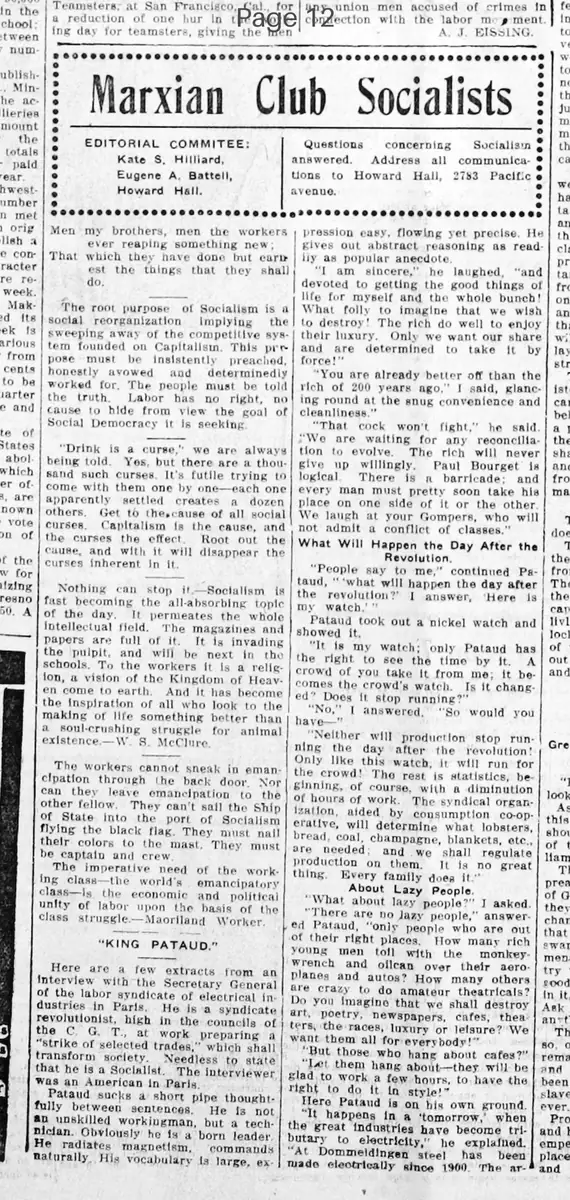
Marxian Club Socialists
EDITORIAL COMMITTEE:
Questions concerning Socialism answered.
Address all communications to Howard Hall, 2783 Pacific avenue.
Howard Hall.
The root purpose of Socialism is a social reorganization implying the sweeping away of the competitive system founded on Capitalism. This purpose must be insistently preached, honestly avowed and determinedly worked for. The people must be told the truth. Labor has no right, no cause to hide from view the goal of Social Democracy it is seeking.
"Drink is a curse," we are always being told. Yes, but there are a thousand such curses. It's futile trying to come with them one by one—each one apparently settled creates a dozen others. Get to the cause of all social curses. Capitalism is the cause, and the curses the effect. Root out the cause, and with it will disappear the curses inherent in it.
Nothing can stop it—Socialism is fast becoming the all-absorbing topic of the day. It permeates the whole intellectual field. The magazines and papers are full of it. It is invading the pulpit, and will be next in the schools. To the workers it is a religion, a vision of the Kingdom of Heaven come to earth. And it has become the inspiration of all who look to the making of life something better than a soul-crushing struggle for animal existence.—W. S. McClure.
The workers cannot sneak in emancipation through the back door. Nor can they leave emancipation to the other fellow. They can't sail the Ship of State into the port of Socialism flying the black flag. They must nail their colors to the mast. They must be captain and crew.
The imperative need of the working class—the world's emancipatory class—is the economic and political unity of labor upon the basis of the class struggle.—Maoriland Worker.
"KING PATAUD."
Here are a few extracts from an Interview with the Secretary General of the labor syndicate of electrical industries in Paris. He is a syndicate revolutionist, high in the councils of the C. G. T., at work preparing a 'strike of selected trades,' which shall transform society. Needless to state that he is a Socialist. The interviewer was an American in Paris.
Pataud sucks a short pipe thoughtfully between sentences. He is not an unskilled workingman, but a technician. Obviously he is a born leader. He radiates magnetism, commands naturally. His vocabulary is large, expression easy, flowing yet precise. He gives out abstract reasoning as readily as popular anecdote.
"I am sincere," he laughed, "and devoted to getting the good things of life for myself and the whole bunch! What folly to imagine that we wish to destroy! The rich do well to enjoy their luxury. Only we want our share and are determined to take it by force!"
"You are already better off than the rich of 200 years ago," I said, glancing round at the snug convenience and cleanliness.
"That cock won't fight," he said. "We are waiting for any reconciliation to evolve. The rich will never give up willingly. Paul Bourget is logical. There is a barricade: and every man must pretty soon take his place on one side of it or the other. We laugh at your Gompers, who will not admit a conflict of classes."
What Will Happen the Day After the Revolution.
"People say to me," continued Pataud, "'what will happen the day after the revolution?' I answer, Here is my watch."
Pataud took out a nickel watch and showed it.
"It is my watch; only Pataud has the right to see the time by it. A crowd of you take it from me: it becomes the crowd's watch. Is it changed? Does it stop running?"
"No," I answered. "So would you have"
"Neither will production stop running the day after the revolution! Only like this watch, it will run for the crowd! The rest is statistics, beginning, of course, with a diminution of hours of work. The syndical organization, aided by consumption co-operative, will determine what lobsters, bread, coal, champagne, blankets, etc., are needed, and we shall regulate production on them. It is no great thing. Every family does it."
About Lazy People.
What about lazy people?" I asked.
"There are no lazy people," answered Pataud, "only people who are out of their right places. How many rich young men toil with the monkey-wrench and oilcan over their aero-planes and autos? How many others are crazy to do amateur theatricals? Do you imagine that we shall destroy art, poetry, newspapers, cafes, theaters, the races, luxury or leisure? We want them all for everybody!"
"But those who hang about cafes?"
"Let them hang about—they will be glad to work a few hours, to have the right to do it in style!"
Here Pataud is on his own ground.
"It happens in a 'tomorrow,' when the great industries have become tributary to electricity," he explained. "At Dommeldingen steel has been made electrically since 1900. The ar-
EDITORIAL COMMITTEE:
Questions concerning Socialism answered.
Address all communications to Howard Hall, 2783 Pacific avenue.
Howard Hall.
The root purpose of Socialism is a social reorganization implying the sweeping away of the competitive system founded on Capitalism. This purpose must be insistently preached, honestly avowed and determinedly worked for. The people must be told the truth. Labor has no right, no cause to hide from view the goal of Social Democracy it is seeking.
"Drink is a curse," we are always being told. Yes, but there are a thousand such curses. It's futile trying to come with them one by one—each one apparently settled creates a dozen others. Get to the cause of all social curses. Capitalism is the cause, and the curses the effect. Root out the cause, and with it will disappear the curses inherent in it.
Nothing can stop it—Socialism is fast becoming the all-absorbing topic of the day. It permeates the whole intellectual field. The magazines and papers are full of it. It is invading the pulpit, and will be next in the schools. To the workers it is a religion, a vision of the Kingdom of Heaven come to earth. And it has become the inspiration of all who look to the making of life something better than a soul-crushing struggle for animal existence.—W. S. McClure.
The workers cannot sneak in emancipation through the back door. Nor can they leave emancipation to the other fellow. They can't sail the Ship of State into the port of Socialism flying the black flag. They must nail their colors to the mast. They must be captain and crew.
The imperative need of the working class—the world's emancipatory class—is the economic and political unity of labor upon the basis of the class struggle.—Maoriland Worker.
"KING PATAUD."
Here are a few extracts from an Interview with the Secretary General of the labor syndicate of electrical industries in Paris. He is a syndicate revolutionist, high in the councils of the C. G. T., at work preparing a 'strike of selected trades,' which shall transform society. Needless to state that he is a Socialist. The interviewer was an American in Paris.
Pataud sucks a short pipe thoughtfully between sentences. He is not an unskilled workingman, but a technician. Obviously he is a born leader. He radiates magnetism, commands naturally. His vocabulary is large, expression easy, flowing yet precise. He gives out abstract reasoning as readily as popular anecdote.
"I am sincere," he laughed, "and devoted to getting the good things of life for myself and the whole bunch! What folly to imagine that we wish to destroy! The rich do well to enjoy their luxury. Only we want our share and are determined to take it by force!"
"You are already better off than the rich of 200 years ago," I said, glancing round at the snug convenience and cleanliness.
"That cock won't fight," he said. "We are waiting for any reconciliation to evolve. The rich will never give up willingly. Paul Bourget is logical. There is a barricade: and every man must pretty soon take his place on one side of it or the other. We laugh at your Gompers, who will not admit a conflict of classes."
What Will Happen the Day After the Revolution.
"People say to me," continued Pataud, "'what will happen the day after the revolution?' I answer, Here is my watch."
Pataud took out a nickel watch and showed it.
"It is my watch; only Pataud has the right to see the time by it. A crowd of you take it from me: it becomes the crowd's watch. Is it changed? Does it stop running?"
"No," I answered. "So would you have"
"Neither will production stop running the day after the revolution! Only like this watch, it will run for the crowd! The rest is statistics, beginning, of course, with a diminution of hours of work. The syndical organization, aided by consumption co-operative, will determine what lobsters, bread, coal, champagne, blankets, etc., are needed, and we shall regulate production on them. It is no great thing. Every family does it."
About Lazy People.
What about lazy people?" I asked.
"There are no lazy people," answered Pataud, "only people who are out of their right places. How many rich young men toil with the monkey-wrench and oilcan over their aero-planes and autos? How many others are crazy to do amateur theatricals? Do you imagine that we shall destroy art, poetry, newspapers, cafes, theaters, the races, luxury or leisure? We want them all for everybody!"
"But those who hang about cafes?"
"Let them hang about—they will be glad to work a few hours, to have the right to do it in style!"
Here Pataud is on his own ground.
"It happens in a 'tomorrow,' when the great industries have become tributary to electricity," he explained. "At Dommeldingen steel has been made electrically since 1900. The ar-
What sub-type of article is it?
Historical Event
Curiosity
What themes does it cover?
Justice
Moral Virtue
Triumph
What keywords are associated?
Socialism
Capitalism
Labor Unity
Revolution
Syndicalism
Class Struggle
Pataud Interview
What entities or persons were involved?
Howard Hall
W. S. Mcclure
Pataud
Paul Bourget
Gompers
Where did it happen?
Paris
Story Details
Key Persons
Howard Hall
W. S. Mcclure
Pataud
Paul Bourget
Gompers
Location
Paris
Story Details
Editorial promotes socialism as reorganization against capitalism, quotes on labor unity and emancipation; interview with Pataud describes revolutionary seizure of production for the masses without disruption, addressing post-revolution society and lazy people.