Thank you for visiting SNEWPapers!
Sign up free
Story
June 1, 1854
The Literary Echo, And Pawcatuck Advertiser
Westerly, Washington County, Rhode Island
What is this article about?
1854 article from Westerly, RI, justifying 'Niantic Bank' name by recounting Niantic tribe's historical residence in the area, relations with Pequots and Narragansetts, wars, and local town formations from colonial times.
Clipping
OCR Quality
98%
Excellent
Full Text
Westerly, June 1, 1854.
"Niantic."
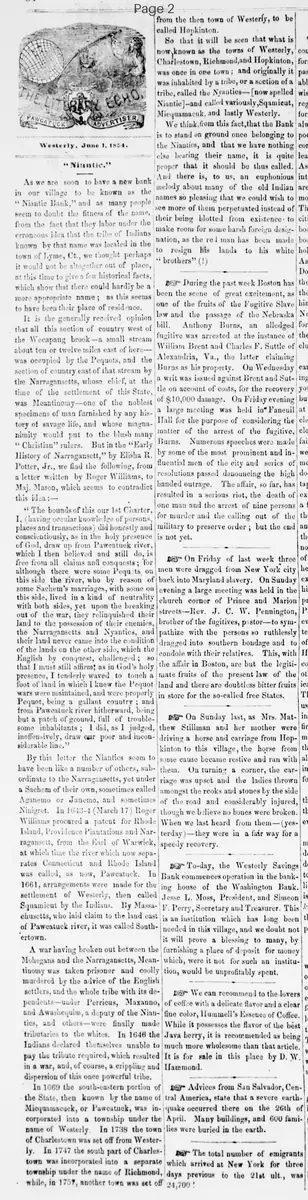
As we are soon to have a new bank in our village to be known as the "Niantic Bank," and as many people seem to doubt the fitness of the name, from the fact that they labor under the erroneous idea that the tribe of Indians known by that name was located in the town of Lyme, Ct., we thought perhaps it would not be altogether out of place, at this time to give a few historical facts, which show that there could hardly be a more appropriate name; as this seems to have been their place of residence.
It is the generally received opinion that all this section of country west of the Wecapaug brook—a small stream about ten or twelve miles east of here—was occupied by the Pequots, and the section of country east of that stream by the Narragansetts, whose chief, at the time of the settlement of this State, was Meantinomy—one of the noblest specimens of man furnished by any history of savage life, and whose magnanimity would put to the blush many "Christian" rulers. But in the "Early History of Narragansett," by Elisha R. Potter, Jr., we find the following, from a letter written by Roger Williams, to Maj. Mason, which seems to contradict this idea: —
"The bounds of this our 1st Charter, I, (having ocular knowledge of persons, places and transactions) did honestly and conscientiously, as in the holy presence of God, draw up from Pawcatuck river, which I then believed and still do, is free from all claims and conquests; for although there were some Pequots on this side the river, who by reason of some Sachem's marriages, with some on this side, lived in a kind of neutrality with both sides, yet upon the breaking out of the war, they relinquished their land to the possession of their enemies, the Narragansetts and Niantic, and their land never came into the condition of the lands on the other side, which the English by conquest, challenged; so that I must still affirm; as in God's holy presence, I tenderly waived to touch a foot of land in which I knew the Pequot wars were maintained, and were properly Pequot, being a gallant country; and from Pawcatuck river hitherward, being but a patch of ground, full of troublesome inhabitants; I did, as I judged, inoffensively, draw our poor and inconsiderable line."
By this letter the Niantic seem to have been like a number of others, subordinate to the Narragansetts, yet under a Sachem of their own, sometimes called Aganemo or Janemo, and sometimes Ninigret. In 1643-4 (March 17) Roger Williams procured a patent for Rhode Island, Providence Plantations and Narragansett, from the Earl of Warwick, at which time the river which now separates Connecticut and Rhode Island was called, as now, Pawcatuck. In 1661, arrangements were made for the settlement of Westerly, then called Squamicut by the Indians. By Massachusetts, who laid claim to the land east of Pawcatuck river, it was called Southertown.
A war having broken out between the Mohegans and the Narragansetts, Meantinomy was taken prisoner and coolly murdered by the advice of the English settlers, and the whole tribe with its dependents—under Pericus, Maxanno, and Awashequim, a deputy of the Niantic, and others—were finally made tributaries to the whites. In 1646 the Indians declared themselves unable to pay the tribute required, which resulted in a war, and, of course, a crippling and dispersion of this once powerful tribe.
In 1669 the south-eastern portion of the State, then known by the name of Micquamacuck, or Pawcatuck, was incorporated into a township under the name of Westerly. In 1738 the town of Charlestown was set off from Westerly. In 1747 the south part of Charlestown was incorporated into a separate township under the name of Richmond, while, in 1757, another town was set off from the then town of Westerly, to be called Hopkinton.
So that it will be seen that what is now known as the towns of Westerly, Charlestown, Richmond, and Hopkinton, was once one town; and originally it was inhabited by a tribe, or a section of a tribe, called the Nyantics—[now spelled Niantic]—and called variously, Squamicut, Micquamacuk, and lastly Westerly.
We think, from this fact, that the Bank is to stand on ground once belonging to the Niantic, and that we have nothing else bearing their name, it is quite proper that it should be thus called.
And there is, to us, an euphonious melody about many of the old Indian names so pleasing that we could wish to see more of them perpetuated instead of their being blotted from existence to make room for some harsh foreign designation, as the red man has been made to resign his lands to his white "brothers" (!).
"Niantic."
As we are soon to have a new bank in our village to be known as the "Niantic Bank," and as many people seem to doubt the fitness of the name, from the fact that they labor under the erroneous idea that the tribe of Indians known by that name was located in the town of Lyme, Ct., we thought perhaps it would not be altogether out of place, at this time to give a few historical facts, which show that there could hardly be a more appropriate name; as this seems to have been their place of residence.
It is the generally received opinion that all this section of country west of the Wecapaug brook—a small stream about ten or twelve miles east of here—was occupied by the Pequots, and the section of country east of that stream by the Narragansetts, whose chief, at the time of the settlement of this State, was Meantinomy—one of the noblest specimens of man furnished by any history of savage life, and whose magnanimity would put to the blush many "Christian" rulers. But in the "Early History of Narragansett," by Elisha R. Potter, Jr., we find the following, from a letter written by Roger Williams, to Maj. Mason, which seems to contradict this idea: —
"The bounds of this our 1st Charter, I, (having ocular knowledge of persons, places and transactions) did honestly and conscientiously, as in the holy presence of God, draw up from Pawcatuck river, which I then believed and still do, is free from all claims and conquests; for although there were some Pequots on this side the river, who by reason of some Sachem's marriages, with some on this side, lived in a kind of neutrality with both sides, yet upon the breaking out of the war, they relinquished their land to the possession of their enemies, the Narragansetts and Niantic, and their land never came into the condition of the lands on the other side, which the English by conquest, challenged; so that I must still affirm; as in God's holy presence, I tenderly waived to touch a foot of land in which I knew the Pequot wars were maintained, and were properly Pequot, being a gallant country; and from Pawcatuck river hitherward, being but a patch of ground, full of troublesome inhabitants; I did, as I judged, inoffensively, draw our poor and inconsiderable line."
By this letter the Niantic seem to have been like a number of others, subordinate to the Narragansetts, yet under a Sachem of their own, sometimes called Aganemo or Janemo, and sometimes Ninigret. In 1643-4 (March 17) Roger Williams procured a patent for Rhode Island, Providence Plantations and Narragansett, from the Earl of Warwick, at which time the river which now separates Connecticut and Rhode Island was called, as now, Pawcatuck. In 1661, arrangements were made for the settlement of Westerly, then called Squamicut by the Indians. By Massachusetts, who laid claim to the land east of Pawcatuck river, it was called Southertown.
A war having broken out between the Mohegans and the Narragansetts, Meantinomy was taken prisoner and coolly murdered by the advice of the English settlers, and the whole tribe with its dependents—under Pericus, Maxanno, and Awashequim, a deputy of the Niantic, and others—were finally made tributaries to the whites. In 1646 the Indians declared themselves unable to pay the tribute required, which resulted in a war, and, of course, a crippling and dispersion of this once powerful tribe.
In 1669 the south-eastern portion of the State, then known by the name of Micquamacuck, or Pawcatuck, was incorporated into a township under the name of Westerly. In 1738 the town of Charlestown was set off from Westerly. In 1747 the south part of Charlestown was incorporated into a separate township under the name of Richmond, while, in 1757, another town was set off from the then town of Westerly, to be called Hopkinton.
So that it will be seen that what is now known as the towns of Westerly, Charlestown, Richmond, and Hopkinton, was once one town; and originally it was inhabited by a tribe, or a section of a tribe, called the Nyantics—[now spelled Niantic]—and called variously, Squamicut, Micquamacuk, and lastly Westerly.
We think, from this fact, that the Bank is to stand on ground once belonging to the Niantic, and that we have nothing else bearing their name, it is quite proper that it should be thus called.
And there is, to us, an euphonious melody about many of the old Indian names so pleasing that we could wish to see more of them perpetuated instead of their being blotted from existence to make room for some harsh foreign designation, as the red man has been made to resign his lands to his white "brothers" (!).
What sub-type of article is it?
Historical Event
What themes does it cover?
Misfortune
Catastrophe
What keywords are associated?
Niantic Tribe
Westerly History
Pequot War
Narragansetts
Pawcatuck River
Colonial Settlement
Indian Lands
Bank Naming
What entities or persons were involved?
Roger Williams
Meantinomy
Ninigret
Aganemo
Janemo
Pericus
Maxanno
Awashequim
Where did it happen?
Westerly, Rhode Island; Pawcatuck River; Areas West Of Wecapaug Brook
Story Details
Key Persons
Roger Williams
Meantinomy
Ninigret
Aganemo
Janemo
Pericus
Maxanno
Awashequim
Location
Westerly, Rhode Island; Pawcatuck River; Areas West Of Wecapaug Brook
Event Date
1643 1757
Story Details
Historical account arguing for 'Niantic Bank' name by detailing Niantic tribe's residence in Westerly area, subordination to Narragansetts, involvement in Pequot wars, subjugation by English settlers, and evolution of local townships from original Niantic lands.