Thank you for visiting SNEWPapers!
Sign up free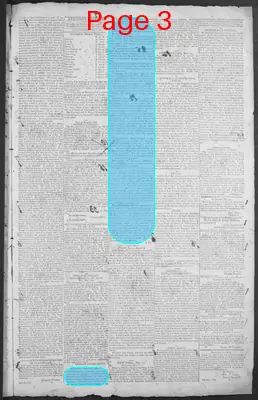
Literary
May 30, 1809
Kentucky Gazette
Lexington, Fayette County, Kentucky
What is this article about?
An essay by J.W. in the Virginia Argus explores a mechanical principle: the lowest point of a rolling wheel moves slower than the highest for the first 90 degrees. It analogizes this to Earth's rotation, suggesting unequal velocities in hemispheres explain tidal inequalities, challenging Newtonian theory.
Clipping
OCR Quality
95%
Excellent
Full Text
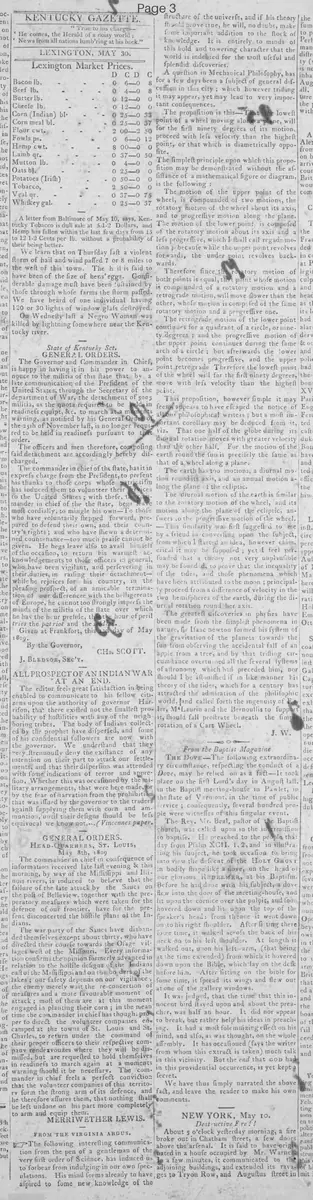
FROM THE VIRGINIA ARGUS.
The following interesting communication from the pen of a gentleman of the very first order of Science, has induced us to forbear from indulging in our own speculations. His mind seems already to have aspired to some new knowledge of the structure of the universe, and if his theory should prove true, he will, no doubt, make some important addition to the stock of knowledge. It is entirely to minds of this bold and towering character that the world is indebted for the most useful and splendid discoveries.
A question in Mechanical Philosophy, has for a few days been a subject of general discussion in this city; which however trifling it may appear, yet may lead to very important consequences.
The proposition is this—That the lowest point of a wheel moving along a plane, will for the first ninety degrees of its motion, proceed with less velocity than the highest point, or that which is diametrically opposite.
The simplest principle upon which this proposition may be demonstrated without the assistance of a mathematical figure or diagram, is the following:
The motion of the upper point of the wheel, is compounded of two motions, the rotatory motion of the wheel about its axis, and to progressive motion along the plane.
The motion of the lower point is composed of the rotatory motion about its axis and a less progressive, which I shall call retrograde motion; because while the upper point revolves forwards, the under point revolves backwards.
Therefore since the rotatory motion of both points is equal, that point whose motion is compounded of a rotatory motion and a retrograde motion, will move slower than the other, whose motion is composed of the same rotatory motion and a progressive one.
The retrograde motion of the lower point continues for a quadrant of a circle, or ninety degrees; and the progressive motion of the upper point continues during the same arch of a circle: but afterwards the lower point becomes progressive, and the upper point retrograde Therefore the lowest point of the wheel will for the first ninety degrees, move with less velocity than the highest point.
This proposition, however simple it may seem appears to have escaped the notice of all our philosophical writers; but a most important corollary may be deduced from it, viz. That one half of the globe during its diurnal rotation moves with greater velocity than the other half. For the motion of the earth round the sun is precisely the same as that of a wheel along a plane.
The earth has two motions, a diurnal motion round its axis, and an annual motion along the plane of the ecliptic.
The diurnal motion of the earth is similar to the rotatory motion of the wheel, and its motion along the plane of the ecliptic, answers to the progressive motion of the wheel.
--This similarity was first suggested to me by a friend in conversing upon the subject, from which I started an idea, however chimerical it may be supposed; yet I feel persuaded that a theory not very implausible may be founded, to prove that the inequality of the tides, and those phenomena which have been attributed to the moon: principally proceed from a difference of velocity in the two hemispheres of the earth, during the diurnal rotation round her axis.
The greatest discoveries in physics have been made from the simplest phenomena in nature, sic Isaac Newton formed his system of the gravitation of the planets towards the sun from observing the accidental fall of an apple from a tree, and by that trifling circumstance overturned all the several systems of astronomy which had preceded him, nor should I be astonished if in like manner his theory of the tides, which for a century has attracted the admiration of the philosophic world, and called forth the ingenuity of Euler, M'Laurin and the Bernoullis to support it, should fall prostrate beneath the simple rotation of a Cart Wheel.
J. W.
The following interesting communication from the pen of a gentleman of the very first order of Science, has induced us to forbear from indulging in our own speculations. His mind seems already to have aspired to some new knowledge of the structure of the universe, and if his theory should prove true, he will, no doubt, make some important addition to the stock of knowledge. It is entirely to minds of this bold and towering character that the world is indebted for the most useful and splendid discoveries.
A question in Mechanical Philosophy, has for a few days been a subject of general discussion in this city; which however trifling it may appear, yet may lead to very important consequences.
The proposition is this—That the lowest point of a wheel moving along a plane, will for the first ninety degrees of its motion, proceed with less velocity than the highest point, or that which is diametrically opposite.
The simplest principle upon which this proposition may be demonstrated without the assistance of a mathematical figure or diagram, is the following:
The motion of the upper point of the wheel, is compounded of two motions, the rotatory motion of the wheel about its axis, and to progressive motion along the plane.
The motion of the lower point is composed of the rotatory motion about its axis and a less progressive, which I shall call retrograde motion; because while the upper point revolves forwards, the under point revolves backwards.
Therefore since the rotatory motion of both points is equal, that point whose motion is compounded of a rotatory motion and a retrograde motion, will move slower than the other, whose motion is composed of the same rotatory motion and a progressive one.
The retrograde motion of the lower point continues for a quadrant of a circle, or ninety degrees; and the progressive motion of the upper point continues during the same arch of a circle: but afterwards the lower point becomes progressive, and the upper point retrograde Therefore the lowest point of the wheel will for the first ninety degrees, move with less velocity than the highest point.
This proposition, however simple it may seem appears to have escaped the notice of all our philosophical writers; but a most important corollary may be deduced from it, viz. That one half of the globe during its diurnal rotation moves with greater velocity than the other half. For the motion of the earth round the sun is precisely the same as that of a wheel along a plane.
The earth has two motions, a diurnal motion round its axis, and an annual motion along the plane of the ecliptic.
The diurnal motion of the earth is similar to the rotatory motion of the wheel, and its motion along the plane of the ecliptic, answers to the progressive motion of the wheel.
--This similarity was first suggested to me by a friend in conversing upon the subject, from which I started an idea, however chimerical it may be supposed; yet I feel persuaded that a theory not very implausible may be founded, to prove that the inequality of the tides, and those phenomena which have been attributed to the moon: principally proceed from a difference of velocity in the two hemispheres of the earth, during the diurnal rotation round her axis.
The greatest discoveries in physics have been made from the simplest phenomena in nature, sic Isaac Newton formed his system of the gravitation of the planets towards the sun from observing the accidental fall of an apple from a tree, and by that trifling circumstance overturned all the several systems of astronomy which had preceded him, nor should I be astonished if in like manner his theory of the tides, which for a century has attracted the admiration of the philosophic world, and called forth the ingenuity of Euler, M'Laurin and the Bernoullis to support it, should fall prostrate beneath the simple rotation of a Cart Wheel.
J. W.
What sub-type of article is it?
Essay
What keywords are associated?
Wheel Motion
Rotatory Motion
Earth Rotation
Tides Inequality
Mechanical Philosophy
Newton Theory
What entities or persons were involved?
J. W.
Literary Details
Author
J. W.
Subject
A Question In Mechanical Philosophy
Form / Style
Prose Argument On Wheel Motion And Astronomical Analogy
Key Lines
The Proposition Is This—That The Lowest Point Of A Wheel Moving Along A Plane, Will For The First Ninety Degrees Of Its Motion, Proceed With Less Velocity Than The Highest Point, Or That Which Is Diametrically Opposite.
That One Half Of The Globe During Its Diurnal Rotation Moves With Greater Velocity Than The Other Half.
A Theory Not Very Implausible May Be Founded, To Prove That The Inequality Of The Tides... Principally Proceed From A Difference Of Velocity In The Two Hemispheres Of The Earth