Thank you for visiting SNEWPapers!
Sign up free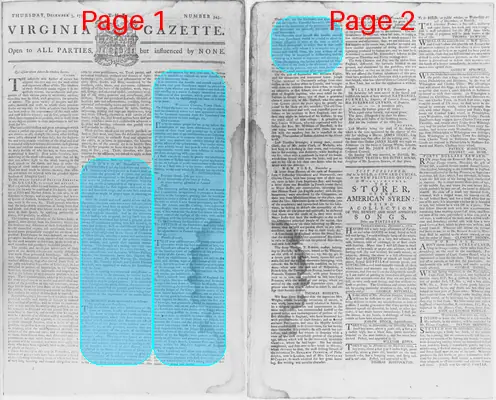
The Virginia Gazette
Williamsburg, Virginia
What is this article about?
On November 2, 1772, Boston inhabitants met at Faneuil Hall to address alarming reports of Crown-appointed salaries for superior court judges, rendering them independent of the General Assembly. They sent a message to Governor Hutchinson, who refused to confirm; the town then petitioned for the Assembly to convene to deliberate on the issue.
Merged-components note: This is a continuation of the Boston town meeting report on judges' salaries, split across pages 1 and 2, with sequential reading order and direct text flow.
Clippings
1 of 2
OCR Quality
Full Text
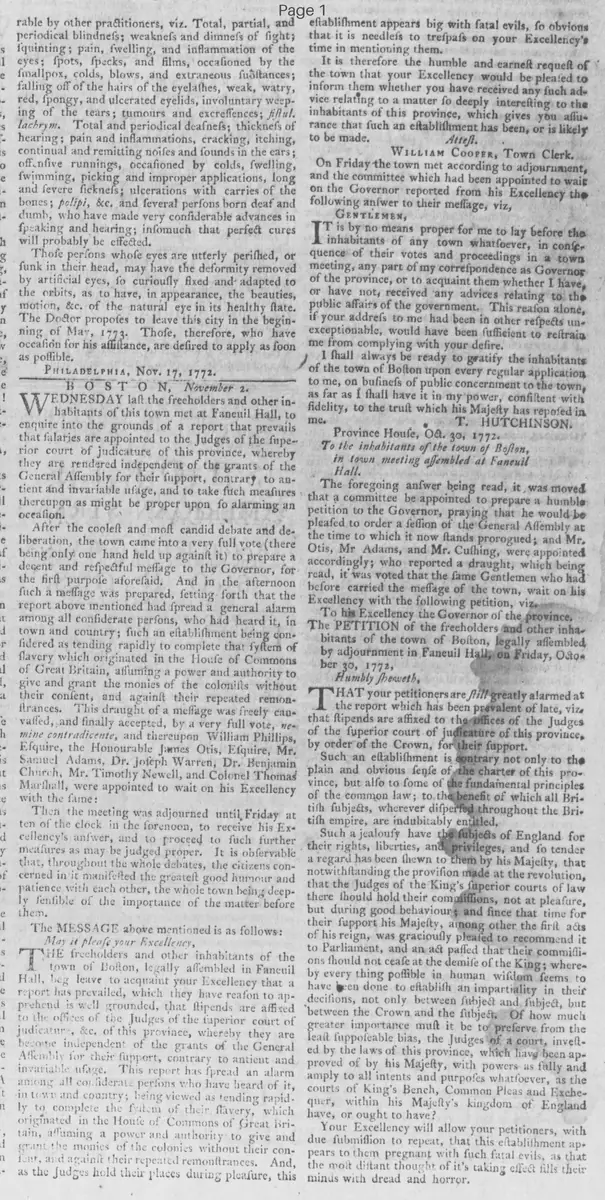
BOSTON, November 2.
WEDNESDAY last the freeholders and other inhabitants of this town met at Faneuil Hall, to enquire into the grounds of a report that prevails that salaries are appointed to the Judges of the superior court of judicature of this province, whereby they are rendered independent of the grants of the General Assembly for their support, contrary to ancient and invariable usage, and to take such measures thereupon as might be proper upon so alarming an occasion.
After the coolest and most candid debate and deliberation, the town came into a very full vote (there being only one hand held up against it) to prepare a decent and respectful message to the Governor, for the first purpose aforesaid. And in the afternoon such a message was prepared, setting forth that the report above mentioned had spread a general alarm among all considerate persons, who had heard it, in town and country; such an establishment being considered as tending rapidly to complete that system of slavery which originated in the House of Commons of Great Britain, assuming a power and authority to give and grant the monies of the colonists without their consent, and against their repeated remonstrances. This draught of a message was freely canvassed, and finally accepted, by a very full vote, nemine contradicente, and thereupon William Phillips, Esquire, the Honourable James Otis, Esquire, Mr. Samuel Adams, Dr. Joseph Warren, Dr. Benjamin Church, Mr. Timothy Newell, and Colonel Thomas Marshall, were appointed to wait on his Excellency with the same:
Then the meeting was adjourned until Friday at ten of the clock in the forenoon, to receive his Excellency's answer, and to proceed to such further measures as may be judged proper. It is observable that, throughout the whole debates, the citizens concerned in it manifested the greatest good humour and patience with each other, the whole town being deeply sensible of the importance of the matter before them.
The MESSAGE above mentioned is as follows:
May it please your Excellency,
The freeholders and other inhabitants of the town of Boston, legally assembled in Faneuil Hall, beg leave to acquaint your Excellency that a report has prevailed, which they have reason to apprehend is well grounded, that stipends are affixed to the offices of the Judges of the superior court of judicature, &c. of this province, whereby they are become independent of the grants of the General Assembly for their support, contrary to ancient and invariable usage. This report has spread an alarm among all considerate persons who have heard of it, in town and country; being viewed as tending rapidly to complete the system of their slavery, which originated in the House of Commons of Great Britain, assuming a power and authority to give and grant the monies of the colonies without their consent, and against their repeated remonstrances. And, as the Judges hold their places during pleasure, this establishment appears big with fatal evils, so obvious that it is needless to trespass on your Excellency's time in mentioning them.
It is therefore the humble and earnest request of the town that your Excellency would be pleased to inform them whether you have received any such advice relating to a matter so deeply interesting to the inhabitants of this province, which gives you assurance that such an establishment has been, or is likely to be made.
Attest,
William Cooper, Town Clerk.
On Friday the town met according to adjournment, and the committee which had been appointed to wait on the Governor reported from his Excellency the following answer to their message, viz,
GENTLEMEN,
It is by no means proper for me to lay before the inhabitants of any town whatsoever, in consequence of their votes and proceedings in a town meeting, any part of my correspondence as Governor of the province, or to acquaint them whether I have, or have not, received any advices relating to the public affairs of the government. This reason alone, if your address to me had been in other respects unexceptionable, would have been sufficient to restrain me from complying with your desire.
I shall always be ready to gratify the inhabitants of the town of Boston upon every regular application to me, on business of public concernment to the town as far as I shall have it in my power, consistent with fidelity, to the trust which his Majesty has reposed in me.
T. HUTCHINSON.
Province House, Oct. 30, 1772.
To the inhabitants of the town of Boston, in town meeting assembled at Faneuil Hall.
The foregoing answer being read, it was moved that a committee be appointed to prepare a humble petition to the Governor, praying that he would be pleased to order a session of the General Assembly at the time to which it now stands prorogued; and Mr. Otis, Mr. Adams, and Mr. Cushing, were appointed accordingly; who reported a draught, which being read, it was voted that the same Gentlemen who had before carried the message of the town, wait on his Excellency with the following petition, viz.
To his Excellency the Governor of the province.
The PETITION of the freeholders and other inhabitants of the town of Boston, legally assembled by adjournment in Faneuil Hall, on Friday, October 30, 1772,
Humbly sheweth,
That we are alarmed at the report that stipends are affixed to the offices of the Judges of the superior court of judicature of this province, by order of the Crown, for their support.
Such an establishment is contrary not only to the plain and obvious sense of the charter of this province, but also to some of the fundamental principles of the common law; to the benefit of which all British subjects, wherever dispersed throughout the British empire, are indubitably entitled.
Such a jealousy have the subjects of England for their rights, liberties, and privileges, and so tender a regard has been shewn to them by his Majesty, that notwithstanding the provision made at the revolution, that the Judges of the King's superior courts of law there should hold their commissions, not at pleasure, but during good behaviour; and since that time for their support his Majesty, among other the first acts of his reign, was graciously pleased to recommend it to Parliament, and an act passed that their commissions should not cease at the demise of the King; whereby every thing possible in human wisdom seems to have been done to establish an impartiality in their decisions, not only between subject and subject, but between the Crown and the subject. Of how much greater importance must it be to preserve from the least supposable bias, the Judges of a court, invested by the laws of this province, which have been approved of by his Majesty, with powers as fully and amply to all intents and purposes whatsoever, as the courts of King's Bench, Common Pleas and Exchequer, within his Majesty's kingdom of England have, or ought to have?
Your Excellency will allow your petitioners, with due submission to repeat, that this establishment appears to them pregnant with such fatal evils, as that the most distant thought of it's taking effect fills their minds with dread and horror.
These, Sir, are the sentiments and apprehensions of this metropolis: Expressed however, with due deference to the sentiments of the province, with which your petitioners are anxiously solicitous of being made acquainted.
It is therefore their earnest and humble request, that your Excellency would be pleased to allow the General Assembly to meet at the time to which it now stands prorogued; in order, that in that constitutional body, with whom it is to enquire into grievances and redress them, the joint wisdom of the province may be employed in deliberating and determining on a matter so important and alarming.
Then the meeting was further adjourned till Monday at three of the clock in the afternoon, to receive an answer to the petition, and take such further measures as this most important affair may require.
What sub-type of article is it?
What keywords are associated?
What entities or persons were involved?
Where did it happen?
Domestic News Details
Primary Location
Boston
Event Date
November 2, 1772
Key Persons
Outcome
town meeting voted to send message to governor; governor refused to provide information; town petitioned for general assembly to meet; adjourned to await response.
Event Details
Freeholders and inhabitants of Boston met at Faneuil Hall to investigate reports of salaries appointed to superior court judges by the Crown, making them independent of the General Assembly. After debate, they prepared and sent a respectful message to Governor Hutchinson expressing alarm over the report as a step toward slavery. The Governor responded that he could not share correspondence. The town then prepared and sent a petition requesting the General Assembly be allowed to meet to address the grievance.