Thank you for visiting SNEWPapers!
Sign up free
Story
March 6, 1961
The Nome Nugget
Nome, Nome County, Alaska
What is this article about?
Hal Boyle's AP article from New York laments the societal shift from using cash to relying on credit cards and checks, noting its impact on perceptions of wealth, crime like pickpocketing and mugging, and nostalgia for the era when money was king.
Clipping
OCR Quality
100%
Excellent
Full Text
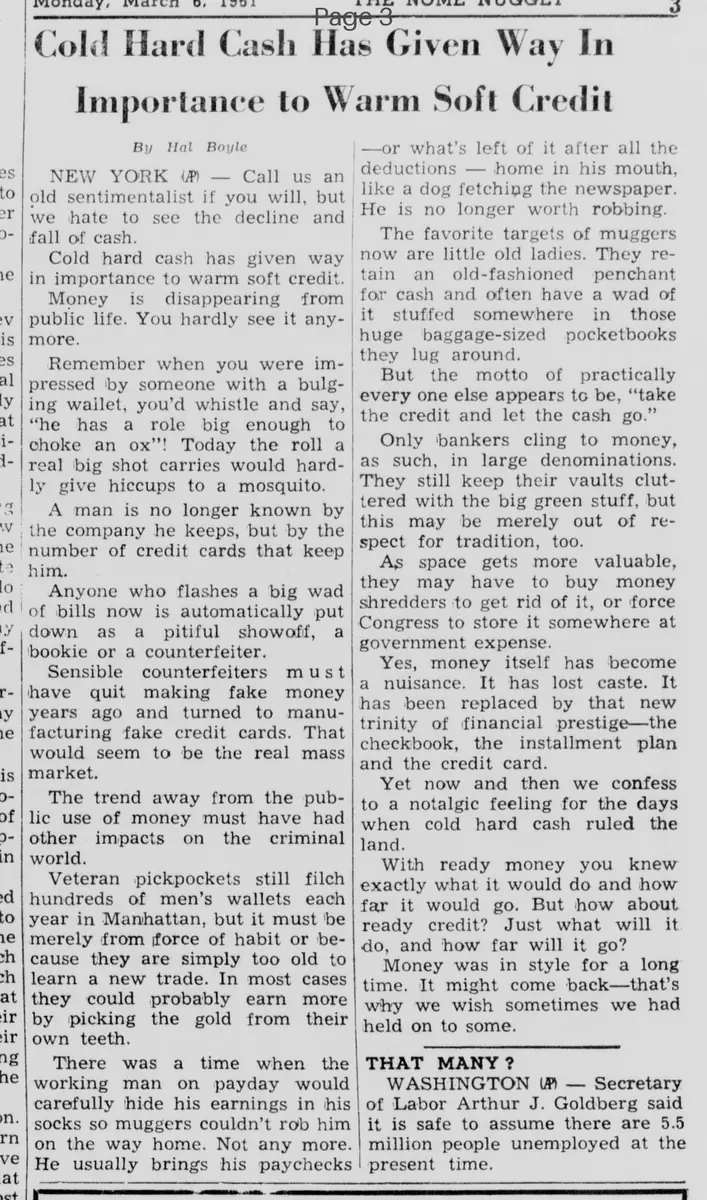
Cold Hard Cash Has Given Way In Importance to Warm Soft Credit
By Hal Boyle
NEW YORK (AP) - Call us an old sentimentalist if you will, but we hate to see the decline and fall of cash.
Cold hard cash has given way in importance to warm soft credit.
Money is disappearing from public life. You hardly see it anymore.
Remember when you were impressed by someone with a bulging wallet, you'd whistle and say, "he has a roll big enough to choke an ox"! Today the roll a real big shot carries would hardly give hiccups to a mosquito.
A man is no longer known by the company he keeps, but by the number of credit cards that keep him.
Anyone who flashes a big wad of bills now is automatically put down as a pitiful showoff, a bookie or a counterfeiter.
Sensible counterfeiters must have quit making fake money years ago and turned to manufacturing fake credit cards. That would seem to be the real mass market.
The trend away from the public use of money must have had other impacts on the criminal world.
Veteran pickpockets still filch hundreds of men's wallets each year in Manhattan, but it must be merely from force of habit or because they are simply too old to learn a new trade. In most cases they could probably earn more by picking the gold from their own teeth.
There was a time when the working man on payday would carefully hide his earnings in his socks so muggers couldn't rob him on the way home. Not any more.
He usually brings his paychecks - or what's left of it after all the deductions - home in his mouth, like a dog fetching the newspaper.
He is no longer worth robbing.
The favorite targets of muggers now are little old ladies. They retain an old-fashioned penchant for cash and often have a wad of it stuffed somewhere in those huge baggage-sized pocketbooks they lug around.
But the motto of practically every one else appears to be, "take the credit and let the cash go."
Only bankers cling to money, as such, in large denominations.
They still keep their vaults cluttered with the big green stuff, but this may be merely out of respect for tradition, too.
As space gets more valuable, they may have to buy money shredders to get rid of it, or force Congress to store it somewhere at government expense.
Yes, money itself has become a nuisance. It has lost caste. It has been replaced by that new trinity of financial prestige--the checkbook, the installment plan and the credit card.
Yet now and then we confess to a nostalgic feeling for the days when cold hard cash ruled the land.
With ready money you knew exactly what it would do and how far it would go. But how about ready credit? Just what will it do, and how far will it go?
Money was in style for a long time. It might come back--that's why we wish sometimes we had held on to some.
By Hal Boyle
NEW YORK (AP) - Call us an old sentimentalist if you will, but we hate to see the decline and fall of cash.
Cold hard cash has given way in importance to warm soft credit.
Money is disappearing from public life. You hardly see it anymore.
Remember when you were impressed by someone with a bulging wallet, you'd whistle and say, "he has a roll big enough to choke an ox"! Today the roll a real big shot carries would hardly give hiccups to a mosquito.
A man is no longer known by the company he keeps, but by the number of credit cards that keep him.
Anyone who flashes a big wad of bills now is automatically put down as a pitiful showoff, a bookie or a counterfeiter.
Sensible counterfeiters must have quit making fake money years ago and turned to manufacturing fake credit cards. That would seem to be the real mass market.
The trend away from the public use of money must have had other impacts on the criminal world.
Veteran pickpockets still filch hundreds of men's wallets each year in Manhattan, but it must be merely from force of habit or because they are simply too old to learn a new trade. In most cases they could probably earn more by picking the gold from their own teeth.
There was a time when the working man on payday would carefully hide his earnings in his socks so muggers couldn't rob him on the way home. Not any more.
He usually brings his paychecks - or what's left of it after all the deductions - home in his mouth, like a dog fetching the newspaper.
He is no longer worth robbing.
The favorite targets of muggers now are little old ladies. They retain an old-fashioned penchant for cash and often have a wad of it stuffed somewhere in those huge baggage-sized pocketbooks they lug around.
But the motto of practically every one else appears to be, "take the credit and let the cash go."
Only bankers cling to money, as such, in large denominations.
They still keep their vaults cluttered with the big green stuff, but this may be merely out of respect for tradition, too.
As space gets more valuable, they may have to buy money shredders to get rid of it, or force Congress to store it somewhere at government expense.
Yes, money itself has become a nuisance. It has lost caste. It has been replaced by that new trinity of financial prestige--the checkbook, the installment plan and the credit card.
Yet now and then we confess to a nostalgic feeling for the days when cold hard cash ruled the land.
With ready money you knew exactly what it would do and how far it would go. But how about ready credit? Just what will it do, and how far will it go?
Money was in style for a long time. It might come back--that's why we wish sometimes we had held on to some.
What sub-type of article is it?
Social Commentary
Humor
What themes does it cover?
Social Manners
What keywords are associated?
Cash Decline
Credit Rise
Social Change
Pickpockets
Muggers
Bankers
What entities or persons were involved?
Hal Boyle
Where did it happen?
New York
Story Details
Key Persons
Hal Boyle
Location
New York
Story Details
The article humorously discusses the decline of cash usage in favor of credit, its effects on social status, crime, and banking, expressing nostalgia for the era of tangible money.