Thank you for visiting SNEWPapers!
Sign up free
Winchester Virginia Republican
Winchester, Virginia
What is this article about?
Henry R. Warfield publicly denies accusations in the 'Republican Citizen' newspaper that John Quincy Adams lobbied him privately for his vote in the 1824 presidential election, which he claims gave Maryland's casting vote. He asserts no such contact occurred and that his support for Adams over Jackson aligned with his district's majority preference and his conscientious beliefs.
Clipping
OCR Quality
Full Text
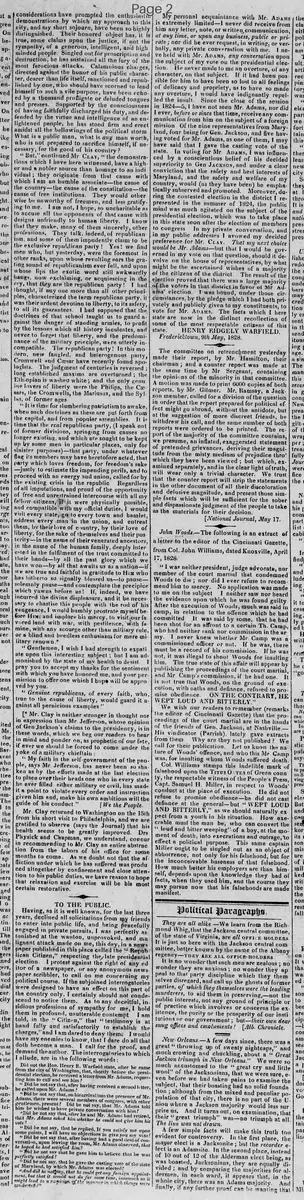
Having, as it is well known, for the last three years, declined all solicitations from my friends to enter into public life, and being peacefully engaged in private pursuits, I was perfectly astonished at the wanton, unprovoked, and malignant attack made on me, this day, in a newspaper published in this place called the "Republican Citizen," respecting the late presidential election. I protest against the right of any editor of a newspaper, or any anonymous newspaper scribbler, to call on me concerning my political course. If the subjoined interrogatories were designed to have an effect on this part of the country only, I certainly should not condescend to notice them. As to any deceitful, insidious professions of sympathy for me, I hold them in profound, unutterable contempt. I am told, in the "Citizen," that "testimony is at hand fully and satisfactorily to establish the charges," and I am dared to deny them. I would have my enemies to know, that I dare do all that doth become a man. I call for the proof, and demand the author. The interrogatories to which I allude, are in the following words:
Did not the Hon. Henry R. Warfield state, after he came from the city of Washington, that, shortly before the presidential election, he received a letter from Mr. Adams, requesting him to call and see him?
Did he not say that, after having received a second letter, he called upon Mr. Adams?
Did he not say that, on his arrival into the presence of Mr. Adams, there were several members of congress, with other gentlemen, present? Did he not say, that Mr. Adams told him he wished to have private conversation with him?
Did he not say that, after he and Mr. Adams had retired, that Mr. Adams asked him whether he could not give him his vote?
Did he not say, that he replied, If you satisfy me upon some points, I will have no objections to give you my vote?
Did he not say that, after having had a good deal of conversation, upon leaving the room, Mr. Adams observed, that he hoped he had satisfied him?
Did he not say, that he gave him to believe that he was perfectly satisfied?
Did he not say, that he gave the casting vote of the state of Maryland, by which Mr. Adams was elected?
And did he not say, that he could get any foreign appointment, but that it would not do for some time, inasmuch as it might lead to a suspicion of the manner in which things were conducted.?
My personal acquaintance with Mr. Adams is extremely limited—I never did receive from him any letter, note, or written communication, at any time, or upon any business, public or private; nor did he ever request, in writing, or verbally, any private conversation with me. I never held with Mr. Adams, any conversation upon the subject of my vote on the presidential election. He never made to me an overture, of any character, on that subject. If it had been possible for him to have been so lost to all feelings of delicacy and propriety, as to have so made any overture, I would have indignantly repelled the insult. Since the close of the session in 1824-5, I have not seen Mr. Adams, nor did I ever, before or since that time, receive any communication from him on the subject of a foreign mission. Of the nine representatives from Maryland, four being for Gen. Jackson, and five having voted for Mr. Adams, as one of them, I may have said that I gave the casting vote of the state. In voting for Mr. Adams, I was influenced by a conscientious belief of his decided superiority to Gen Jackson, and under a clear conviction that the safety and best interests of Maryland, and the safety and welfare of my country, would (as they have been) be emphatically subserved and promoted. Moreover, during the contested election in the district I represented in the summer of 1824, the public mind was much agitated on the subject of the presidential election, which was to take place in this state soon after the election of members to congress. In my private conversation, and in my public addresses I avowed my decided preference for Mr. Clay. That my next choice would be Mr. Adams—but that I would be governed in my vote on that question, should it devolve on the house of representatives, by what might be the ascertained wishes of a majority of the citizens of the district. The result of the election proved that there was a large majority of the voters in that district in favor of Mr. Adams' election. I was bound, under those circumstances, by the pledge which I had both privately and publicly given to my constituents, to vote for Mr. Adams. The facts which I here state are now in the distinct recollection of some of the most respectable citizens of this state.
HENRY RIDGELY WARFIELD,
Fredericktown, 9th May, 1828.
What sub-type of article is it?
What themes does it cover?
What keywords are associated?
What entities or persons were involved?
Letter to Editor Details
Author
Henry Ridgely Warfield
Recipient
To The Public
Main Argument
henry r. warfield denies receiving any letters or overtures from john quincy adams regarding his vote in the 1824 presidential election and asserts that his support for adams was based on his constituents' majority preference in his district and his belief in adams' superiority over jackson.
Notable Details