Thank you for visiting SNEWPapers!
Sign up free
Virginia Argus
Richmond, Virginia
What is this article about?
Philadelphia celebrated the Louisiana Purchase on May 12, 1804, with a large procession involving military units, societies, and citizens, an oration by Dr. Michael Leib at Centre Square, salutes, and patriotic toasts at gatherings like the Tammany Society, despite prior rainy weather.
Clipping
OCR Quality
Full Text
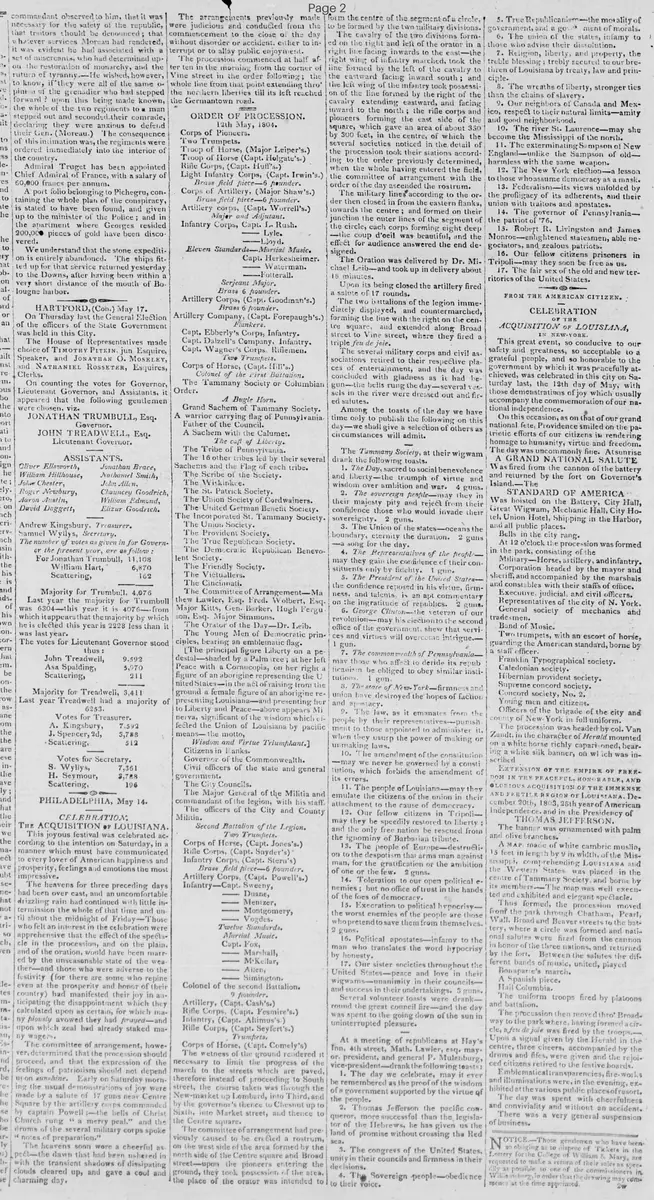
CELEBRATION.
THE ACQUISITION OF LOUISIANA.
This joyous festival was celebrated according to the intention on Saturday, in a manner which must have communicated to every lover of American happiness and prosperity, feelings and emotions the most impressive.
The heavens for three preceding days had been overcast, and an uncomfortable drizzling rain had continued with little intermission the whole of that time and until about the midnight of Friday. Those who felt an interest in the celebration were apprehensive that the effect of the spectacle in the procession, and on the plain, and of the oration, would have been marred by the unseasonable state of the weather--and those who were adverse to the festivity (for there are some who repine even at the prosperity and honor of their country) had manifested their joy in anticipating the disappointment which they calculated upon as certain, for which many avowedly they had prayed--and upon which zeal had already staked many wagers.
The committee of arrangement, however, determined that the procession should proceed, and that the expression of the feelings of patriotism should not depend upon sunshine. Early on Saturday morning the usual demonstrations of joy were made by a salute of 17 guns near Centre Square by the artillery corps commanded by captain Powell;--the bells of Christ Church rung "a merry peal," and the drums of the several military corps spoke "notes of preparation."
The heavens soon wore a cheerful aspect--the dawn that had been ushered in with the transient shadows of dissipating clouds cleared up, and gave a cool and charming day.
The arrangements previously made were judicious and conducted from the commencement to the close of the day without disorder or accident, either to interrupt or to allay public enjoyment.
The procession commenced at half after ten in the morning from the corner of Vine street in the order following; the whole line from that point extending thro' the northern liberties till its left reached the Germantown road.
ORDER OF PROCESSION.
12th May, 1804.
Corps of Pioneers.
Two Trumpets.
Troop of Horse, (Major Leiper's.)
Troop of Horse (Capt. Holgate's.)
Rifle Corps, (Capt. Huff's.)
Light Infantry Corps, (Capt. Irwin's.)
Brass field piece--6 pounder.
Corps of Artillery, (Major Shaw's.)
Brass field piece--6 pounder.
Artillery corps, (Capt. Worrell's.)
Major and Adjutant.
Infantry Corps, Capt. L. Rush.
Lyle.
-Lloyd.
Eleven Standards--Martial Music.
Capt. Herkesheimer.
Waterman.
Fotterall.
Serjeant Major.
Brass 6 pounder.
Artillery Corps, (Capt. Goodman's.)
Brass 6 pounder.
Artillery Company, (Capt. Forepaugh's.)
Flankers.
Capt. Ebberly's Corps, Infantry.
Capt. Dalzell's Company, Infantry.
Capt. Wagner's Corps. Rifiemen.
Two Trumpets.
Corps of Horse, (Capt. Hill's.)
Colonel of the first Battalion.
The Tammany Society or Columbian Order.
A Bugle Horn.
Grand Sachem of Tammany Society.
A warrior carrying flag of Pennsylvania.
Father of the Council.
A Sachem with the Calumet.
The call of Liberty.
The Tribe of Pennsylvania.
The 16 other tribes led by their several Sachems and the Flag of each tribe.
The Scribe of the Society.
The Wiskinkce.
The St. Patrick Society.
The Union Society of Cordwainers.
The United German Benefit Society.
The Incorporated St. Tammany Society.
The Union Society.
The Provident Society.
The True Republican Society.
The Democratic Republican Benevolent Society.
The Friendly Society.
The Victuallers.
The Cincinnati.
The Committee of Arrangement--Matthew Lawler, Esq. Fred. Wolbert, Esq.
Major Kitts, Gen. Barker, Hugh Ferguson, Esq. Major Simmons.
The Orator of the Day--Dr. Leib.
The Young Men of Democratic principles, bearing an emblematic flag.
[The principal figure Liberty on a pedestal--shaded by a Palm tree; at her left Peace with a Cornucopia, on her right a figure of an aborigine representing the United States--in the act of raising from the ground a female figure of an aborigine representing Louisiana--and presenting her to Liberty and Peace--above appears Minerva, significant of the wisdom which effected the Union of Louisiana by pacific means--the motto,
Wisdom and Virtue Triumphant.]
Citizens in ranks.
Governor of the Commonwealth.
Civil officers of the state and general government.
The City Councils.
The Major General of the Militia and commandant of the legion, with his staff.
The officers of the City and County Militia.
Second Battalion of the Legion.
Two Trumpets.
Corps of Horse, (Capt. Jones's.)
Rifle Corps, (Capt. Snyder's)
Infantry Corps, (Capt. Stern's)
Brass field piece--6 pounder.
Artillery Corps, (Capt. Powell's.)
Infantry--Capt. Sweeny,
Duane,
Mentzer,
Montgomery,
Vogdes.
Twelve Standards.
Martial Music.
Capt. Fox,
Marshall,
M. Kellar,
Allen,
Simington.
Colonel of the second Battalion.
9 pounder.
Artillery, (Capt. Cash's)
Rifle Corps, (Capt. Fesmire's.)
Infantry, (Capt. Altimus's.)
Rifle Corps, (Capt. Seyfert's.)
Trumpets.
Corps of Horse, (Capt. Comely's)
The wetness of the ground rendered it necessary to limit the progress of the march to the streets which are paved, therefore instead of proceeding to South street, the course taken was through the New-market up Lombard, into Third, and by the governor's thence to Chestnut up to Sixth, into Market street, and thence to the Centre square.
The committee of arrangement had previously caused to be erected a rostrum, on the west side of the area formed by the north side of the Centre square and Broad street--upon the pioneers entering the ground, they took possession of the area, the place of the orator was intended to form the centre of the segment of a circle, to be formed by the two military divisions.
The cavalry of the two divisions formed on the right and left of the orator in a right line facing inwards to the east--the right wing of infantry marched, took the line formed by the left of the cavalry to the eastward facing inward south; and the left wing of the infantry took possession of the line formed by the right of the cavalry extending eastward, and facing inward to the north; the rifle corps and pioneers forming the east side of the square, which gave an area of about 330 by 300 feet, in the centre, of which the several societies noticed in the detail of the procession took their stations according to the order previously determined, when the whole having entered the field, the committee of arrangement with the order of the day ascended the rostrum.
The military lines according to the order then closed in from the eastern flanks, towards the centre; and formed on their junction the outer lines of the segment of the circle, each corps forming eight deep --the coup d'oeil was beautiful, and the effect for audience answered the end designed.
The Oration was delivered by Dr. Michael Leib--and took up in delivery about 18 minutes.
Upon its being closed the artillery fired a salute of 17 rounds.
The two battalions of the legion immediately displayed, and countermarched, forming the line with the right on the centre square, and extended along Broad street to Vine street, where they fired a triple feu de joie.
The several military corps and civil associations retired to their respective places of entertainment, and the day was concluded with gladness as it had begun--the bells rung the day--several vessels in the river were dressed out and fired salutes.
Among the toasts of the day we have time only to publish the following on this day--we shall give a selection of others as circumstances will admit.
The Tammany Society, at their wigwam drank the following toasts.
1. The Day, sacred to social benevolence and liberty--the triumph of virtue and wisdom over ambition and war. 4 guns.
2. The sovereign people--may they in their majesty pity and reject from their confidence those who would invade their sovereignty. 2 guns.
3. The Union of the states--oceans the boundary, eternity the duration. 2 guns --a song for the day.
4. The Representatives of the people--may they gain the confidence of their constituents only by fidelity. 1 gun.
5. The President of the United States--the confidence reposed in his virtue, firmness, and talents, is an apt commentary on the ingratitude of republics. 2 guns.
6. George Clinton--the veteran of our revolution--may his election to the second office of the government, shew that services and virtues will overcome intrigue. 1 gun.
7. The commonwealth of Pennsylvania--may those who affect to deride its republicanism be obliged to obey similar institutions. 1 gun.
8. The state of New-York--firmness and union have destroyed the hopes of faction and apostasy.
9. The law, as it emanates from the people by their representatives--punishment to those appointed to administer it, when they usurp the power of making or unmaking laws.
10. The amendment of the constitution --may we never be governed by a constitution, which forbids the amendment of its errors.
11. The people of Louisiana--may they emulate the citizens of the union in their attachment to the cause of democracy.
12. Our fellow citizens in Tripoli--may they be speedily restored to liberty; and the only free nation be rescued from the ignominy of Barbarian tribute.
13. The people of Europe--destruction to the despotism that arms man against man, for the gratification of the ambition of one or the few. 2 guns.
14. Toleration to our open political enemies; but no office of trust in the hands of the foes of democracy.
15. Execration to political hypocrisy--the worst enemies of the people are those who pretend to save them from themselves. 2 guns.
16. Political apostates--infamy to the man who translates the word hypocrisy by honesty.
17. Our sister societies throughout the United States--peace and love in their wigwams--unanimity in their councils-- and success in their undertakings. 3 guns.
Several volunteer toasts were drank round the great council fire--and the day was spent to the going down of the sun in uninterrupted pleasure.
At a meeting of republicans at Hay's Inn, 4th street, Math. Lawler, esq. mayor, president, and general P. Muhlenberg, vice-president--drank the following toasts:
1. The day we celebrate, may it ever be remembered as the proof of the wisdom of a government supported by the virtue of the people.
2. Thomas Jefferson the pacific conqueror, more successful than the legislator of the Hebrews, he has given us the land of promise without crossing the Red sea.
3. The congress of the United States, unity in their councils and firmness in their decisions.
4. The Sovereign people--obedience to their voice.
5. True Republicanism the morality of government, and a government of morals.
6. The union of the states, infamy to those who advise their dissolution.
7. Religion, liberty, and property, the treble blessing; trebly secured to our brethren of Louisiana by treaty, law and principle.
8. The wreaths of liberty, stronger ties than the chains of slavery.
9. Our neighbors of Canada and Mexico, respect to their natural limits--amity and good neighborhood.
10. The river St. Laurence--may she become the Mississippi of the north.
11. The exterminating Sampson of New England--unlike the Sampson of old--harmless with the same weapon.
12. The New York election--a lesson to those who assume democracy as a mask.
13. Federalism--its views unfolded by the profligacy of its adherents, and their union with traitors and apostates.
14. The governor of Pennsylvania--the patriot of '76.
15. Robert R. Livingston and James Monroe--enlightened statesmen, able negotiators, and zealous patriots.
16. Our fellow citizens prisoners in Tripoli--may they soon be free as us.
17. The fair sex of the old and new territories of the United States.
What sub-type of article is it?
What keywords are associated?
What entities or persons were involved?
Where did it happen?
Domestic News Details
Primary Location
Philadelphia
Event Date
12th May, 1804
Key Persons
Outcome
the celebration proceeded without disorder or accident, concluding with gladness, salutes, and toasts.
Event Details
A grand procession of military corps, societies, and citizens marched through Philadelphia streets to Centre Square, where Dr. Michael Leib delivered an 18-minute oration on the Louisiana acquisition. Artillery salutes and a feu de joie followed, with patriotic toasts drunk at gatherings including the Tammany Society.