Thank you for visiting SNEWPapers!
Sign up free
Alexandria Daily Advertiser
Alexandria, Virginia
What is this article about?
A novel wheat variety imported from Jerusalem by Thomas Whaley's servant is trialed by Mr. Doran in Clontarf, Ireland, yielding exceptional results: 7-foot stalks with 42-45 ears each containing 150-190 grains, high flour output, and usable straw for cattle feed. Seed costs 10 guineas per stone.
Clipping
OCR Quality
Full Text
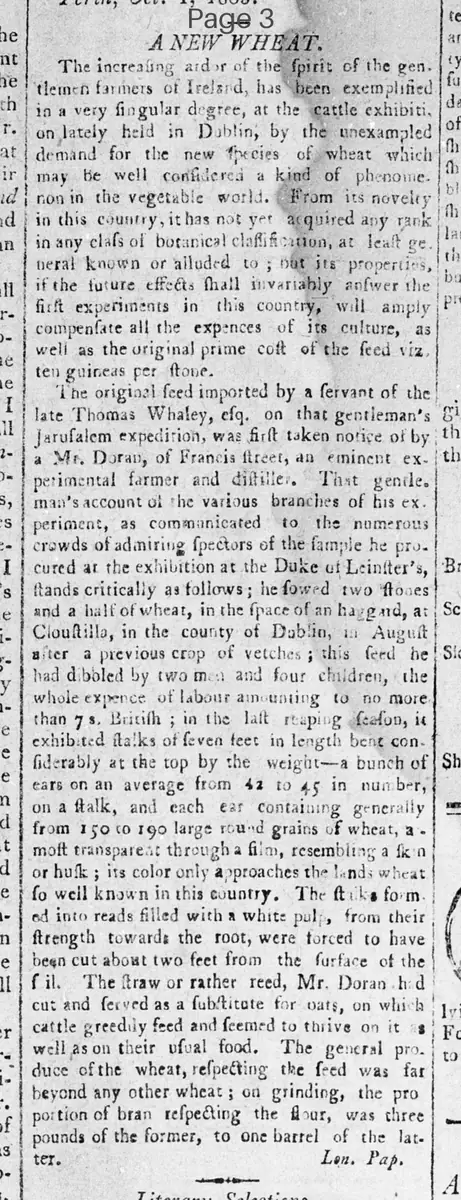
The increasing ardour of the spirit of the gentlemen farmers of Ireland, has been exemplified in a very singular degree, at the cattle exhibition lately held in Dublin, by the unexampled demand for the new species of wheat which may be well considered a kind of phenomenon in the vegetable world. From its novelty in this country, it has not yet acquired any rank in any class of botanical classification, at least generally known or alluded to; but its properties, if the future effects shall invariably answer the first experiments in this country, will amply compensate all the expenses of its culture, as well as the original prime cost of the seed viz. ten guineas per stone.
The original seed imported by a servant of the late Thomas Whaley, Esq. on that gentleman's Jerusalem expedition, was first taken notice of by a Mr. Doran, of Francis street, an eminent experimental farmer and distiller. That gentleman's account of the various branches of his experiment, as communicated to the numerous crowds of admiring spectators of the sample he procured at the exhibition at the Duke of Leinster's, stands critically as follows; he sowed two tons and a half of wheat, in the space of an acre, at Clontarf, in the county of Dublin, in August after a previous crop of vetches; this seed he had dibbled by two men and four children, the whole expense of labour amounting to no more than 7s. British; in the last reaping season, it exhibited stalks of seven feet in length bent considerably at the top by the weight--a bunch of ears on an average from 42 to 45 in number, on a stalk, and each ear containing generally from 150 to 190 large round grains of wheat, almost transparent through a film, resembling a skin or husk; its color only approaches the land's wheat so well known in this country. The stalk from and into reeds filled with a white pulp, from their strength towards the root, were forced to have been cut about two feet from the surface of the soil. The straw or rather reed, Mr. Doran had cut and served as a substitute for oats, on which cattle greedily feed and seemed to thrive on it as well as on their usual food. The general produce of the wheat, respecting the seed was far beyond any other wheat; on grinding, the proportion of bran respecting the flour, was three pounds of the former, to one barrel of the latter.
Lon. Pap.
What sub-type of article is it?
What keywords are associated?
What entities or persons were involved?
Where did it happen?
Foreign News Details
Primary Location
Clontarf, County Of Dublin, Ireland
Event Date
Sown In August, Harvested In The Last Reaping Season
Key Persons
Outcome
exceptional yield: stalks 7 feet tall with 42-45 ears per stalk, each ear 150-190 grains; straw used as cattle feed; grinding ratio 3 pounds bran to 1 barrel flour; labor cost 7s. british for sowing 2.5 tons on 1 acre
Event Details
New wheat species imported from Jerusalem by servant of Thomas Whaley, noticed by Mr. Doran who sowed 2.5 tons on 1 acre at Clontarf after vetches, dibbled by 2 men and 4 children. Showed high productivity at Dublin cattle exhibition with samples at Duke of Leinster's; seed cost 10 guineas per stone.