Thank you for visiting SNEWPapers!
Sign up free
The National Intelligencer And Washington Advertiser
Washington, District Of Columbia
What is this article about?
In January 1802, US Consul H.R. Saabye in Copenhagen reports that American ships are exempt from quarantine based on trusted bills of health. Consultations with Danish officials result in a circular letter declaring US exports like rice, tobacco, sugar, coffee, and rum non-contagious, with requests for special certificates for cotton from southern states.
Clipping
OCR Quality
Full Text
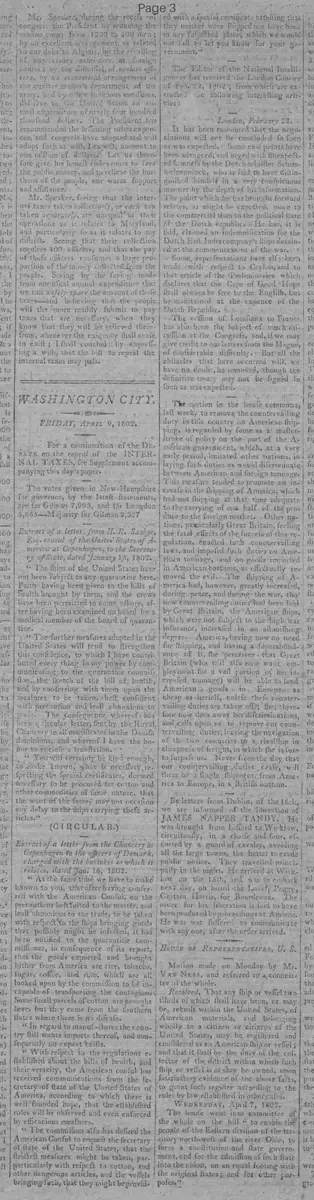
"The ships of the United States have not been subject to any quarantine here. Faith having been given to the bills of health brought by them, and the crews have been permitted to come ashore, after having been examined on board by a medical member of the board of quarantine.
The further measures adopted in the United States will tend to strengthen this confidence, to which I have contributed every thing in my power by communicating to the quarantine commission, the sketch of the bill of health, and by conferring with them upon the measures to be taken, best consistent with precaution and least obnoxious to trade. The consequence whereof has been a circular letter, sent by the Royal Chancery to all magistrates in the Danish dominions, and whereof I have the honor to enclose a translation.
You will certainly be kind enough, to make known, what is necessary respecting the special certificates, deemed necessary to be procured for cotton and other commodities of same nature, that the want of the same, may not occasion any delay to the ships carrying these articles."
(CIRCULAR.)
Extract of a letter from the Chancery at Copenhagen to the officers of Denmark, charged with the business to which it relates, dated Jan. 16, 1802.
"At the same time we have to make known to you, that after having conferred with the American Consul, on the precautions best suited to the matter, and least obnoxious to the trade, to be taken with respect to the ships bringing goods that possibly might be infected, it has been notified to the quarantine commissioner, in consequence of its report, that the goods exported and brought hither from America are rice, tobacco, sugar, coffee, and rum, which are all looked upon by the commission to be incapable of transporting the contagion. Some small parcels of cotton are brought here, but they come from the southern states where there is no disease.
In regard to manufactures the country still wants imports thereof, and consequently no export exists.
With respect to the regulations established about the bills of health, and their veracity, the American consul has received communications from the secretary of state of the United States of America, according to which there is well founded hope, that the established rules will be observed and even enforced by efficacious measures.
The commission also has desired the American Consul to request the secretary of state of the United States, that the strictest measures might be taken, particularly with respect to cotton, and other dangerous articles, and the vessels bringing such, that they might be provided with a special certificate attesting that they neither were shipped nor have been in any suspected place, which we would not fail to let you know for your government."
What sub-type of article is it?
What keywords are associated?
What entities or persons were involved?
Where did it happen?
Foreign News Details
Primary Location
Copenhagen
Event Date
January 16, 1802
Key Persons
Outcome
us ships exempt from quarantine; circular letter issued declaring us goods like rice, tobacco, sugar, coffee, rum non-contagious; special certificates requested for cotton to avoid delays.
Event Details
US Consul Saabye reports that American ships in Copenhagen are not quarantined due to trusted bills of health, with crews examined on board. He contributed to discussions with Danish quarantine commission on measures balancing precaution and trade, leading to a Royal Chancery circular to Danish magistrates. The circular notes consultations with the consul, identifies US exports as non-contagious except potential concerns with cotton from southern states, and requests stricter US measures including special certificates for cotton and similar goods attesting no contact with suspected places.