Thank you for visiting SNEWPapers!
Sign up free
The New Hampshire Gazette
Portsmouth, Rockingham County, New Hampshire
What is this article about?
Reports on U.S. House of Representatives proceedings from January 26 to February 2, 1798, including bills on pensions, Indian treaties, foreign intercourse; Blount impeachment managers; resolutions on British treaty losses and duties; and a committee investigation into Matthew Lyon's assault on Roger Griswold, recommending expulsion, postponed for further review.
Merged-components note: These components form a continuous report on congressional proceedings, including the Lyon-Griswold incident.
Clipping
OCR Quality
Full Text
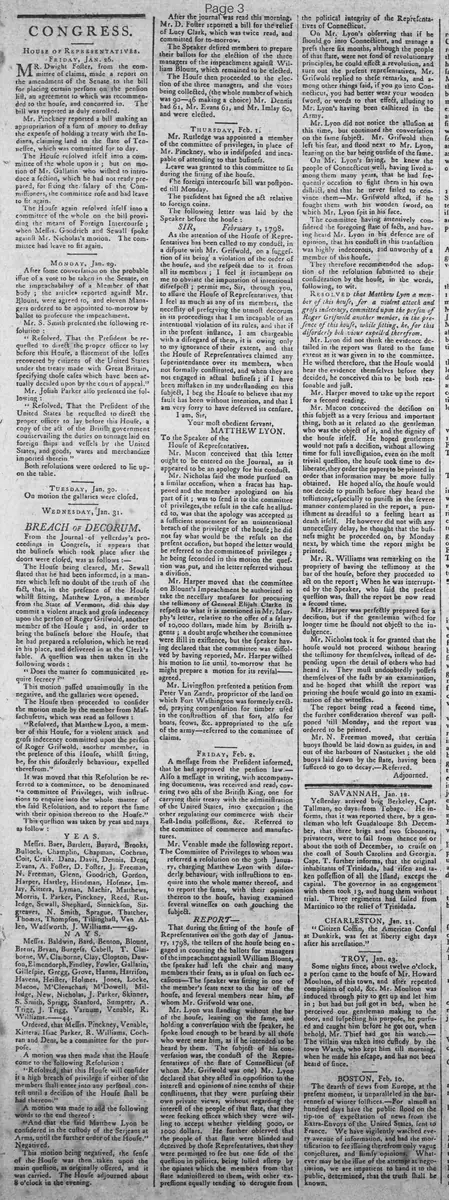
HOUSE OF REPRESENTATIVES.
Friday, Jan. 26.
Mr. Dwight Foster, from the committee of claims, made a report on the amendment of the Senate to the bill for placing certain persons on the pension list, an agreement to which was recommended to the house, and concurred in. The bill was reported as duly enrolled.
Mr. Pinckney reported a bill making an appropriation of a sum of money to defray the expense of holding a treaty with the Indians, claiming land in the state of Tennessee, which was committed for to-day.
The House resolved itself into a committee of the whole upon it; but on motion of Mr. Gallatin who wished to introduce a section, which he had not ready prepared, for fixing the salary of the Commissioners, the committee rose and had leave to sit again.
The House again resolved itself into a committee of the whole on the bill providing the means of Foreign Intercourse; when Messrs. Goodrich and Sewall spoke against Mr. Nicholas's motion. The committee had leave to sit again.
MONDAY, Jan. 29.
After some conversation on the probable issue of a vote to be taken in the Senate, on the impeachability of a Member of that body; the articles reported against Mr. Blount, were agreed to, and eleven Managers ordered to be appointed to-morrow by ballot to prosecute the impeachment.
Mr. S. Smith presented the following resolution:
"Resolved, That the President be requested to direct the proper officer to lay before this House, a statement of the losses recovered by citizens of the United States under the treaty made with Great Britain, specifying those cases which have been actually decided upon by the court of appeal."
Mr. Josiah Parker also presented the following:
"Resolved, That the President of the United States be requested to direct the proper officer to lay before this House, a copy of the act of the British government countervailing the duties on tonnage laid on foreign ships and vessels by the United States, and goods, wares and merchandize imported therein."
Both resolutions were ordered to lie on the table.
TUESDAY, Jan. 30.
On motion the galleries were closed.
Wednesday, Jan. 31.
BREACH OF DECORUM.
From the Journal of yesterday's proceedings in Congress, it appears that the business which took place after the doors were closed, was as follows:
The House being cleared, Mr. Sewall stated that he had been informed, in a manner which left no doubt of the truth of the fact, that, in the presence of the House whilst sitting, Matthew Lyon, a member from the State of Vermont, did this day commit a violent attack and gross indecency upon the person of Roger Griswold, another member of the House; and, in order to bring the business before the House, that he had prepared a resolution, which he read in his place, and delivered in at the Clerk's table. A question was then taken in the following words:
"Does the matter so communicated require secrecy?"
This motion passed unanimously in the negative, and the galleries were opened.
The House then proceeded to consider the motion made by the member from Massachusetts, which was read as follows:
"Resolved, that Matthew Lyon, a member of this House, for a violent attack and gross indecency committed upon the person of Roger Griswold, another member, in the presence of this House, whilst sitting, be, for this disorderly behaviour, expelled therefrom."
It was moved that this Resolution be referred to a committee, to be denominated "a committee of Privileges, with instructions to enquire into the whole matter of the said Resolution, and to report the same with their opinion thereon to the House."
This question was taken by yeas and nays as follow:
YEAS.
Messrs. Baer, Bartlett, Bayard, Brooks, Bullock, Champlin, Chapman, Cochran, Coit, Craik, Dana, Davis, Dennis, Dent, Evans, A. Foster, D. Foster, J. Freeman, N. Freeman, Glenn, Goodrich, Gordon, Harper, Hartley, Hindman, Homer, ImLay, Kittera, Lyman, Machir, Matthews, Morris, I. Parker, Pinckney, Reed, Rutledge, Sewall, Shephard, Sinnickson, Sitgreaves, N. Smith, Sprague, Thatcher, Thomas, Thompson, Tillinghast, Van Allen, Wadsworth, J. Williams.--49.
NAYS.
Messrs. Baldwin, Bard, Benton, Blount, Brent, Bryan, Burges, Cabell, T. Claiborne, W. Claiborne, Clay, Clopton, Dawson, Elmendorf, Findley, Fowler, Gallatin, Gillespie, Gregg, Grove, Hanna, Harrison, Havens, Heister, Holmes, Jones, Locke, Macon, M'Clenachan, M'Dowell, Milledge, New, Nicholas, J. Parker, Skinner, S. Smith, Sprigg, Stanford, Sumpter, A. Trigg, J. Trigg, Varnum, Venable, R. Williams.---44.
Ordered, that Messrs. Pinckney, Venable, Kittera, Isaac Parker, R. Williams, Cochran and Dent, be a committee for the purpose.
A motion was then made that the House come to the following Resolution:
"Resolved, that this House will consider it a high breach of privilege if either of the members shall enter into any personal contest until a decision of the House shall be had thereon."
A motion was made to add the following words to the end thereof:
"And that the said Matthew Lyon be considered in the custody of the Sergeant at Arms, until the further order of the House."
Negatived.
This motion being negatived, the sense of the House was then taken upon the main question, as originally offered, and it was carried. The House adjourned about 8 o'clock in the evening.
After the journal was read this morning, Mr. D. Foster reported a bill for the relief of Lucy Clark, which was twice read, and committed for to-morrow.
The Speaker desired members to prepare their ballots for the election of the three managers of the impeachment against William Blount, which remained to be elected.
The House then proceeded to the election of the three managers, and the votes being collected, (the whole number of which was 90-46 making a choice) Mr. Dennis had 61, Mr. Evans 61, and Mr. Imlay 60, and were elected.
THURSDAY, Feb. 1.
Mr. Rutledge was appointed a member of the committee of privileges, in place of Mr. Pinckney, who is indisposed and incapable of attending to that business.
Leave was granted to this committee to sit during the sitting of the house.
The foreign intercourse bill was postponed till Monday.
The president has signed the act relative to foreign coins.
The following letter was laid by the Speaker before the house:
SIR,
February 1, 1798
As the attention of the House of Representatives has been called to my conduct, in a dispute with Mr. Griswold, on a suggestion of its being a violation of the order of the house, and the respect due to it from all its members; I feel it incumbent on me to obviate the imputation of intentional disrespect; permit me, Sir, through you, to assure the House of Representatives, that I feel as much as any of its members, the necessity of preserving the utmost decorum in its proceedings that I am incapable of an intentional violation of its rules, and that if in the present instance, I am chargeable with a disregard of them, it is owing only to my ignorance of their extent, and that the House of Representatives claimed any superintendence over its members, when not formally constituted, and when they are not engaged in actual business; if I have been mistaken in my understanding on this subject, I beg the House to believe that my fault has been without intention, and that I am very sorry to have deserved its censure.
I am, Sir,
Your most obedient servant,
MATTHEW LYON.
To the Speaker of the House of Representatives.
Mr. Macon conceived that this letter ought to be entered on the Journal, as it appeared to be an apology for his conduct.
Mr. Nicholas said the mode pursued on a similar occasion, when a fracas has happened and the member apologized on his part of it; was to send it to the committee of privileges, the result in the case he alluded to, was that the apology was accepted as a sufficient atonement for an unintentional breach of the privilege of the house; he did not say what would be the result on the present occasion, but hoped the letter would be referred to the committee of privileges; he being seconded in this motion the question was put, and the letter referred without a division.
Mr. Harper moved that the committee on Blount's Impeachment be authorized to take the necessary measures for procuring the testimony of General Elijah Clarke in respect to what it is mentioned in Mr. Murphy's letter, relative to the offer of a salary of 10,000 dollars, made him by British agents; a doubt arose whether the committee were still in existence, but the speaker having declared that the committee was dissolved by having reported, Mr. Harper wished his motion to lie until to-morrow that he might prepare a motion for its revival--agreed.
Mr. Livingston presented a petition from Peter Van Zandt, proprietor of the land on which Fort Washington was formerly erected, praying compensation for timber used in the construction of that fort, also for boats, cows, &c. appropriated to the use of the army—referred to the committee of claims.
Friday, Feb. 2.
A message from the President informed, that he had approved the pension law.
Also a message in writing, with accompanying documents, was received and read, covering two acts of the British King, one for carrying their treaty with the administration of the United States, into execution; the other regulating our commerce with their East-India possessions, &c. Referred to the committee of commerce and manufactures.
Mr. Venable made the following report.
The Committee of Privileges to whom was referred a resolution on the 30th January, charging Matthew Lyon with disorderly behaviour, with instructions to enquire into the whole matter thereof, and to report the same, with their opinion thereon to the house, having examined several witnesses on oath touching the subject.
REPORT
That during the sitting of the house of Representatives on the 30th day of January, 1798, the tellers of the house being engaged in counting the ballots for managers of the impeachment against William Blount, the speaker had left the chair and many members their seats, as is usual on such occasions—The speaker was sitting in one of the member's seats next to the bar of the house, and several members near him, of whom Mr. Griswold was one.
Mr. Lyon was standing without the bar of the house, leaning on the same, and holding a conversation with the speaker, he spoke loud enough to be heard by all those who were near him, as if he intended to be heard by them. The subject of his conversation was, the conduct of the Representatives of the state of Connecticut (of whom Mr. Griswold was one) Mr. Lyon declared that they acted in opposition to the interest and opinions of nine tenths of their constituents, that they were pursuing their own private views, without regarding the interest of the people of that state, that they were seeking offices which they were willing to accept whether yielding 600, or 1000 dollars. He further observed that the people of that state were blinded and deceived by those Representatives, that they were permitted to see but one side of the question in politics, being lulled asleep by the opiates which the members from that state administered to them, with other expressions equally tending to derogate from the political integrity of the Representatives of Connecticut.
On Mr. Lyon's observing that if he should go into Connecticut, and manage a press there six months, although the people of that state, were not fond of revolutionary principles, he could effect a revolution, and turn out the present representatives, Mr. Griswold replied to these remarks, and among other things said, if you go into Connecticut, you had better wear your wooden sword, or words to that effect, alluding to Mr. Lyon's having been cashiered in the Army.
Mr. Lyon did not notice the allusion at this time, but continued the conversation on the same subject. Mr. Griswold then left his seat, and stood next to Mr. Lyon, leaning on the bar being outside of the same.
On Mr. Lyon's saying, he knew the people of Connecticut well, having lived among them many years, that he had frequently occasion to fight them in his own district, and that he never failed to convince them--Mr. Griswold asked, if he fought them with his wooden sword, on which Mr, Lyon spit in his face.
The committee having attentively considered the foregoing state of facts, and having heard Mr. Lyon in his defence are of opinion, that his conduct in this transaction was highly indecorous, and unworthy of a member of this house.
They therefore recommended the adoption of the resolution submitted to their consideration by the house, in the words, following, to wit.
Resolved that Matthew Lyon a member of this house, for a violent attack and gross indecency, committed upon the person of Roger Griswold another member, in the presence of this house, while sitting, be, for this disorderly behaviour expelled therefrom.
Mr. Lyon did not think the evidence detailed in the report was stated to the same extent as it was given in to the committee.
He wished therefore, that the House would hear the evidence themselves before they decided. he conceived this to be both reasonable and just.
Mr. Harper moved to take up the report for a second reading.
Mr. Macon conceived the decision on this subject as a very serious and important thing, both as it related to the gentleman who was the object of it, and the dignity of the house itself. He hoped gentlemen would not pass a decision, without allowing time for full investigation, even on the most trivial question, the house took time to deliberate, they order the papers to be printed in order that information may be more fully obtained. He hoped also, the house would not decide to punish before they heard the testimony,especially to punish in the severe manner contemplated in the report, a punishment as dreadful to a feeling heart as death itself. He however did not wish any unnecessary delay, he thought that the business might be proceeded on, by Monday next, by which time the report might be printed.
Mr. R. Williams was remarking on the propriety of having the testimony at the bar of the house, before they proceeded to act on the report; When he was interrupted by the Speaker, who said the present question was, shall the report now read a second time.
Mr. Harper was perfectly prepared for a decision, but if the gentleman wished for longer time he should not object to the indulgence.
Mr. Nicholas took it for granted that the house would not proceed without hearing the testimony for themselves, instead of depending upon the detail of others who had heard it. They must undoubtedly possess themselves of the facts by an examination, and he hoped that whilst the report was printing the house would go into an examination of the witnesses.
The report being read a second time, the further consideration thereof was postponed 'till Monday, and the report was ordered to be printed.
Mr. N. Freeman moved, that certain buoys should be laid down as guides, in and out of the harbours of Nantucket; the old buoys laid down by the state, having been suffered to go to decay.--Referred.
Adjourned.
What sub-type of article is it?
What keywords are associated?
What entities or persons were involved?
Where did it happen?
Domestic News Details
Primary Location
United States House Of Representatives
Event Date
January 26 To February 2, 1798
Key Persons
Outcome
pension bill enrolled; indian treaty appropriation bill committed; foreign intercourse bill debated; blount impeachment articles agreed, managers elected (including dennis, evans, imlay); resolutions on british treaty losses and duties tabled; lyon-griswold incident investigated, expulsion resolution recommended but postponed to monday for printing and witness examination; lyon's apologetic letter referred to committee; pension law approved by president; british acts referred to commerce committee; petition from peter van zandt referred.
Event Details
The text details daily proceedings in the U.S. House of Representatives, covering legislative business such as reports on bills for pensions, Indian treaties, foreign intercourse, and relief for Lucy Clark; election of managers for William Blount's impeachment; presentation and tabling of resolutions requesting information from the President on British treaty matters; formation of a Committee of Privileges to investigate Matthew Lyon's spitting on Roger Griswold during a House sitting, including witness testimonies, Lyon's defense and letter of apology, and the committee's report recommending expulsion, which was read and postponed.