Thank you for visiting SNEWPapers!
Sign up free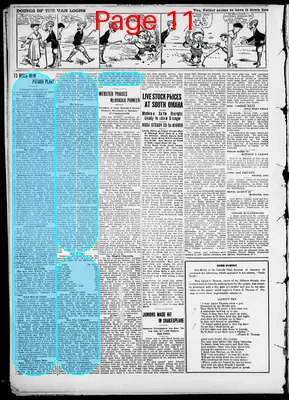
The Alliance Herald
Alliance, Box Butte County, Nebraska
What is this article about?
Nebraska's potash industry boomed during WWI due to European supply shortages. Pioneers Snow and Modestt founded Potash Products Co. in 1912 near Alliance, using lake brines for fertilizer. By 1916, five companies operated, valuing lakes at millions from Sheridan and Cherry counties.
Clipping
OCR Quality
Full Text
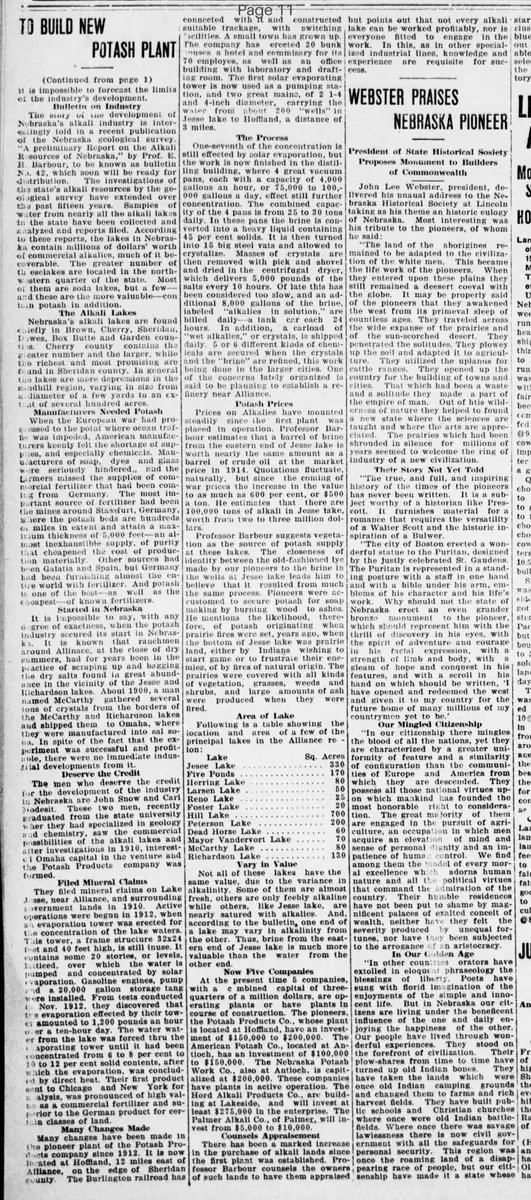
POTASH PLANT
(Continued from page 1)
It is impossible to forecast the limits of the industry's development.
Bulletin on Industry
The story of the development of Nebraska's alkali industry is interestingly told in a recent publication of the Nebraska geological survey.
"A preliminary Report on the Alkali Resources of Nebraska," by Prof. E. H. Barbour, to be known as bulletin No. 42, which soon will be ready for distribution.
The investigations of the state's alkali resources by the geological survey have extended over the past fifteen years. Samples of water from nearly all the alkali lakes in the state have been collected and analyzed and reports filed. According to these reports, the lakes in Nebraska contain millions of dollars' worth of commercial alkalics, much of it recoverable. The greater number of these lakes are located in the northwestern quarter of the state. Most of them are soda lakes, but a few—and these are the more valuable—contain potash in addition.
The Alkali Lakes
Nebraska's alkali lakes are found chiefly in Brown, Cherry, Sheridan, Dawes, Box Butte and Garden counties. Cherry county contains the greater number and the larger, while the richest and most promising are found in Sheridan county. In general the lakes are mere depressions in the sandhill region, varying in size from a diameter of a few yards to an extent of several hundred acres.
Manufacturers Needed Potash
When the European war had progressed to the point where ocean traffic was impeded, American manufacturers keenly felt the shortage of supplies, and especially chemicals. Manufacturers of soap, dyes and glass were seriously hindered, and the farmers missed the supplies of commercial fertilizer that had been coming from Germany. The most important source of fertilizer had been the mines around Stassfurt, Germany, where the potash beds are hundreds of miles in extent and attain a maximum thickness of 5,000 feet—an almost inexhaustible supply of purity that cheapened the cost of production materially. Other sources had been Galatia and Spain, but Germany had been furnishing almost the entire world with fertilizer. And potash is one of the best—as well as the cheapest—of known fertilizers.
Started in Nebraska
It is impossible to say, with any degree of exactness, when the potash industry secured its start in Nebraska. It is known that ranchmen around Alliance, at the close of dry summers, had for years been in the practice of scraping up and bagging the dry salts found in great abundance in the vicinity of the Jesse and Richardson lakes. About 1900, a man named McCarthy gathered several tons of crystals from the borders of the McCarthy and Richardson lakes and shipped them to Omaha, where they were manufactured into soda. In spite of the fact that the experiment was successful and profitable, there were no immediate industrial developments from it.
Deserve the Credit
The men who deserve the credit for the development of the industry in Nebraska are John Snow and Carl Modestt. These two men, recently graduated from the state university where they had specialized in geology and chemistry, saw the commercial possibilities of the alkali lakes after investigations in 1910, interested Omaha capital in the venture and the Potash Products company was formed.
Filed Mineral Claims
They filed mineral claims on Lake Jesse, near Alliance, and surrounding government lands in 1910. Active operations were begun in 1912, when an evaporation tower was erected for the concentration of the lake waters. This tower, a frame structure 32x24 feet and 40 feet high, is still in use. It contains some 20 lattices, over which the water is pumped and concentrated by solar evaporation. Gasoline engines, pumps and a 20,000 gallon storage tank were installed. From tests conducted in Nov. 1912, they discovered that the evaporation effected by their tower amounted to 1,200 pounds an hour over a ten-hour day. The water from the lake was forced thru the evaporating tower until it had been concentrated from 6 to 8 per cent to 10 to 12 per cent solid contents, after which the evaporation was concluded by direct heat. Their first product sent to Chicago and New York for analysis, was pronounced of high value as a commercial fertilizer and superior to the German product for certain classes of land.
Many Changes Made
Many changes have been made in the pioneer plant of the Potash Products company since 1912. It is now located at Hoffland, 12 miles east of Alliance, on the edge of Sheridan county. The Burlington railroad has connected with it and constructed suitable trackage. A small town has grown up. The company has erected 20 bunk houses, a hotel and commissary for its 70 employees, as well as an office building with laboratory and drafting room. The first solar evaporating tower is now used as a pumping station, and two great mains, of 2 1-4 and 4-inch diameter, carrying the water from about 200 wells in Jesse lake to Hoffland, a distance of 3 miles.
The Process
One-seventh of the concentration is still effected by solar evaporation, but the work is now finished in the distilling building, where 4 great vacuum pans, each with a capacity of 4,000 gallons an hour, or 75,000 to 100,000 gallons a day, effect still further concentration. The combined capacity of the 4 pans is from 25 to 30 tons daily. In these pans the brine is converted into a heavy liquid containing 45 per cent solids. It is then turned into 15 big steel vats and allowed to crystalize. Masses of crystals are then removed with pick and shovel and dried in the centrifugal dryer, which delivers 5,000 pounds of the salts every 10 hours. Of late this has been considered too slow, and an additional 8,000 gallons of the brine, labeled "alkalies in solution," are billed daily—a tank car each 24 hours. In addition, a carload of "wet alkalies," or crystals, is shipped daily. 5 or 6 different kinds of chemicals are secured when the crystals and the "brine" are refined, this work being done in the larger cities. One of the concerns lately organized is said to be planning to establish a refinery near Alliance.
Potash Prices
Prices on Alkalies have mounted steadily since the first plant was placed in operation. Professor Barbour estimates that a barrel of brine from the eastern end of Jesse lake is worth nearly the same amount as a barrel of crude oil at the market price in 1914. Quotations fluctuate, naturally, but since the coming of war prices the increase in the value to-as much as 600 per cent, or $500 a ton. He estimates that there are 100,000 tons of alkali in Jesse lake, worth from two to three million dollars.
Professor Barbour suggests vegetation as the source of potash supply at these lakes. The closeness of identity between the old-fashioned lye made by our pioneers to the brine in the wells at Jesse lake leads him to believe that it resulted from much the same process. Pioneers were accustomed to secure potash for soap making by burning wood to ashes. He mentions the likelihood, therefore, of potash originating when prairie fires were set, years ago, when the bottom of Jesse lake was prairie land, either by Indians wishing to start game or to frustrate their enemies, or by fires of natural origin. The prairies were covered with all kinds of vegetation, grasses, weeds and shrubs, and large amounts of ash were produced when they were fired.
Following is a table showing the location and area of a few of the principal lakes in the Alliance region:
| Lake | Sq. Acres |
|-------------------|-----------|
| Jesse Lake | 330 |
| Five Ponds | 170 |
| Herring Lake | 80 |
| Larsen Lake | 50 |
| Reno Lake | 25 |
| Foster Lake | 20 |
| Hill Lake | 700 |
| Peterson Lake | 200 |
| Dead Horse Lake | 60 |
| Mayor Vandervort Lake | 70 |
| McCarthy Lake | 80 |
| Richardson Lake | 130 |
Vary in Value
Not all of these lakes have the same value, due to the variance in alkalinity. Some of them are almost fresh, others are only feebly alkaline while others, like Jesse lake, are nearly saturated with alkalies. And, according to the bulletin, one end of a lake may vary in alkalinity from the other. Thus, brine from the eastern end of Jesse lake is much more valuable than the water from the other end.
Now Five Companies
At the present time 5 companies, with a combined capital of three-quarters of a million dollars, are operating plants or have plants in course of construction. The pioneers, the Potash Products Co., whose plant is located at Hoffland, have an investment of $150,000 to $200,000. The American Potash Co., located at Antioch, has an investment of $100,000 to $150,000. The Nebraska Potash Work Co., also at Antioch, is capitalized at $200,000. These companies have plants in active operation. The Hord Alkali Products Co., are building at Lakeside, and will invest at least $275,000 in the enterprise. The Palmer Alkali Co., of Palmer, will invest from $5,000 to $10,000.
Counsels Appraisement
There has been a marked increase in the purchase of alkali lands since the first plant was established. Professor Barbour counsels the owners of such lands to have them appraised but points out that not every alkali lake can be worked profitably, nor is everyone fitted to engage in the work. In this, as in other specialized industrial lines, knowledge and experience are requisite for success.
What sub-type of article is it?
What themes does it cover?
What keywords are associated?
What entities or persons were involved?
Where did it happen?
Story Details
Key Persons
Location
Nebraska, Northwestern Counties Including Sheridan, Cherry, Brown, Dawes, Box Butte, Garden; Near Alliance And Hoffland
Event Date
1910 1916
Story Details
Development of Nebraska's potash industry from early salt collection around 1900, pioneered by Snow and Modestt in 1912 with solar evaporation at Lake Jesse, expanding to multiple companies amid WWI shortages, extracting valuable alkalies from northwestern lakes.