Thank you for visiting SNEWPapers!
Sign up free
Norfolk Gazette And Publick Ledger
Norfolk, Virginia
What is this article about?
Report of a conference on June 4, 1807, at Schlatkow between the King of Sweden and General Brune discussing the armistice terms, loyalty to the Bourbon monarchy, the French Revolution, and Napoleon's rule, with the King refusing to acknowledge additional clauses and expressing support for the exiled French king.
Clipping
OCR Quality
Full Text
Sun.
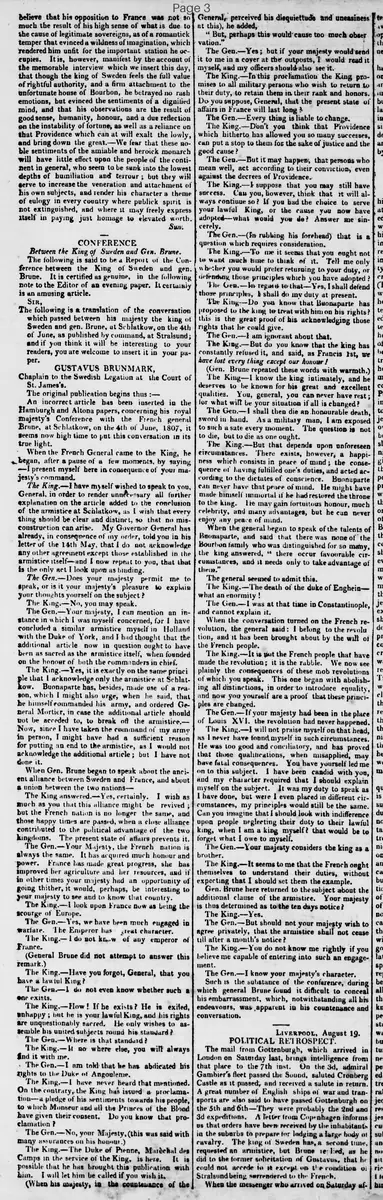
CONFERENCE
Between the King of Sweden and Gen. Brune.
The following is said to be a Report of the Conference between the King of Sweden and gen. Brune. It is certified as genuine, in the following note to the Editor of an evening paper. It certainly is an amusing article.
SIR,
The following is a translation of the conversation which passed between his majesty the king of Sweden and gen. Brune, at Schlatkow, on the 4th of June, as published by command, at Stralsund; and if you think it will be interesting to your readers, you are welcome to insert it in your paper.
GUSTAVUS BRUNMARK,
Chaplain to the Swedish Legation at the Court of St. James's.
The original publication begins thus:
An incorrect article has been inserted in the Hamburgh and Altona papers, concerning his royal majesty's Conference with the French general Brune, at Schlatkow, on the 4th of June, 1807, it seems now high time to put this conversation in its true light.
When the French General came to the King, he began, after a pause of a few moments, by saying
I present myself here in consequence of your majesty's command.
The King. I have myself wished to speak to you, General, in order to render unnecessary all further explanation on the article added to the conclusion of the armistice at Schlatkow, as I wish that every thing should be clear and distinct, so that no misconstruction can arise. My Governor General has already, in consequence of my order, told you in his letter of the 14th May, that I do not acknowledge any other agreement except those established in the armistice itself and I now repeat to you, that that is the only act I look upon as binding.
The Gen. Does your majesty permit me to speak, or is it your majesty's pleasure to explain your thoughts yourself on the subject?
The King. No, you may speak.
The Gen. Your majesty, I can mention an instance in which I was myself concerned, for I have concluded a similar armistice myself in Holland with the Duke of York, and I had thought that the additional article now in question ought to have been as sacred as the armistice itself, when founded on the honour of both the commanders in chief.
The King. Yes, it is exactly on the same principle that I acknowledge only the armistice at Schlatkow. Buonaparte has, besides, made use of a reason, which I might also urge, when he said, that he himself commanded his army, and ordered General Mortier, in case the additional article should not be acceded to, to break off the armistice. Now, since I have taken the command of my army in person, I might have had a sufficient reason for putting an end to the armistice, as I would not acknowledge the additional article; but I have not done it.
When Gen. Brune began to speak about the ancient alliance between Sweden and France, and about a union between the two nations
The King answered. Yes, certainly. I wish as much as you that this alliance might be revived; but the French nation is no longer the same, and those happy times are passed, when a close alliance contributed to the political advantage of the two kingdoms. The present state of affairs prevents it.
The Gen. Your Majesty, the French nation is always the same. It has acquired much honour and power. France has made great progress, she has improved her agriculture and her resources, and if in other times your majesty had an opportunity of going thither, it would, perhaps, be interesting to your majesty to see and to know that country.
The King. I look upon France now as being the scourge of Europe.
The Gen. Yes, we have been much engaged in warfare. The Emperor has a great character.
The King. I do not know of any emperor of France.
(General Brune did not attempt to answer this remark.)
The King. Have you forgot, General, that you have a lawful King?
The Gen. I do not even know whether such a one exists.
The King. How! If he exists? He is exiled, unhappy; but he is your lawful King, and his rights are unquestionably sacred. He only wishes to assemble his united subjects round his standard.
The Gen. Where is that standard?
The King. It is nowhere else, you will always find it with me.
The Gen. I am told that he has abdicated his rights to the Duke of Angouleme.
The King. I have never heard that mentioned. On the contrary, the King has issued a proclamation a pledge of his sentiments towards his people, to which Monsieur and all the Princes of the Blood have given their consent. Do you know that proclamation?
The Gen. No, your Majesty, (this was said with many assurances on his honour.)
The King. The Duke of Penne, Maréchal des Camps in the service of the King, is here. It is possible that he has brought this publication with him. I will let him be called if you wish it.
(When his majesty, in the countenance of the General, perceived his disquietude and uneasiness at this), he added.
But, perhaps this would cause too much observation.
The Gen. Yes; but if your majesty would send it to me in a cover at the outposts, I would read it myself, and my officers should also see it.
The King. In this proclamation the King promises to all military persons who wish to return to their duty, to retain them in their rank and honors. Do you suppose, General, that the present state of affairs in France will last long?
The Gen. Every thing is liable to change.
The King. Don't you think that Providence which hitherto has allowed you so many successes, can put a stop to them for the sake of justice and the good cause?
The Gen. But it may happen; that persons who mean well, act according to their conviction, even against the decrees of Providence.
The King. I suppose that you may still have success. Can you, however, think that it will always continue so? If you had the choice to serve your lawful King, or the cause you now have adopted what would you do? Answer me sincerely.
The Gen. (In rubbing his forehead) that is a question which requires consideration.
The King. To me it seems that you ought not to want much time to think of it. Tell me only whether you would prefer returning to your duty, or defending those principles which you have adopted?
The Gen. In regard to that Yes, I shall defend those principles, I shall do my duty at present.
The King. Do you know that Buonaparte has proposed to the king to treat with him on his rights? this is the great proof of his acknowledging those rights that he could give.
The Gen. I am ignorant about that.
The King. But do you know that the king has constantly refused it, and said, as Francis I. we have lost every thing except our honour!
(Gen. Brune repeated these words with warmth.)
The King. I know the king intimately, and he deserves to be known for his great and excellent qualities. You, general, you can never have rest; for what will be your situation if all is changed?
The Gen. I shall then die an honourable death, sword in hand. As a military man, I am exposed to such a fate every moment. The question is not to die, but to die as one ought.
The King. But that depends upon unforeseen circumstances. There exists, however, a happiness which consists in peace of mind; the consequence of having fulfilled one's duties, and acted according to the dictates of conscience. Buonaparte can never have that peace of mind. He might have made himself immortal if he had restored the throne to the king. He may gain fortuitous honour, much celebrity, and many advantages, but he can never enjoy any peace of mind.
When the general began to speak of the talents of Buonaparte, and said that there was none of the Bourbon family who was distinguished for so many.
the king answered, there occur favourable circumstances, and it needs only to take advantage of them.
The general seemed to admit this.
The King. The death of the duke of Enghien what an enormity!
The Gen. I was at that time in Constantinople, and cannot explain it.
When the conversation turned on the French revolution, the general said: I belong to the revolution, and it has been brought about by the will of the French people.
The King. It is not the French people that have made the revolution; it is the rabble. We now see plainly the consequences of these mob revolutions of which you speak. This one began with abolishing all distinctions, in order to introduce equality, and now you yourself are a proof that these principles are changed.
The Gen. If your majesty had been in the place of Louis XVI. the revolution had never happened.
The King. I will not praise myself on that head, as I never have found myself in such circumstances. He was too good and conciliatory, and has proved that those qualifications, when misapplied, may have fatal consequences. You have yourself led me on to this subject. I have been candid with you, and my character required that I should explain myself on the subject. It was my duty to speak as I have done, but were I even placed in different circumstances, my principles would still be the same. Can you imagine that I should look with indifference upon people neglecting their duty to their lawful king, when I am a king myself? that would be to forget what I owe to myself.
The Gen. Your majesty considers the king as a brother.
The King. It seems to me that the French ought themselves to understand their duties, without expecting that I should set them the example.
Gen. Brune here returned to the subject about the additional clause of the armistice. Your majesty is thus determined as to the ten days notice?
The King. Yes.
The Gen. But should not your majesty wish to agree privately, that the armistice shall not cease until after a month's notice?
The King. You do not know me rightly if you believe me capable of entering into such an engagement.
The Gen. I know your majesty's character.
Such is the substance of the conference, during which general Brune found it difficult to conceal his embarrassment, which, notwithstanding all his endeavours, was apparent in his countenance and conversation.
What sub-type of article is it?
What keywords are associated?
What entities or persons were involved?
Where did it happen?
Foreign News Details
Primary Location
Schlatkow
Event Date
1807 06 04
Key Persons
Outcome
the king refuses to acknowledge the additional article to the armistice, reaffirms support for the bourbon monarchy, and rejects private agreements on notice periods; general brune defends french principles but shows embarrassment.
Event Details
The King of Sweden meets General Brune to clarify that he recognizes only the original armistice at Schlatkow, not the added article. The discussion covers the ancient Sweden-France alliance, the French Revolution, loyalty to the exiled Bourbon king, Napoleon's actions, and the instability of current French affairs, with the King expressing moral and providential views on monarchy and duty.