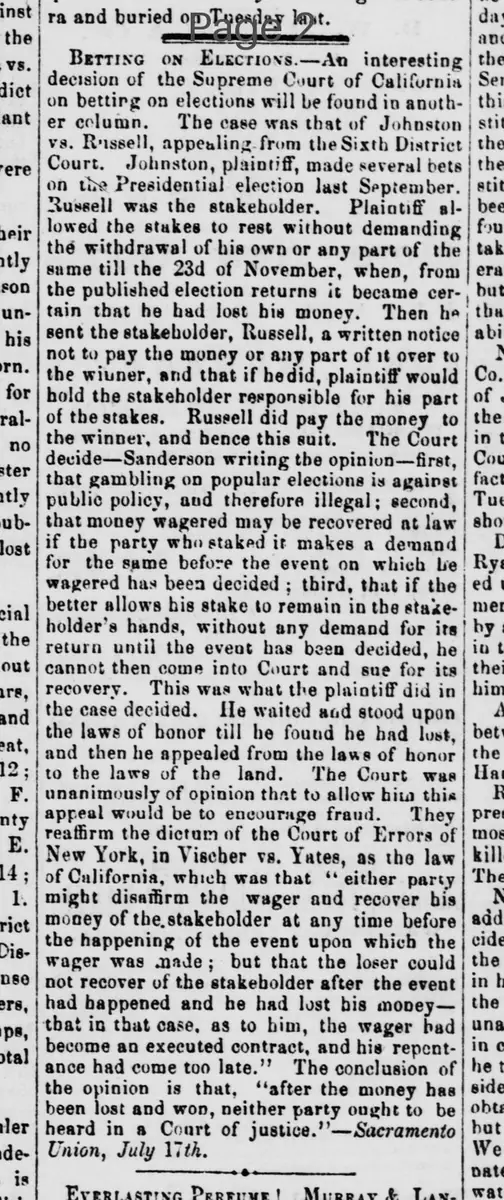
Betting on Elections. An interesting decision of the Supreme Court of California on betting on elections will be found in another column. The case was that of Johnston vs. Russell, appealing from the Sixth District Court. Johnston, plaintiff, made several bets on the Presidential election last September. Russell was the stakeholder. Plaintiff allowed the stakes to rest without demanding the withdrawal of his own or any part of the same till the 23d of November, when, from the published election returns it became certain that he had lost his money. Then he sent the stakeholder, Russell, a written notice not to pay the money or any part of it over to the winner, and that if he did, plaintiff would hold the stakeholder responsible for his part of the stakes. Russell did pay the money to the winner, and hence this suit. The Court decided, Sanderson writing the opinion, first, that gambling on popular elections is against public policy, and therefore illegal; second, that money wagered may be recovered at law if the party who staked it makes a demand for the same before the event on which he wagered has been decided; third, that if the bettor allows his stake to remain in the stakeholder's hands, without any demand for its return until the event has been decided, he cannot then come into Court and sue for its recovery. This was what the plaintiff did in the case decided. He waited and stood upon the laws of honor till he found he had lost, and then he appealed from the laws of honor to the laws of the land. The Court was unanimously of opinion that to allow him this appeal would be to encourage fraud. They reaffirm the dictum of the Court of Errors of New York, in Vischer vs. Yates, as the law of California, which was that "either party might disclaim the wager and recover his money of the stakeholder at any time before the happening of the event upon which the wager was made; but that the loser could not recover of the stakeholder after the event had happened and he had lost his money- that in that case, as to him, the wager had become an executed contract, and his repentance had come too late." The conclusion of the opinion is that, "after the money has been lost and won, neither party ought to be heard in a Court of justice."-Sacramento Union, July 17th,