Thank you for visiting SNEWPapers!
Sign up free
Literary
May 14, 1828
The Hillsborough Recorder
Hillsboro, Orange County, North Carolina
What is this article about?
A folk tale from southern Ireland about blacksmith Terence O'Sullivan, the 'Whisperer,' who learns a secret to tame horses by whispering. He uses it to persuade a priest to allow the marriage of Jerry Ryan and Mary Mulcahy, despite their close kinship, for a fee.
Clipping
OCR Quality
92%
Excellent
Full Text
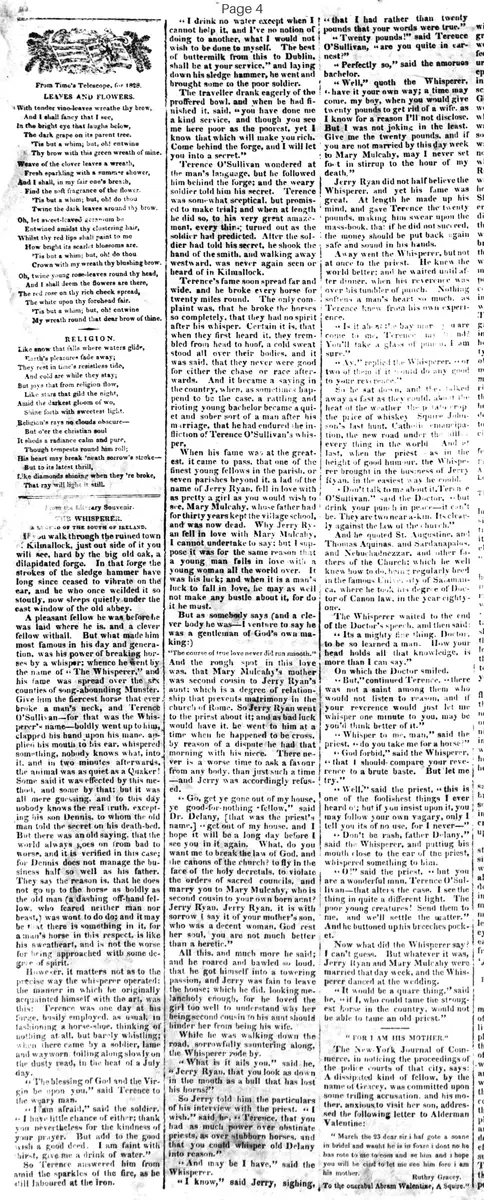
THE WHISPERER.
A Tale of the south of Ireland.
If you walk through the ruined town Kilmallock, just outside of it you will see, hard by the big old oak, a dilapidated forge. In that forge the strokes of the sledgehammer have long since ceased to vibrate on the ear, and he who once wielded it so stoutly, now sleeps quietly under the east window of the old abbey.
A pleasant fellow he was before he was laid where he is, and a clever fellow withal. But what made him most famous in his day and generation, was his power of breaking horses by a whisper; whence he went by the name of "The Whisperer," and his fame was spread over the six counties of song-abounding Munster.
Give him the fiercest horse that ever broke a man's neck, and Terence O'Sullivan—for that was the Whisperer's name—boldly went up to him, clapped his hand upon his mane, applied his mouth to his ear, whispered something, nobody knows what, into it, and in two minutes afterwards, the animal was as quiet as a Quaker!
Some said it was effected by this method, and some by that; but it was all mere guessing, and to this day nobody knows the real truth, excepting his son Dennis, to whom the old man told the secret on his death-bed.
But there was an old saying, that the world always goes on from bad to worse, and it is verified in this case; for Dennis does not manage the business half so well as his father. They say the reason is, that he does not go up to the horse as boldly as the old man (a dashing off-hand fellow, who feared neither man nor beast,) was wont to do; and it may be that there is something in it, for a man's horse in this respect is like his sweetheart, and is not the worse for being approached with some degree of spirit.
However, it matters not as to the precise way the whisperer operated: the manner in which he originally acquainted himself with the art, was this: Terence was one day at his forge, busily employed, as usual, in fashioning a horse-shoe, thinking of nothing at all, but barely whistling: when there came by a soldier, lame and way worn, toiling along slowly on the dusty road, in the heat of a July day.
"The blessing of God and the Virgin be upon you," said Terence to the weary man.
"I am afraid," said the soldier, "I have little chance of either: thank you nevertheless for the kindness of your prayer. But add to the good wish a good deed. I am faint with thirst; give me a drink of water."
So Terence answered him from amid the sparkles of the fire, as he still laboured at the iron.
"I drink no water except when I cannot help it, and I've no notion of doing to another, what I would not wish to be done to myself. The best of buttermilk from this to Dublin, shall be at your service," and laying down his sledge hammer, he went and brought some to the poor soldier.
The traveller drank eagerly of the proffered bowl, and when he had finished it, said, "you have done me a kind service, and though you see me here poor as the poorest, yet I know that which will make you rich. Come behind the forge, and I will let you into a secret."
Terence O'Sullivan wondered at the man's language, but he followed him behind the forge; and the weary soldier told him his secret. Terence was somewhat sceptical, but promised to make trial; and when at length he did so, to his very great amazement, every thing turned out as the soldier had predicted. After the soldier had told his secret, he shook the hand of the smith, and walking away westward, was never again seen or heard of in Kilmallock.
Terence's fame soon spread far and wide, and he broke every horse for twenty miles round. The only complaint was, that he broke the horses so completely, that they had no spirit afterwards. Certain it is, that when they first heard it, they trembled from head to hoof, a cold sweat stood all over their bodies, and it was said, that they never were good for either the chase or race afterwards. And it became a saying in the country, when, as sometimes happened to be the case, a rattling and rioting young bachelor became a quiet and sober sort of a man after his marriage, that he had endured the infliction of Terence O'Sullivan's whisper.
When his fame was at the greatest, it came to pass, that one of the finest young fellows in the parish, or seven parishes beyond it, a lad of the name of Jerry Ryan, fell in love with as pretty a girl as you would wish to see, Mary Mulcahy, whose father had for thirty years kept the village school, and was now dead. Why Jerry Ryan fell in love with Mary Mulcahy, I cannot undertake to say: but I suppose it was for the same reason that a young man falls in love with a young woman all the world over. It was his luck: and when it is a man's luck to fall in love, he may as well not make any bustle about it, for do it he must.
But as somebody says (and a clever body he was I venture to say he was a gentleman of God's own making:)
"The course of true love never did run smooth."
And the rough spot in this love was, that Mary Mulcahy's mother was second cousin to Jerry Ryan's aunt: which is a degree of relationship that prevents matrimony in the church of Rome. So Jerry Ryan went to the priest about it; and as bad luck would have it, he went to him at a time when he happened to be cross, by reason of a dispute he had that morning with his niece. There never is a worse time to ask a favour from any body, than just such a time—and Jerry was accordingly refused.
"Go, get ye gone out of my house, you good-for-nothing fellow," said Dr. Delany, that was the priest's name—"get out of my house, and I hope it will be a long day before I see you in it again. What, do you want me to break the law of God, and the canons of the church? to fly in the face of the holy decretals, to violate the orders of sacred councils, and marry you to Mary Mulcahy, who is second cousin to your own born aunt? Jerry Ryan, Jerry Ryan, it is with sorrow I say it of your mother's son, who was a decent woman, God rest her soul, you are not much better than a heretic."
All this, and much more he said: and he roared and bawled so loud, that he got himself into a towering passion, and Jerry was fain to leave the house; which he did, looking melancholy enough, for he loved the girl too well to understand why her being second cousin to his aunt should hinder her from being his wife.
While he was walking down the road, sorrowfully sauntering along, the Whisperer rode by.
"What is it ails you," said he, "Jerry Ryan, that you look as down in the mouth as a bull that has lost his horns?"
So Jerry told him the particulars of his interview with the priest. "I wish," said he, "Terence, that you had as much power over obstinate priests, as over stubborn horses, and that you could whisper old Delany into reason."
"And may be I have," said the Whisperer.
"that I had rather than twenty pounds that your words were true."
"Twenty pounds!" said Terence O'Sullivan, "are you quite in earnest?"
"Perfectly so," said the amorous bachelor.
"Well," quoth the Whisperer, "have it your own way; a time may come, my boy, when you would give twenty pounds to get rid of a wife, as I know for a reason I'll not disclose. But I was not joking in the least. Give me the twenty pounds, and if you are not married by this day week to Mary Mulcahy, may I never set foot in stirrup to the hour of my death."
Jerry Ryan did not half believe the Whisperer, and yet his fame was great. At length he made up his mind, and gave Terence the twenty pounds, making him swear upon the mass-book, that if he did not succeed, the money should be put back again safe and sound in his hands.
Away went the Whisperer, but not at once to the priest. He knew the world better; and he waited until after dinner, when his reverence was over his tumbler of punch. Nothing softens a man's heart so much, as Terence knew from his own experience.
"Is it about the bad man you are come to me, Terence?" said he.
"You'll take a glass of punch, I am sure."
"Av," replied the Whisperer, "or two of them if it would do any good to your reverence."
So he sat down, and they talked away as fast as they could, about the heat of the weather, the potato crop, the price of whiskey, Squire Johnson's last hunt, Catholic emancipation, the new road under the hill, every thing in the world. And at last, when the priest was in the height of good humour, the Whisperer brought in the business of Jerry Ryan, in the easiest way he could.
"Don't talk to me about it, Terence O'Sullivan," said the Doctor, "but drink your punch in peace—it can't be. They are two near a-h'm. It's clearly against the law of the church."
And he quoted St. Augustine, and Thomas Aquinas, and Sardanapalus, and Nebuchadnezzar, and other fathers of the Church: which he well knew how to do, being regularly bred in the famous University of Salamanca, where he took his degree of Doctor of Canon law, in the year eighty-one.
The Whisperer waited to the end of the Doctor's speech, and then said:
"It's a mighty fine thing, Doctor, to be so learned a man. How your head holds all that knowledge, is more than I can say."
On which the Doctor smiled.
"But," continued Terence, "there was not a saint among them who would not listen to reason, and if your reverence would just let me whisper one minute to you, may be you'd think better of it."
"Whisper to me, man," said the priest, "do you take me for a horse?"
"God forbid," said the Whisperer, "that I should compare your reverence to a brute beast. But let me try."
"Well?" said the priest, "this is one of the foolishest things I ever heard of; but if you insist upon it, you may follow your own vagary, only I tell you it's of no use, for I never—"
"Don't be rash, father Delany," said the Whisperer, and putting his mouth close to the ear of the priest, whispered something to him.
"O!" said the priest, "but you are a wonderful man, Terence O'Sullivan—that alters the case. I see the thing in quite a different light. The poor young creatures! Send them to me, and we'll settle the matter."
And he buttoned up his breeches pocket.
Now what did the Whisperer say? I can't guess. But whatever it was, Jerry Ryan and Mary Mulcahy were married that day week, and the Whisperer danced at the wedding.
"It would be a quare thing," said he, "if I, who could tame the strongest horse in the country, would not be able to tame an old priest."
A Tale of the south of Ireland.
If you walk through the ruined town Kilmallock, just outside of it you will see, hard by the big old oak, a dilapidated forge. In that forge the strokes of the sledgehammer have long since ceased to vibrate on the ear, and he who once wielded it so stoutly, now sleeps quietly under the east window of the old abbey.
A pleasant fellow he was before he was laid where he is, and a clever fellow withal. But what made him most famous in his day and generation, was his power of breaking horses by a whisper; whence he went by the name of "The Whisperer," and his fame was spread over the six counties of song-abounding Munster.
Give him the fiercest horse that ever broke a man's neck, and Terence O'Sullivan—for that was the Whisperer's name—boldly went up to him, clapped his hand upon his mane, applied his mouth to his ear, whispered something, nobody knows what, into it, and in two minutes afterwards, the animal was as quiet as a Quaker!
Some said it was effected by this method, and some by that; but it was all mere guessing, and to this day nobody knows the real truth, excepting his son Dennis, to whom the old man told the secret on his death-bed.
But there was an old saying, that the world always goes on from bad to worse, and it is verified in this case; for Dennis does not manage the business half so well as his father. They say the reason is, that he does not go up to the horse as boldly as the old man (a dashing off-hand fellow, who feared neither man nor beast,) was wont to do; and it may be that there is something in it, for a man's horse in this respect is like his sweetheart, and is not the worse for being approached with some degree of spirit.
However, it matters not as to the precise way the whisperer operated: the manner in which he originally acquainted himself with the art, was this: Terence was one day at his forge, busily employed, as usual, in fashioning a horse-shoe, thinking of nothing at all, but barely whistling: when there came by a soldier, lame and way worn, toiling along slowly on the dusty road, in the heat of a July day.
"The blessing of God and the Virgin be upon you," said Terence to the weary man.
"I am afraid," said the soldier, "I have little chance of either: thank you nevertheless for the kindness of your prayer. But add to the good wish a good deed. I am faint with thirst; give me a drink of water."
So Terence answered him from amid the sparkles of the fire, as he still laboured at the iron.
"I drink no water except when I cannot help it, and I've no notion of doing to another, what I would not wish to be done to myself. The best of buttermilk from this to Dublin, shall be at your service," and laying down his sledge hammer, he went and brought some to the poor soldier.
The traveller drank eagerly of the proffered bowl, and when he had finished it, said, "you have done me a kind service, and though you see me here poor as the poorest, yet I know that which will make you rich. Come behind the forge, and I will let you into a secret."
Terence O'Sullivan wondered at the man's language, but he followed him behind the forge; and the weary soldier told him his secret. Terence was somewhat sceptical, but promised to make trial; and when at length he did so, to his very great amazement, every thing turned out as the soldier had predicted. After the soldier had told his secret, he shook the hand of the smith, and walking away westward, was never again seen or heard of in Kilmallock.
Terence's fame soon spread far and wide, and he broke every horse for twenty miles round. The only complaint was, that he broke the horses so completely, that they had no spirit afterwards. Certain it is, that when they first heard it, they trembled from head to hoof, a cold sweat stood all over their bodies, and it was said, that they never were good for either the chase or race afterwards. And it became a saying in the country, when, as sometimes happened to be the case, a rattling and rioting young bachelor became a quiet and sober sort of a man after his marriage, that he had endured the infliction of Terence O'Sullivan's whisper.
When his fame was at the greatest, it came to pass, that one of the finest young fellows in the parish, or seven parishes beyond it, a lad of the name of Jerry Ryan, fell in love with as pretty a girl as you would wish to see, Mary Mulcahy, whose father had for thirty years kept the village school, and was now dead. Why Jerry Ryan fell in love with Mary Mulcahy, I cannot undertake to say: but I suppose it was for the same reason that a young man falls in love with a young woman all the world over. It was his luck: and when it is a man's luck to fall in love, he may as well not make any bustle about it, for do it he must.
But as somebody says (and a clever body he was I venture to say he was a gentleman of God's own making:)
"The course of true love never did run smooth."
And the rough spot in this love was, that Mary Mulcahy's mother was second cousin to Jerry Ryan's aunt: which is a degree of relationship that prevents matrimony in the church of Rome. So Jerry Ryan went to the priest about it; and as bad luck would have it, he went to him at a time when he happened to be cross, by reason of a dispute he had that morning with his niece. There never is a worse time to ask a favour from any body, than just such a time—and Jerry was accordingly refused.
"Go, get ye gone out of my house, you good-for-nothing fellow," said Dr. Delany, that was the priest's name—"get out of my house, and I hope it will be a long day before I see you in it again. What, do you want me to break the law of God, and the canons of the church? to fly in the face of the holy decretals, to violate the orders of sacred councils, and marry you to Mary Mulcahy, who is second cousin to your own born aunt? Jerry Ryan, Jerry Ryan, it is with sorrow I say it of your mother's son, who was a decent woman, God rest her soul, you are not much better than a heretic."
All this, and much more he said: and he roared and bawled so loud, that he got himself into a towering passion, and Jerry was fain to leave the house; which he did, looking melancholy enough, for he loved the girl too well to understand why her being second cousin to his aunt should hinder her from being his wife.
While he was walking down the road, sorrowfully sauntering along, the Whisperer rode by.
"What is it ails you," said he, "Jerry Ryan, that you look as down in the mouth as a bull that has lost his horns?"
So Jerry told him the particulars of his interview with the priest. "I wish," said he, "Terence, that you had as much power over obstinate priests, as over stubborn horses, and that you could whisper old Delany into reason."
"And may be I have," said the Whisperer.
"that I had rather than twenty pounds that your words were true."
"Twenty pounds!" said Terence O'Sullivan, "are you quite in earnest?"
"Perfectly so," said the amorous bachelor.
"Well," quoth the Whisperer, "have it your own way; a time may come, my boy, when you would give twenty pounds to get rid of a wife, as I know for a reason I'll not disclose. But I was not joking in the least. Give me the twenty pounds, and if you are not married by this day week to Mary Mulcahy, may I never set foot in stirrup to the hour of my death."
Jerry Ryan did not half believe the Whisperer, and yet his fame was great. At length he made up his mind, and gave Terence the twenty pounds, making him swear upon the mass-book, that if he did not succeed, the money should be put back again safe and sound in his hands.
Away went the Whisperer, but not at once to the priest. He knew the world better; and he waited until after dinner, when his reverence was over his tumbler of punch. Nothing softens a man's heart so much, as Terence knew from his own experience.
"Is it about the bad man you are come to me, Terence?" said he.
"You'll take a glass of punch, I am sure."
"Av," replied the Whisperer, "or two of them if it would do any good to your reverence."
So he sat down, and they talked away as fast as they could, about the heat of the weather, the potato crop, the price of whiskey, Squire Johnson's last hunt, Catholic emancipation, the new road under the hill, every thing in the world. And at last, when the priest was in the height of good humour, the Whisperer brought in the business of Jerry Ryan, in the easiest way he could.
"Don't talk to me about it, Terence O'Sullivan," said the Doctor, "but drink your punch in peace—it can't be. They are two near a-h'm. It's clearly against the law of the church."
And he quoted St. Augustine, and Thomas Aquinas, and Sardanapalus, and Nebuchadnezzar, and other fathers of the Church: which he well knew how to do, being regularly bred in the famous University of Salamanca, where he took his degree of Doctor of Canon law, in the year eighty-one.
The Whisperer waited to the end of the Doctor's speech, and then said:
"It's a mighty fine thing, Doctor, to be so learned a man. How your head holds all that knowledge, is more than I can say."
On which the Doctor smiled.
"But," continued Terence, "there was not a saint among them who would not listen to reason, and if your reverence would just let me whisper one minute to you, may be you'd think better of it."
"Whisper to me, man," said the priest, "do you take me for a horse?"
"God forbid," said the Whisperer, "that I should compare your reverence to a brute beast. But let me try."
"Well?" said the priest, "this is one of the foolishest things I ever heard of; but if you insist upon it, you may follow your own vagary, only I tell you it's of no use, for I never—"
"Don't be rash, father Delany," said the Whisperer, and putting his mouth close to the ear of the priest, whispered something to him.
"O!" said the priest, "but you are a wonderful man, Terence O'Sullivan—that alters the case. I see the thing in quite a different light. The poor young creatures! Send them to me, and we'll settle the matter."
And he buttoned up his breeches pocket.
Now what did the Whisperer say? I can't guess. But whatever it was, Jerry Ryan and Mary Mulcahy were married that day week, and the Whisperer danced at the wedding.
"It would be a quare thing," said he, "if I, who could tame the strongest horse in the country, would not be able to tame an old priest."
What sub-type of article is it?
Prose Fiction
What themes does it cover?
Love Romance
Social Manners
Moral Virtue
What keywords are associated?
Irish Tale
Horse Whisperer
Secret Power
Forbidden Marriage
Priest Persuasion
Folktale
Munster
Literary Details
Title
The Whisperer. A Tale Of The South Of Ireland.
Key Lines
"The Course Of True Love Never Did Run Smooth."
"It Would Be A Quare Thing," Said He, "If I, Who Could Tame The Strongest Horse In The Country, Would Not Be Able To Tame An Old Priest."