Thank you for visiting SNEWPapers!
Sign up free
Editorial
April 24, 1810
The Rhode Island American, And General Advertiser
Providence, Providence County, Rhode Island
What is this article about?
Providence editorial condemns French burning of 39 vessels, mostly American, wrecked in Cadiz storm on March 1, 1810, firing on crews, and imprisoning survivors. Criticizes U.S. rulers for excusing acts as anti-British policy and urges presidential denunciation of neutral rights violations. Includes NY Evening Post account with vessel names.
Clipping
OCR Quality
98%
Excellent
Full Text
Providence, TUESDAY, APRIL 24, 1810.
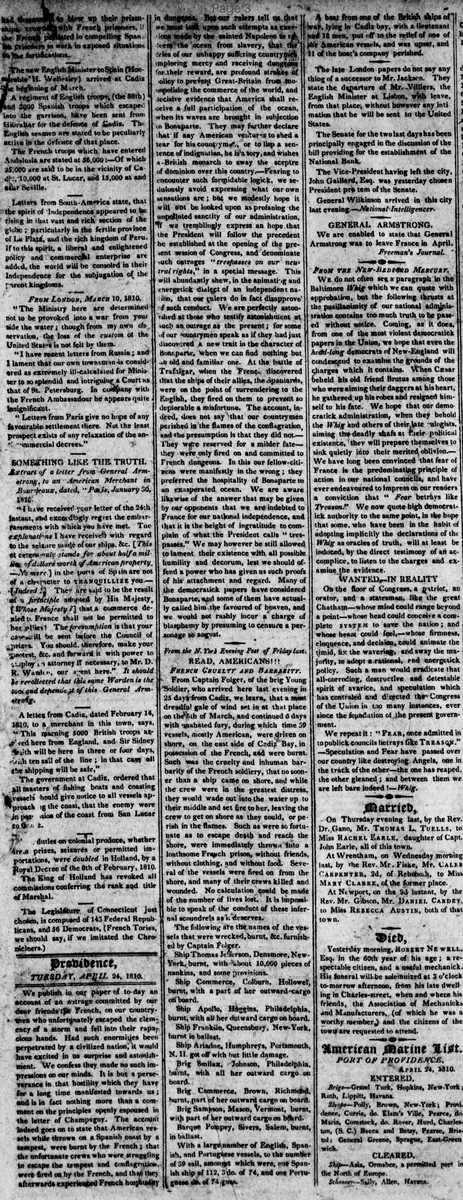
We publish in our paper of to-day an account of an outrage committed by our dear friends the French, on our Countrymen who unfortunately escaped the clemency of a storm and fell into their rapacious hands. Had such enormities been perpetrated by a civilized nation, it would have excited in us surprise and astonishment. We confess they made no such impressions on our minds. It is but a perseverance in that hostility which they have for a long time manifested towards us; and is in fact nothing more than a comment on the principles openly espoused in the letter of Champagny. The account indeed goes on to state that American vessels while thrown on a Spanish coast by a tempest, were burnt by the French; that the unfortunate crews who were struggling to escape the tempest and conflagration, were fired on by the French, and that they afterwards experienced French hospitality in dungeons. But our rulers tell us that we must look upon such attempts as exertions made by the sainted Napoleon to free the ocean from slavery, that the cries of our unhappy suffering countrymen imploring mercy and receiving dungeons for their reward, are profound strokes of policy to prevent Great-Britain from monopolising the commerce of the world, and decisive evidence that America shall receive a full participation of the ocean, when its waves are brought in subjection to Bonaparte. They may further declare that if any American ventures to shed a tear for his countrymen, or to lisp a sentence of indignation, he is a tory, and wishes a British monarch to sway the sceptre of dominion over this country.--Fearing to encounter such formidable logick, we sedulously avoid expressing what our own sensations are; but we modestly hope it will not be looked upon as profaning the unpolluted sanctity of our administration, if we tremblingly express a hope, that the President will follow the precedent he established at the opening of the present session of Congress, and denominate such outrages "trespasses on our neutral rights," in a special message. This will abundantly shew, in the animating and energetick dialect of an independent nation, that our rulers do in fact disapprove of such conduct. We are perfectly astonished at those who testify astonishment at such an outrage as the present; for some of our countrymen speak as if they had just discovered a new trait in the character of Bonaparte, when we can find nothing but an old and familiar one. At the battle of Trafalgar, when the French discovered that the ships of their allies, the Spaniards, were on the point of surrendering to the English, they fired on them to prevent so deplorable a misfortune. The account, indeed, does not say that our countrymen perished in the flames of the conflagration, and the presumption is that they did not. They were reserved for a milder fate--they were only fired on and committed to French dungeons. In this our fellow-citizens were manifestly in the wrong; they preferred the hospitality of Bonaparte to an exasperated ocean. We are aware likewise of the answer that may be given by our opponents that we are indebted to France for our national independence, and that it is the height of ingratitude to complain of what the President calls "trespasses." We may however be still allowed to lament their existence with all possible humility and decorum, lest we should offend a power who has given us such proofs of his attachment and regard. Many of the democratick papers have considered Bonaparte, and some of them have actually called him the favoured of heaven, and we would not rashly incur a charge of blasphemy by presuming to censure a personage so august.
From the N. York Evening Post of Friday last.
READ, AMERICANS!!!
French Cruelty and Barbarity.
From Captain Folger, of the brig Young Soldier, who arrived here last evening in 25 days from Cadiz, we learn, that a most dreadful gale of wind set in at that place on the 1st of March, and continued 6 days with unabated fury, during which time 39 vessels, mostly American, were driven on shore, on the east side of Cadiz Bay, in possession of the French, and were burnt.
Such was the cruelty and inhuman barbarity of the French soldiery, that no sooner than a ship came on shore, and while the crew were in the greatest distress, they would wade out into the water up to their middle and set fire to her, leaving the crew to get on shore as they could, or perish in the flames. Such as were so fortunate as to escape death and reach the shore, were immediately thrown into a loathsome French prison, without friends, without clothing, and without food. Several of the vessels were fired on from the shore, and many of their crews killed and wounded. No calculation could be made of the number of lives lost. It is impossible to speak of the conduct of these infernal scoundrels as it deserves.
The following are the names of the vessels that were wrecked, burnt, &c. furnished by Captain Folger.
Ship Thomas Jefferson, Densmore, New-York, burnt, with about 10,000 pieces of nankins, and some provisions.
Ship Commerce, Colburn, Hallowell, burnt, with a part of her outward cargo on board.
Ship Apollo, Higgins, Philadelphia, burnt, with all her outward cargo on board.
Ship Franklin, Queensbury, New-York, burnt in ballast.
Ship Ariadne, Humphreys, Portsmouth, N. H. got off with but little damage.
Brig Smilax, Johnson, Philadelphia, burnt, with all her outward cargo on board.
Brig Commerce, Brown, Richmond, burnt, part of her outward cargo on board.
Brig Sampson, Mason, Vermont, burnt with part of her outward cargo on board.
Barque Pompey, Sivers, Salem, burnt, in ballast.
With a large number of English, Spanish, and Portuguese vessels, to the number of 39 sail, amongst which were, one Spanish ship of 112, three of 74, and one Portuguese do. of 74 guns.
A boat from one of the British ships of war lying in Cadiz bay, with a lieutenant and 18 men, put off to the relief of one of the American vessels, and was upset, and 11 of the boat's company perished.
We publish in our paper of to-day an account of an outrage committed by our dear friends the French, on our Countrymen who unfortunately escaped the clemency of a storm and fell into their rapacious hands. Had such enormities been perpetrated by a civilized nation, it would have excited in us surprise and astonishment. We confess they made no such impressions on our minds. It is but a perseverance in that hostility which they have for a long time manifested towards us; and is in fact nothing more than a comment on the principles openly espoused in the letter of Champagny. The account indeed goes on to state that American vessels while thrown on a Spanish coast by a tempest, were burnt by the French; that the unfortunate crews who were struggling to escape the tempest and conflagration, were fired on by the French, and that they afterwards experienced French hospitality in dungeons. But our rulers tell us that we must look upon such attempts as exertions made by the sainted Napoleon to free the ocean from slavery, that the cries of our unhappy suffering countrymen imploring mercy and receiving dungeons for their reward, are profound strokes of policy to prevent Great-Britain from monopolising the commerce of the world, and decisive evidence that America shall receive a full participation of the ocean, when its waves are brought in subjection to Bonaparte. They may further declare that if any American ventures to shed a tear for his countrymen, or to lisp a sentence of indignation, he is a tory, and wishes a British monarch to sway the sceptre of dominion over this country.--Fearing to encounter such formidable logick, we sedulously avoid expressing what our own sensations are; but we modestly hope it will not be looked upon as profaning the unpolluted sanctity of our administration, if we tremblingly express a hope, that the President will follow the precedent he established at the opening of the present session of Congress, and denominate such outrages "trespasses on our neutral rights," in a special message. This will abundantly shew, in the animating and energetick dialect of an independent nation, that our rulers do in fact disapprove of such conduct. We are perfectly astonished at those who testify astonishment at such an outrage as the present; for some of our countrymen speak as if they had just discovered a new trait in the character of Bonaparte, when we can find nothing but an old and familiar one. At the battle of Trafalgar, when the French discovered that the ships of their allies, the Spaniards, were on the point of surrendering to the English, they fired on them to prevent so deplorable a misfortune. The account, indeed, does not say that our countrymen perished in the flames of the conflagration, and the presumption is that they did not. They were reserved for a milder fate--they were only fired on and committed to French dungeons. In this our fellow-citizens were manifestly in the wrong; they preferred the hospitality of Bonaparte to an exasperated ocean. We are aware likewise of the answer that may be given by our opponents that we are indebted to France for our national independence, and that it is the height of ingratitude to complain of what the President calls "trespasses." We may however be still allowed to lament their existence with all possible humility and decorum, lest we should offend a power who has given us such proofs of his attachment and regard. Many of the democratick papers have considered Bonaparte, and some of them have actually called him the favoured of heaven, and we would not rashly incur a charge of blasphemy by presuming to censure a personage so august.
From the N. York Evening Post of Friday last.
READ, AMERICANS!!!
French Cruelty and Barbarity.
From Captain Folger, of the brig Young Soldier, who arrived here last evening in 25 days from Cadiz, we learn, that a most dreadful gale of wind set in at that place on the 1st of March, and continued 6 days with unabated fury, during which time 39 vessels, mostly American, were driven on shore, on the east side of Cadiz Bay, in possession of the French, and were burnt.
Such was the cruelty and inhuman barbarity of the French soldiery, that no sooner than a ship came on shore, and while the crew were in the greatest distress, they would wade out into the water up to their middle and set fire to her, leaving the crew to get on shore as they could, or perish in the flames. Such as were so fortunate as to escape death and reach the shore, were immediately thrown into a loathsome French prison, without friends, without clothing, and without food. Several of the vessels were fired on from the shore, and many of their crews killed and wounded. No calculation could be made of the number of lives lost. It is impossible to speak of the conduct of these infernal scoundrels as it deserves.
The following are the names of the vessels that were wrecked, burnt, &c. furnished by Captain Folger.
Ship Thomas Jefferson, Densmore, New-York, burnt, with about 10,000 pieces of nankins, and some provisions.
Ship Commerce, Colburn, Hallowell, burnt, with a part of her outward cargo on board.
Ship Apollo, Higgins, Philadelphia, burnt, with all her outward cargo on board.
Ship Franklin, Queensbury, New-York, burnt in ballast.
Ship Ariadne, Humphreys, Portsmouth, N. H. got off with but little damage.
Brig Smilax, Johnson, Philadelphia, burnt, with all her outward cargo on board.
Brig Commerce, Brown, Richmond, burnt, part of her outward cargo on board.
Brig Sampson, Mason, Vermont, burnt with part of her outward cargo on board.
Barque Pompey, Sivers, Salem, burnt, in ballast.
With a large number of English, Spanish, and Portuguese vessels, to the number of 39 sail, amongst which were, one Spanish ship of 112, three of 74, and one Portuguese do. of 74 guns.
A boat from one of the British ships of war lying in Cadiz bay, with a lieutenant and 18 men, put off to the relief of one of the American vessels, and was upset, and 11 of the boat's company perished.
What sub-type of article is it?
Foreign Affairs
Partisan Politics
What keywords are associated?
French Cruelty
American Vessels
Cadiz Storm
Neutral Rights
Napoleon
Bonaparte
Shipwrecks
Imprisonment
What entities or persons were involved?
Napoleon
Bonaparte
French
President
Champagny
Editorial Details
Primary Topic
French Outrage On American Vessels In Cadiz
Stance / Tone
Strongly Critical Of French Actions And Administration's Response
Key Figures
Napoleon
Bonaparte
French
President
Champagny
Key Arguments
French Burnt American Ships Driven Ashore By Storm In Cadiz Bay
French Fired On Crews Escaping Shipwrecks And Conflagration
Surviving American Crews Imprisoned In French Dungeons Without Aid
Such Acts Continue French Hostility Toward American Neutral Rights
Administration Excuses French Actions As Policy To Counter British Commerce Monopoly
Critics Of French Conduct Labeled As Tories Favoring British Rule
Urges President To Denounce Outrages As Trespasses On Neutral Rights In Message To Congress
Parallels French Behavior To Firing On Spanish Allies At Trafalgar
Rejects Claims Of Ingratitude To France For Aiding American Independence
Demands Humble Lamentation Of French 'Trespasses' Without Offending Bonaparte