Thank you for visiting SNEWPapers!
Sign up free
Fowle's New Hampshire Gazette And General Advertiser
Portsmouth, Rockingham County, New Hampshire
What is this article about?
In this letter to the New-Hampshire Gazette, Observator defends his advocacy for a paper currency funded by mortgages on real estates, critiques a opponent's arguments, accuses speculators of monopolizing state securities, and praises Pennsylvania's recent loan-office establishment as a beneficial precedent for relieving the people.
Clipping
OCR Quality
Full Text
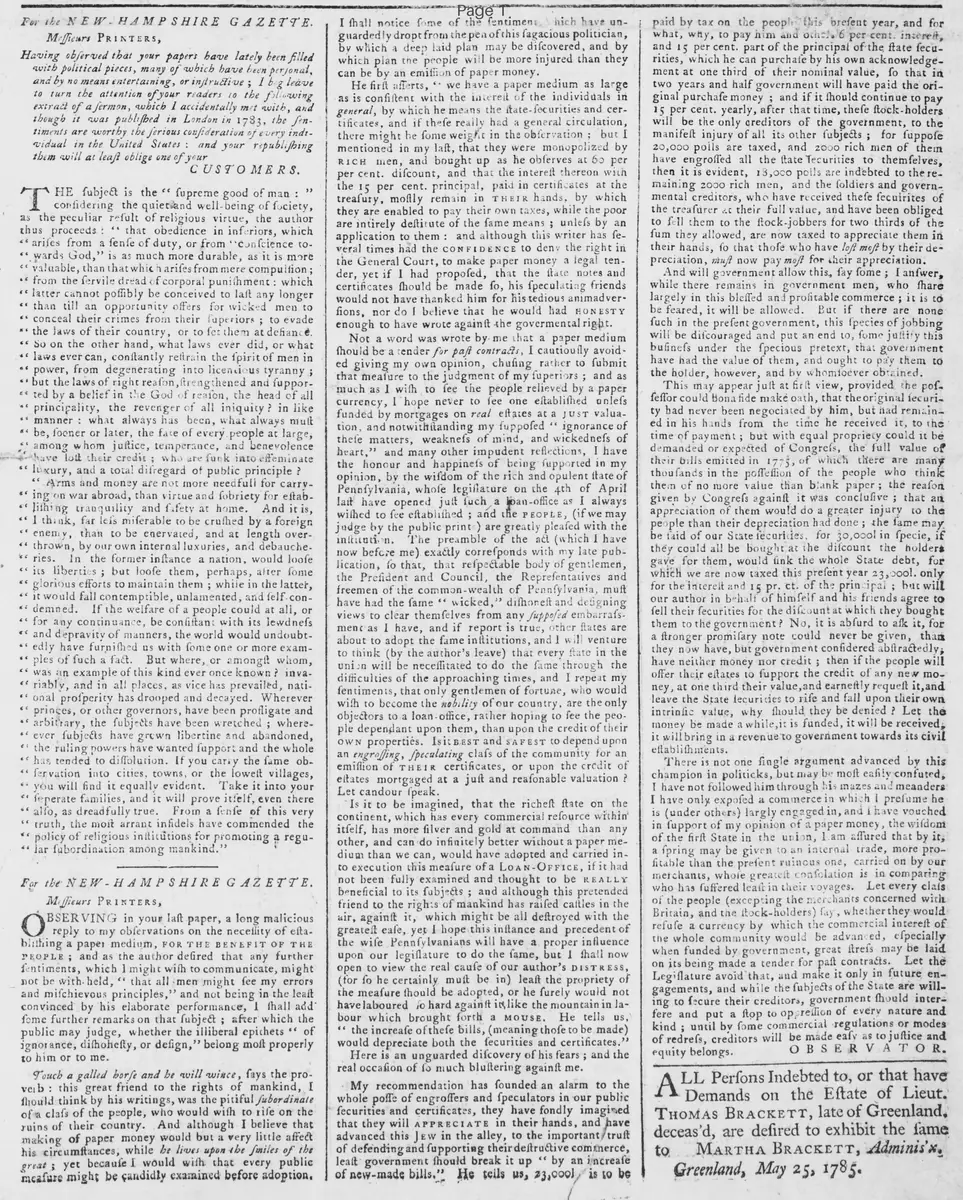
Messieurs Printers,
OBSERVING in your last paper, a long malicious reply to my observations on the necessity of establishing a paper medium, FOR THE BENEFIT OF THE PEOPLE; and as the author desired that any further sentiments, which I might wish to communicate, might not be withheld, "that all men might see my errors and mischievous principles," and not being in the least convinced by his elaborate performance, I shall add some further remarks on that subject: after which the public may judge, whether the illiberal epithets "of ignorance, dishonesty, or design," belong most properly to him or to me.
Touch a galled horse and he will wince, says the proverb: this great friend to the rights of mankind, I should think by his writings, was the pitiful Subordinate of a class of the people, who would wish to rise on the ruins of their country. And although I believe that making of paper money would but a very little affect his circumstances, while he lives upon the smiles of the great; yet because I would wish that every public measure might be candidly examined before adoption.
I shall notice some of the sentiments which have unguardedly dropt from the pen of this sagacious politician, by which a deep laid plan may be discovered, and by which plan the people will be more injured than they can be by an emission of paper money.
He first asserts, "we have a paper medium as large as is consistent with the interest of the individuals in general, by which he means the state-securities and certificates, and if these really had a general circulation, there might be some weight in the observation; but I mentioned in my last, that they were monopolized by Rich men, and bought up as he observes at 60 per cent. discount, and that the interest thereon with the 15 per cent. principal, paid in certificates at the treasury, mostly remain in Their hands, by which they are enabled to pay their own taxes, while the poor are entirely destitute of the same means; unless by an application to them: and although this writer has several times had the confidence to deny the right in the General Court, to make paper money a legal tender, yet if I had proposed, that the state notes and certificates should be made so, his speculating friends would not have thanked him for his tedious animadversions, nor do I believe that he would had Honesty enough to have wrote against the governmental right.
Not a word was wrote by me that a paper medium should be a tender for past contracts, I cautiously avoided giving my own opinion, choosing rather to submit that measure to the judgment of my superiors; and as much as I wish to see the people relieved by a paper currency, I hope never to see one established unless funded by mortgages on real estates at a just valuation, and notwithstanding my supposed "ignorance of these matters, weakness of mind, and wickedness of heart," and many other impudent reflections, I have the honour and happiness of being supported in my opinion, by the wisdom of the rich and opulent state of Pennsylvania, whose legislature on the 4th of April last have opened just such a loan-office as I always wished to see established; and the PEOPLE, (if we may judge by the public prints) are greatly pleased with the institution. The preamble of the act (which I have now before me) exactly corresponds with my late publication, so that, that respectable body of gentlemen, the President and Council, the Representatives and freemen of the common-wealth of Pennsylvania, must have had the same "wicked," dishonest and designing views to clear themselves from any supposed embarrassments as I have, and if report is true, other states are about to adopt the same institutions, and I will venture to think (by the author's leave) that every state in the union will be necessitated to do the same through the difficulties of the approaching times, and I repeat my sentiments, that only gentlemen of fortune, who would wish to become the nobility of our country, are the only objectors to a loan-office, rather hoping to see the people dependant upon them, than upon the credit of their Own properties. Is it best and safest to depend upon an engrossing, speculating class of the community for an emission of Their certificates, or upon the credit of estates mortgaged at a just and reasonable valuation? Let candour speak.
Is it to be imagined, that the richest state on the continent, which has every commercial resource within itself, has more silver and gold at command than any other, and can do infinitely better without a paper medium than we can, would have adopted and carried into execution this measure of a Loan-Office, if it had not been fully examined and thought to be REALLY beneficial to its subjects: and although this pretended friend to the rights of mankind has raised castles in the air, against it, which might be all destroyed with the greatest ease, yet I hope this instance and precedent of the wise Pennsylvanians will have a proper influence upon our legislature to do the same, but I shall now open to view the real cause of our author's Distress, (for so he certainly must be in) lest the propriety of the measure should be adopted, or he surely would not have laboured so hard against it, like the mountain in labour which brought forth a mouse. He tells us, "the increase of these bills, (meaning those to be made) would depreciate both the securities and certificates."
Here is an unguarded discovery of his fears; and the real occasion of so much blustering against me.
My recommendation has sounded an alarm to the whole posse of engrosers and speculators in our public securities and certificates, they have fondly imagined that they will APPRECIATE in their hands, and have advanced this Jew in the alley, to the important trust of defending and supporting their destructive commerce, lest government should break it up "by an increase of new-made bills." He tells us, 23,000l. is to be
paid by tax on the people, this present year, and for what, why, to pay him and others 6 per cent. interest, and 15 per cent. part of the principal of the state securities, which he can purchase by his own acknowledgement at one third of their nominal value, so that in two years and half government will have paid the original purchase money; and if it should continue to pay 15 per cent. yearly, after that time, these stock-holders will be the only creditors of the government, to the manifest injury of all its other subjects; for suppose 20,000 polls are taxed, and 2000 rich men of them have engrossed all the state Securities to themselves, then it is evident, 18,000 polls are indebted to these remaining 2000 rich men, and the soldiers and governmental creditors, who have received these securities of the treasurer at their full value, and have been obliged to sell them to the stock-jobbers for two thirds of the sum they allowed, are now taxed to appreciate them in their hands, so that those who have lost most by their depreciation, must now pay most for their appreciation.
And will government allow this, say some; I answer, while there remains in government men, who share largely in this bleed and profitable commerce; it is to be feared. it will be allowed. But if there are none such in the present government, this species of jobbing will be discouraged and put an end to, some justify this business under the specious pretext, that government have had the value of them, and ought to pay them to the holder, however, and by whomsoever obtained.
This may appear just at first view, provided the possessor could Bona fide make oath, that the original security had never been negotiated by him, but had remained in his hands from the time he received it, to the time of payment; but with equal propriety could it be demanded or expected of Congress, the full value of their bills emitted in 1775, of which there are many thousands in the possession of the people who think them of no more value than blank paper; the reason given by Congress against it was conclusive; that an appreciation of them would do a greater injury to the people than their depreciation had done; the same may be said of our State securities, for 30,000l in specie, if they could all be bought at the discount the holders gave for them, would sink the whole State debt, for which we are now taxed this present year 23,000l. only for the interest and 15 pr. ct. of the principal; but will our author in behalf of himself and his friends agree to sell their securities for the discount at which they bought them to the government? No, it is absurd to ask it, for a stronger promissory note could never be given, than they now have, but government considered abstractedly; have neither money nor credit; then if the people will offer their estates to support the credit of any new money, at one third their value, and earnestly request it, and leave the State securities to rise and fall upon their own intrinsic value, why should they be denied? Let the money be made a while, it is funded, it will be received. it will bring in a revenue to government towards its civil establishments.
There is not one single argument advanced by this champion in politicks, but may be most easily confuted, I have not followed him through his mazes and meanders I have only exposed a commerce in which I presume he is (under others) largely engaged in, and I have vouched in support of my opinion of a paper money, the wisdom of the first State in the union, I am assured that by it; a spring may be given to an internal trade, more profitable than the present ruinous one, carried on by our merchants, whose greatest consolation is in comparing who has suffered least in their voyages. Let every class of the people (excepting the merchants concerned with Britain, and the stock-holders) say, whether they would refuse a currency by which the commercial interest of the whole community would be advanced, especially when funded by government, great stress may be laid on its being made a tender for past contracts. Let the Legislature avoid that, and make it only in future engagements, and while the subjects of the State are willing to secure their creditors, government should interfere and put a stop to oppression of every nature and kind; until by some commercial regulations or modes of redress, creditors will be made easy as to justice and equity belongs.
OBSERVATOR.
What sub-type of article is it?
What themes does it cover?
What keywords are associated?
What entities or persons were involved?
Letter to Editor Details
Author
Observator.
Recipient
Messieurs Printers
Main Argument
advocates for establishing a paper currency funded by mortgages on real estates to benefit the people and relieve economic pressures, criticizing speculators who monopolize state securities and citing pennsylvania's loan-office act of april 4 as a successful precedent, while refuting the opponent's arguments against it.
Notable Details