Thank you for visiting SNEWPapers!
Sign up free
New York Dispatch
New York, New York County, New York
What is this article about?
On June 4, 1864, over 100,000 people gathered in New York City's Union Square to honor Lt. Gen. Ulysses S. Grant for his Civil War victories. The event included speeches, resolutions, letters from Lincoln and Chase, and fireworks, expressing support for the Union cause.
Clipping
OCR Quality
Full Text
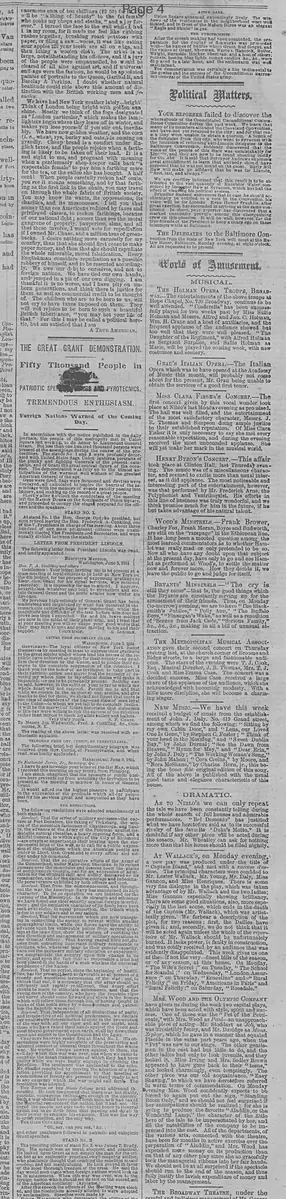
Fifty Thousand People in Union Square—PATRIOTIC SPEECHES PYROTECHNICS.
TREMENDOUS ENTHUSIASM.
Foreign Nations Warned of the Coming Day.
In accordance with the notice published in the daily journals, the people of this metropolis met in Union Square last evening, to do honor to Lieutenant General Grant. Not less than one hundred thousand persons were present at the assemblage during the course of the proceedings. The stands No. 1 and 2 were profusely decorated with United States flags, Union lanterns, portraits of the plucky and fighting Generals of the present campaign, and of Grant the great central figure of the occasion. The demonstration was fully up to the utmost anticipations of the warmest well wishers of the greatest American General of the age.
Guns were fired, flags were festooned and devices were displayed, all calculated to inspire the hearts of the assemblage with the memory of events rapidly passing into history, and making up the record of a great people. Shortly after 8 o'clock the conductors of the meeting left the Maison Doree on the South side of Union Square, and proceeded to occupy the stages prepared for the officers and the speakers.
STAND NO. 1.
At stand No. 1 the Hon. George Opdyke presided, but soon retired leaving the Hon. Frederick A. Conkling, one of the Vice Presidents in charge of the meeting. About three hundred of our most prominent citizens were unanimously elected Vice Presidents and Secretaries, and were equally divided between the stands.
LETTER FROM PRESIDENT LINCOLN.
The following letter from President Lincoln was read, and loudly applauded:
EXECUTIVE MANSION,
Washington, June 3, 1864
Hon. F. A. Conkling and others:
Gentlemen: Your letter, inviting me to be present at a mass meeting of loyal citizens to be held at New York on the 4th instant, for the purpose of expressing gratitude to Lieut.-Gen. Grant for his signal services. Was received yesterday. It is impossible for me to attend. I approve, nevertheless, whatever may tend to strengthen and sustain General Grant and the noble armies now under his direction My previous high estimate of General Grant has been maintained and heightened by what has occurred in the remarkable campaign he is now conducting, while the magnitude and difficulty of the task before him does not prove less than expected He and his brave soldiers are now in the midst of their great trial, and I trust that at your meeting you will so shape your good words that they may turn to men and guns moving to his and their support.
Yours truly,
A. LINCOLN.
LETTER FROM SECRETARY CHASE.
WASHINGTON, June 3, 1864.
Gentlemen—The loyal citizens of New York honor themselves by meeting in mass to express their gratitude to the great soldier under whose lead the heroes of the republic have achieved so much for their country—to re-affirm their devotion to the Union, and to pledge their energies to the complete suppression of the rebellion. I thank you for the honor of an invitation to take part in their patriotic action and regret that the necessity of devoting my whole time to my official duties will make it impossible for me to be personally present Nothing can be said, however, in the spirit of your letter to which my whole heart will not respond. Permit me to add that while we rejoice in the success of our armies, and give thanks to God for them, we should not forget that there is one class of defenders of the flag—one class of men loyal to the Union—to whom we yet fail to do complete justice. It will be the marvel of future historians that statesmen of this day were willing to risk the success of the rebellion rather than intrust to black loyalists bullets and ballots.
Very truly yours,
S. P. CHASE.
To Messrs Jas. Wadsworth, Fred. A. Conkling, &c., Committee, N. Y.
The reading of the above letter was received with enthusiastic applause.
TELEGRAM FROM GOV. CURTIN, OF PENNSYLVANIA.
The following brief, but complimentary telegram was received from Gov. Curtin, of Pennsylvania, and when read, was loudly applauded:
HARRISBURG, June 3, 1864.
To Nathaniel Jarvis, Jr., Secretary, &c.:
I have to acknowledge your letter of the 31st May, which I received this morning on my return from Pittsburg. I am much chagrined that the pressure of public business here prevents me from accepting the invitation to be present at the meeting to-morrow in honor of General Grant. It would afford me the highest pleasure to participate in the expression of the gratitude which all our people feel for his services great and unequalled as they have been,
A. G. CURTIN.
THE RESOLUTIONS.
The following resolutions were adopted unanimously at both stands:
Resolved, That the series of military successes—the capture of Fort Donelson, the taking of Vicksburg, the seizure of the mountain fastnesses of East Tennessee, and finally the advance of the Army of the Potomac against formidable natural obstacles, heavy opposing force, and a skillful general, to within sight of the City of Richmond —are events so important in their bearing upon the successful issue of the war, as to call for a public expression of the obligations which the American people are under to Lieut. Gen. Grant and to every officer and soldier under his command.
Resolved, That the co-operative efforts of the Army of the Cumberland, under Major-Gen. Sherman in its recent passage over the mountainous and rugged region upon the plains of Northwestern Georgia, call for an expression of admiration of the strategy and display by its commander, and for the dauntless courage and indomitable perseverance exhibited by both officers and men,
Resolved, That from the commencement and through out the war, the American Navy has maintained its high character. To its co-operation we are indebted for the opening of the Mississippi. In its strength and efficiency we have found our chief security against foreign interference; and the emulative character of its deeds have been such as we claim, in equal proportion, the tribute which is due to our Soldiers and to our Sailors
Resolved, That the movements which are now transporting in concentrating the enemy to retreat within smaller geographical limits, while our Armies have the ability to advance upon his vulnerable points from several quarters at the same time, show the wisdom of confiding the whole direction and management of military operations to the General-in-Chief. That having roundly rated those civilians, who, whatever may be their general capacity, have not the necessary military education or experience, we congratulate the country upon this change in its policy, and upon the fact that so responsible a trust has been placed in the hands of a man who has the universal confidence of the Nation
Resolved, That no period, since the beginning of hostilities, has the prospect been so favorable as at present of a speedy and successful termination of the war; but, to ensure that end, it is necessary that our army should be efficiently and rapidly reinforced, that every effort should be made to stimulate enlistments, and that the young men of the country, who have the requisite vigor and nerve should come forward and share in the honors which will follow them through life, of having fought in the ranks of that noble army by whose courage and patriotism the Republic was saved
Resolved, That, independent of all distinctions of party, and irrespective of all political preferences, we declare our unalterable determination to unite in the prosecution of the war with all our vigor and all our might, until those who have raised their hands against the freest and most liberal government upon earth, shall lay down their arms and submit to the Constitution and the Laws.
Chauncey Shaffer spoke first at Stand No. 1. His observations were highly eulogistic of the persevering and talented conduct of General Grant throughout the whole war. He warned foreign powers against, to them, the evil day when this war was over, and when we came to count up the mean transactions of which they had been guilty while we were busily engaged in crushing the Rebellion. The sentiment was applauded to the echo. Mr. Shaffer concluded by moving the adoption of a resolution providing for appointment by that meeting of a committee of twenty six persons to stand ready to act in any exigency which the war might call forth The resolution was adopted.
The Editor of The Staats Zeitung next addressed the meeting. He took the ground that there was not manly, patriotic, courageous enthusiasm enough in the country. Such a war should have called forth men, as it had taxed the material resources of the nation, but it had not. He urged the people not only to do verbal honor to General Grant, but to go forth from that meeting and do all in their power to emulate his example. This was the way to crush rebellion, and the only way.
The Glee Club sang "Oh, say, can you see," &c.; and other gentlemen followed in patriotic and eulogistic Grant speeches.
STAND No. 2.
The presiding officer of stand No. 2, was James T. Brady, Esq. His speech was, as usual, eloquent, and practical. He looked upon Grant as not simply the man for the crisis, but as an eminently practical, well-meaning soldier, who absolutely thought that crushing the rebellion meant crushing, and not manipulating. He took ground in favor of the most thorough freedom of the press. He said the day would soon come when foreign nations would look on us in amazement. When this war was over, woe to the foreign nation which should set its foot on the sacred soil of the American continent [Applause.]
After this speech the officers of the meeting were elected, and the resolutions already alluded to were adopted by acclamation. Speeches were made by HIRAM WALBRIDGE, who deprecated the stifling of the freedom of the Press, and any interference with the rights of foreigners seeking asylum on our shores: and by The Hon. Mr. Rollins The latter gentleman made some exceedingly conservative remarks, and pleaded for the exercise of mercy to the rebels after the war should be over.
Judge Daly also spoke in a conciliatory tone.
WM. Ross WALLACE recited his admirable poem, "Keep step to the music of the Union," &c.
Union Square appeared exceedingly lively. The windows of the residences in the neighborhood were well lighted, and in front of the Maison Doree was an elegant "Eagle and Shield" in gas.
THE PYROTECHNICS
After the speech making had been concluded, the preparation for the display of fireworks was proceeded with—names battles which Grant had fought and the names of Grant, Sherman, Warren, Hancock, Butler, Wright, Burnside, Hooker, Sheridan and others rockets bombs blue lights roman candles were displayed to a late hour, and the enthusiasm was well maintained.
The demonstration was certainly a fine testimonial to the genius and the success of the Unconditional Surrender General of the United States army.
What sub-type of article is it?
What themes does it cover?
What keywords are associated?
What entities or persons were involved?
Where did it happen?
Story Details
Key Persons
Location
Union Square, New York
Event Date
June 4, 1864
Story Details
A large public demonstration in Union Square honored Lt. Gen. Grant for his Civil War successes, featuring speeches, resolutions praising Grant, Sherman, and the Union armies, letters from President Lincoln and Secretary Chase, a telegram from Gov. Curtin, patriotic songs, and a fireworks display depicting battles and generals.